Newsletters




This article was originally written for Türkiye Today’s weekly economy newsletter, Turkish Economy in Brief, in its Mar. 23 issue. Please make sure you are subscribed to the newsletter by clicking here.
As the third week of conflicts in the Middle East passes, conditions on the ground remain largely unchanged. Along with the Strait of Hormuz, the region’s energy routes remain shut, uncertainty persists, and oil prices ended last week at around $110 per barrel.
At this point, two key dynamics stand out:
Market pricing reflects this shift. The U.S. 2-year bond yield, which stood at 3.40% at the beginning of March, reached 3.90% on Friday. In the U.K., 10-year bond yields exceeded 5% for the first time since 2008. In other words, markets appear to have already started pricing in higher interest rates.
Recent signals also suggest that the European Central Bank may raise rates at its April meeting, according to remarks by the head of Germany’s central bank. Meanwhile, Fitch warned that if the Strait of Hormuz remains closed for even three months, average oil prices in 2026 could reach $100.
Against this backdrop, gold prices are showing unusual movements. Concerns over “high inflation–high interest rates” have, for now, outweighed gold’s traditional role as a safe haven amid geopolitical risks.
Gold prices fell 10.42% 10.42%, marking their sharpest weekly decline in 43 years since 1983. (Even during the 2008 global financial crisis, the Sept. 11 attacks, and the COVID-19 pandemic, weekly declines remained in the 8–9% range.) After closing the previous week at $5,020, gold ended last week at $4,497.
Markets are now asking familiar questions: “Will it fall further?” “Is it time to buy or sell?” But the first question should be this: Will global central banks—facing tighter monetary policy and potential foreign currency needs—continue buying gold at the same pace as in recent years? And in an environment where gold yields no interest or income, will demand increase?
The answer to these questions will once again depend on oil prices. If the war ends, conditions stabilize, and oil settles back into a $70–$80 range, then the recent downward pressure on gold prices could gradually ease.
This volatility in gold prices also has implications for Türkiye’s economy. Last year’s 65% increase in gold prices created a significant wealth gain for Turkish households, which hold substantial gold savings.
Central Bank of the Republic of Türkiye (CBRT) Governor Fatih Karahan addressed this in his presentation of the year’s first inflation report, stating: “It is estimated that there is a significant amount of gold held outside the financial system in Türkiye. As gold prices rise, this creates a wealth effect.
Depending on how much of this additional wealth is spent, the impact on inflation may vary. We estimate that gold held ‘under the mattress’ amounts to around $600 billion. Since last year, there has been a wealth effect exceeding $100 billion, possibly reaching $200 billion. This has emerged as one of the factors slowing disinflation.”
After reaching a record $5,602 per ounce in January, gold has now fallen nearly 20% from its peak. If this weak trend continues, the “wealth effect”—which has been a source of resistance in the fight against inflation—may begin to lose its strength.
On the other hand, Türkiye’s central bank is among the biggest gold buyers in the past five years. Rising gold prices positively impact reserves, while falling prices have the opposite effect.
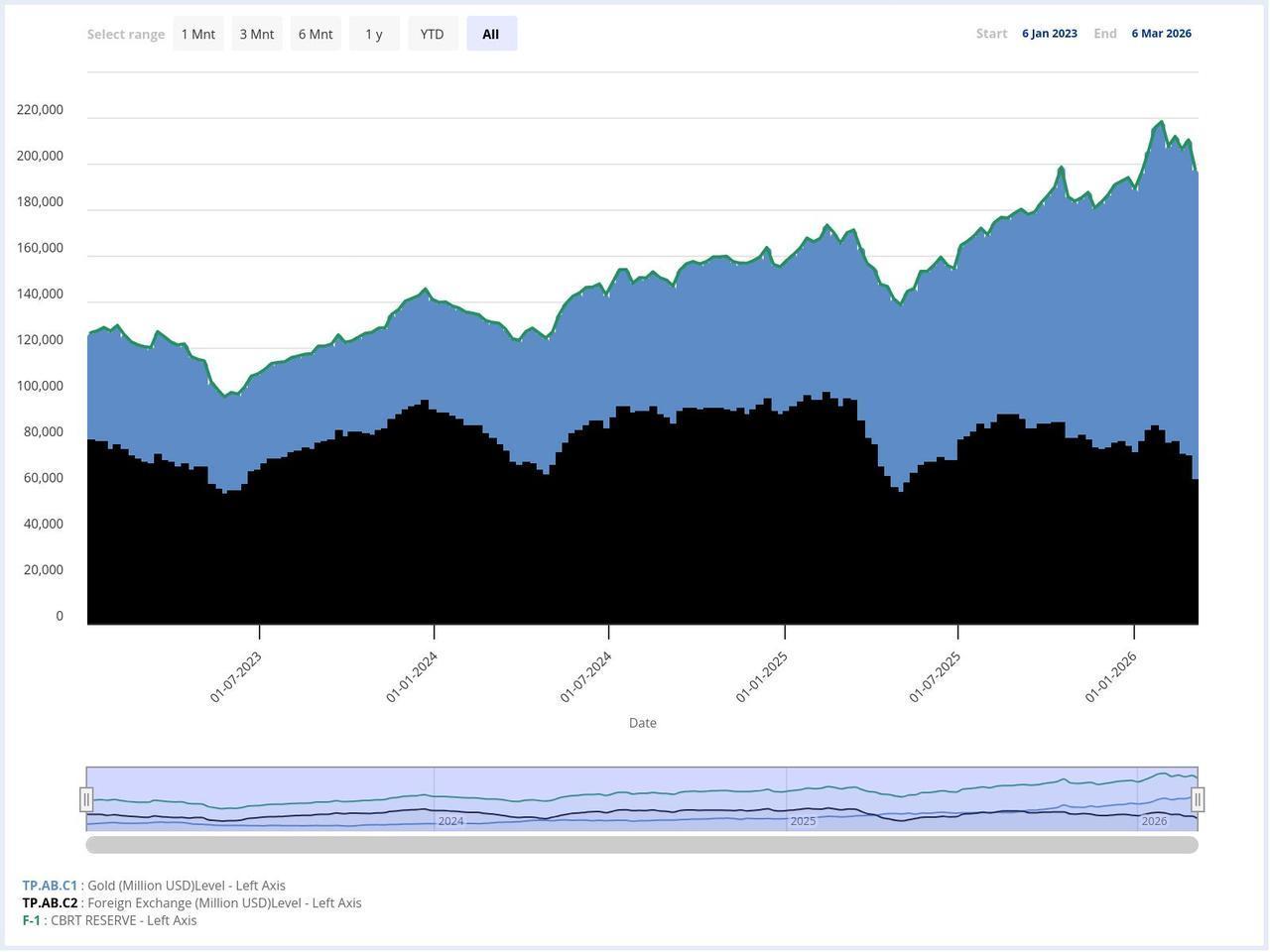

The CBRT’s gold reserves, which stood at $116.9 billion in the last week of 2025, rose to $136.83 billion in the week ending Feb. 27, just before the Middle East conflict began. The latest available data is for the week of Mar. 13, showing that reserves declined to $134.1 billion during the first two weeks of the war. Considering last week’s drop in gold prices, reserves are likely to have declined further.
In summary, the weakening of the asset-driven gains due to falling gold prices may make the CBRT’s job easier. However, the decline in reserves could also have some impact on the central bank’s balance sheet.


 Set as preferred source
 Set as preferred source



 4 min read