Newsletters


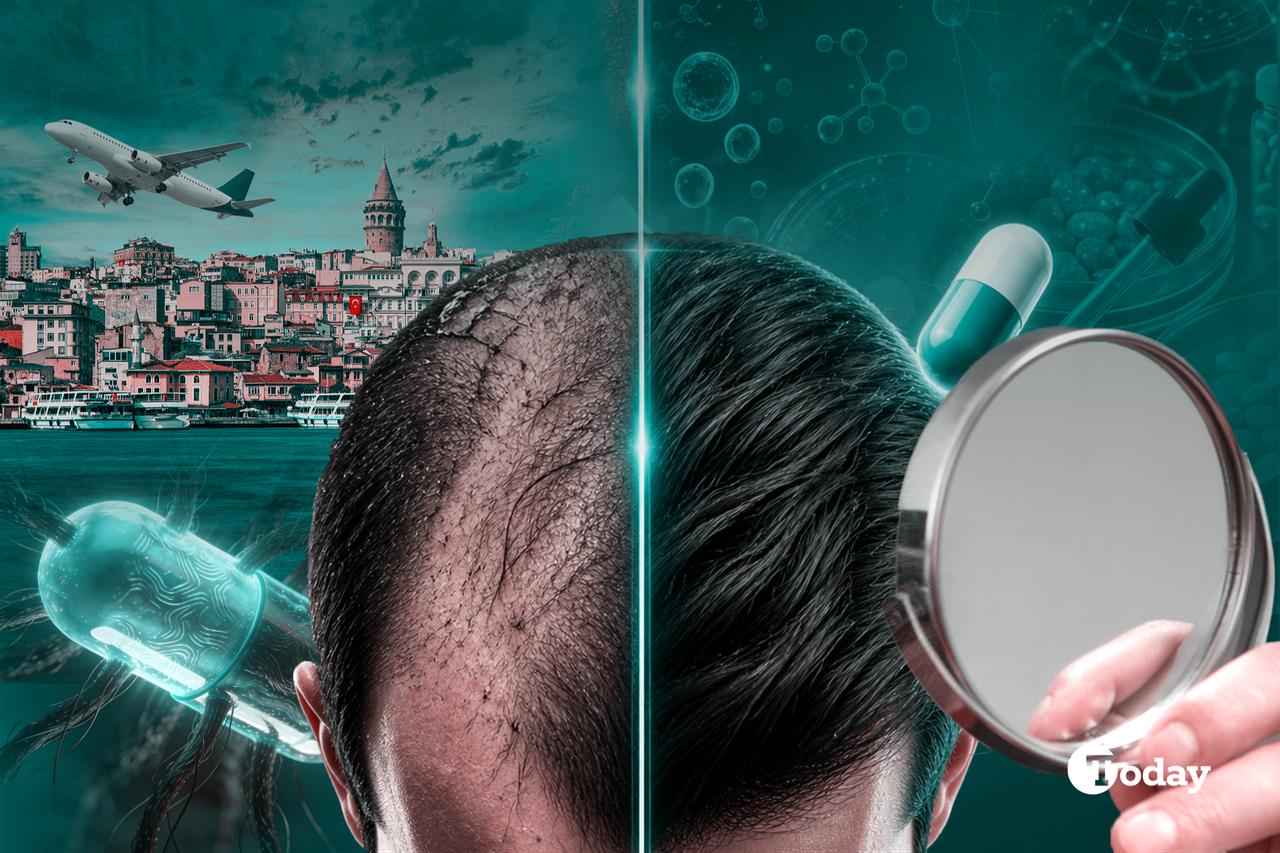


The first thing you notice about those courageous men contemplating a hair transplant in Istanbul is not the hair.
It’s the look in their eyes—the haunted, spreadsheet-driven stare of men who have googled “follicular unit extraction,” realizing they might live to regret it.
“If he has the guts, fate will point out what fork in the road he should take,” was how General George “Old Blood’n’Guts” Patton Jr. explained the dilemma facing similarly anxious men gazing at photographs of heroes with gauze wrapped around their heads like experimental pastries.
For years, Türkiye has been the NATO headquarters of scalp restoration, an intrepid crossroads where hope, vanity, and discounted airfare rally under fluorescent clinic lighting.
Entire neighborhoods hum with the quiet $2 billion-a-year industry of follicles being relocated like soldiers from the back of the head to the front.
It has been a good business. A gallant business. A business built on a simple premise: nature may take your hair, but modern medicine—plus a reasonably priced flight—will sell it back to you in installments.
But now that premise is starting to look shaky.
Because for the first time in nearly three decades, something new is stirring in the world of what the pros call aesthetically sound and dermatologically safe solutions to alopecia areata.
Not a lotion that smells faintly of regret. Not a pill with a warning label long enough to qualify as a novel.
Something else. Something that has people in lab coats using words like “exciting moment,” which, in medical circles, is roughly equivalent to Taylor Swift going on tour with a Bavarian oompah-pah band.
Now on stage from New Haven, Connecticut, is Veradermics, wearing the lab-tested equivalent of a clean suit and a confident smile.
The company has developed a pill that releases slowly throughout the day, avoiding the rapid spikes linked to cardiac risks. In clinical trials, patients grew over four times as much new hair as those on a placebo.
About 80% registered improvement within six months. No serious side effects were reported.
The numbers alone read like a police blotter for follicles. By age 35, two-thirds of American men and a quarter of women notice their hair thinning.
That’s roughly 80 million Americans staring into mirrors and wondering when their foreheads filed for territorial expansion.
The global statistics are even more head-scratching.
The culprit is “pattern” hair loss, a tidy phrase for a messy biological betrayal in which hormones gradually shrink hair follicles until they give up and move somewhere warmer, like Cancun or Bodrum.
For decades, the treatment options have been as inspiring as a late-night diner menu.
Finasteride—marketed under a name that sounds like it should come with a cape—blocks the hormone responsible for follicle shrinkage. It works, but it also comes with the side effects used in a film noir subplot: depression, loss of libido and sexual dysfunction.
The kind of trade-off that makes a man pause and reconsider his priorities, possibly in a dimly lit room with Venetian blinds casting symbolic shadows across his face.
Then there’s minoxidil, the foam or liquid that requires twice-daily application and the patience of a saint. It’s less a treatment and more a lifestyle choice.
You don’t just use minoxidil; you commit to it, like a gym membership you never quite cancel. There’s also a pill version, but it was never formally approved for hair loss and carries risks at higher doses that make cardiologists gulp.
If the new hair fertilizer holds up under regulatory scrutiny, it would be the first new FDA-approved pill for pattern hair loss in nearly 30 years. In pharmaceutical terms, that’s not just a development. It’s a plot twist.
Drug companies across the globe are circling the same prize. One firm is developing a serum that blocks the offending hormone directly at the scalp, avoiding the bloodstream entirely.
Another is developing a gel designed to destroy the protein that triggers hair loss at the follicle level—a hit job carried out with molecular precision.
Yet another is attempting something that sounds suspiciously like science fiction: reawakening dormant stem cells to restart the hair-growth cycle from scratch.
This is how to make the folks behind Türkiye’s some 5,000 hair-transplant clinics nervous.
Because while Istanbul’s hair hospitals have thrived on the limitations of existing treatments, new drugs threaten to change the equation.
Why book a flight, a hotel, and a surgical procedure when you might be able to swallow a pill and keep what you already have?
Why play offense—relocating follicles—when defense suddenly looks viable?
Of course, not everyone is ready to declare a revolution. The cautious voices are still out there, speaking in measured tones.
There is no cure, they remind us. Not yet. Maybe not soon. Hair loss is a stubborn adversary, the kind that doesn’t go down after a single punch but instead lingers, adjusts, and comes back with a different angle.
And the patients—the real protagonists in this slow-motion drama—know better than to celebrate too early.
Take the young man who started losing his hair at 17, who spent years researching, adjusting dosages, and balancing risks. He sees promise in the new treatments, but he’s not betting the house. Not yet. He’s been around this block before, and he knows hope can be as slippery as a freshly treated scalp.
Still, something has shifted.
Somewhere in Istanbul, a Hairstanbul clinic coordinator refreshes a spreadsheet and frowns. Somewhere in Miami, a man looks at a pill and wonders if this might finally be the one that changes the story.
And somewhere in the mirror, under harsh bathroom lighting, a few resilient hairs are holding the line, waiting to see which side wins.


 Set as preferred source
 Set as preferred source



 7 min read