Newsletters


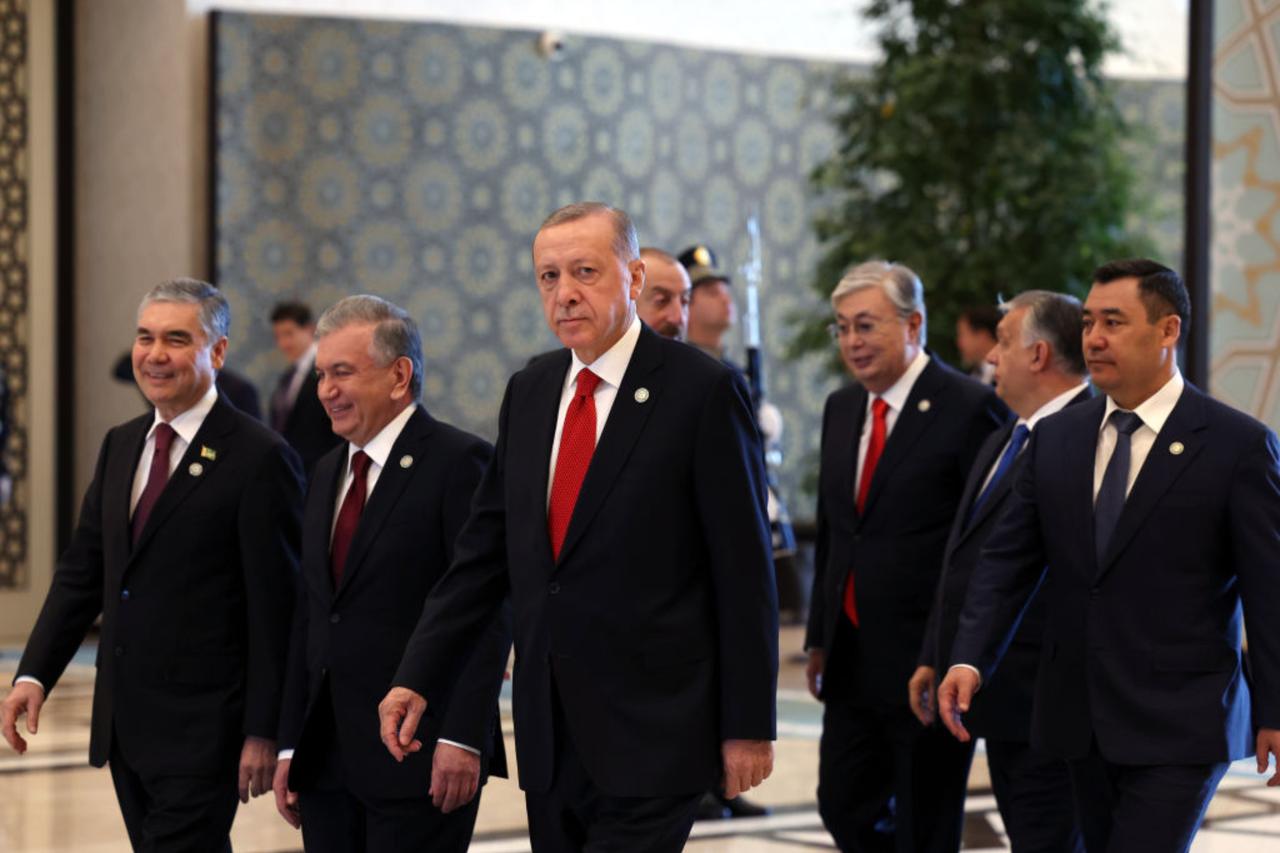


Recently, the Organization of Turkic States (OTS) has unexpectedly become one of the most discussed topics in Russia’s information space.
Just a few years ago, the OTS was mentioned in Moscow only in passing—mainly as a cultural or linguistic framework with little real political significance.
Today, however, Russian officials, major media outlets, and influential Telegram channels increasingly describe it as a factor that directly affects Russia’s interests.
The tone was set by official diplomacy. In late January, Russian Foreign Minister Sergey Lavrov publicly stated that Moscow “sees and is closely monitoring” the processes of formation and deepening within the Organization of Turkic States.
The wording was restrained but revealing: there were no compliments and no references to partnership. In the language of Russian political rhetoric, this is a clear signal that the OTS is not viewed as a cooperative initiative but rather as a development Moscow intends to keep under close watch and influence.
At the same time, a much harsher debate has unfolded in Russia’s leading media.
In several articles published by Kommersant at the end of last year and in January, the OTS was described as a project that Türkiye is using to expand its influence in Central Asia and the South Caucasus.
Some publications went even further, portraying the organization as a “conduit for NATO interests” and as a format that is gradually moving toward military-political coordination—through joint exercises, elements of collective security, and the alignment of defense approaches.
The topic becomes even sharper in the Russian Telegram ecosystem. There, the OTS is no longer described as a “competing interpretation.” Instead, it is framed as a direct security challenge for Russia.
Popular channels increasingly link the organization to the concept of a “Greater Turan,” while maps that place Turkic-speaking regions of the Russian Federation within a broader Turkic space are presented as evidence of hidden territorial ambitions.
Within this narrative, Russian information platforms are more and more frequently discussing potential “risks” for the Volga region, the Southern Urals, and the North Caucasus—areas where millions of Russia’s Turkic-speaking citizens live.
Interestingly, even the more restrained “expert” segment of the Russian discourse no longer treats the OTS as a temporary phenomenon.
A number of analytical publications openly acknowledge that Turkic integration cannot be stopped. From this recognition comes an idea that is increasingly repeated in Russia’s information space: Russia should try to “be inside the process” in order to influence it.
This does not imply equal participation. Rather, it refers to the possibility of blocking unwanted decisions, slowing down political consolidation, and redirecting the organization’s development in a direction favorable to Moscow.
In this context, it is telling how Russian media increasingly reinterpret the very notion of “participation.”
It is presented not as cooperation but as a tool for neutralization. The idea of Russia joining the OTS—even merely as an observer—is framed in such texts not as a gesture of trust, but as an attempt to seize the agenda and limit the organization’s independence.
Against this backdrop, the core contradiction becomes increasingly clear. For the Turkic states, the OTS is a mechanism for cultural, economic, and political rapprochement without external dictate.
For a significant part of Russia’s information space, however, it is seen as a structure that undermines Moscow’s traditional influence and creates risks both beyond Russia’s borders and within the country itself.
This is why, by early 2026, Russian rhetoric toward the Organization of Turkic States has become simultaneously more aggressive and more anxious.
It reflects a mix of fears about losing regional control, suspicions of external influence, and attempts to find ways to shape the process from within.
And the more actively the OTS moves from symbolism to concrete projects, the more this issue rises to the forefront of Russian media discourse—no longer as an abstract idea, but as a practical challenge for which Moscow has yet to find a clear response.


 Set as preferred source
 Set as preferred source



 6 min read