Newsletters




A boy built a border, and before long an entire country was squabbling about what it meant.
There was no fence, no passport booth, and no republic on the other side. There was only the Canal Saint-Martin, a squirt gun and a 14-year-old Baba O'Riley calling himself La Douane—"Customs."
La Douane is a Gallic specimen of something percolating from Paris to Istanbul and beyond: adolescents using social media to turn public space into a stage, themselves into characters and clashes with authority into content. From American “teen takeovers” to the fused digital and street lives of European children, the particulars change but the technology does not.
La Douane's frontier ran through one of Paris’s more civilized pieces of pavement. The tariff was €2. Pay, and you passed dry. Refuse, and the customs officer opened fire. Schengen administered by Super Soaker.
The collision is becoming harder to dismiss.
The old Dickensian machinery of the street—the den, the nickname, the pupils, and their profession—has obtained a smartphone: recruiters gathering children through social media, cultivating reputations, and broadcasting violence on TikTok to frighten rivals. Fagin has Wi-Fi now.
But screen-to-street networks are only one expression of the volatile convergence of adolescence, asphalt, and authority. Here in France, another had reached the school gates: students protesting overcrowded classrooms, crumbling facilities, and teacher shortages.
The movement spread across the Republic, with students blockading schools and staging demonstrations. By Oct. 1, over 1,000 high schools had been affected, and 222 had been blockaded.
Alongside the protests came violence: projectiles and fireworks thrown at police, vandalism, and confrontations with officers. Nearly 2,000 people were arrested that day and hundreds injured.
Then came the politicians smelling opportunity.
The partisan appropriation was not confined to the right. La France Insoumise moved quickly to embrace and amplify a movement that had begun with students. Louis Boyard, an LFI deputy and former student-union leader, bellowed a simple instruction: “The high school movement must spread.”
Other far-left politicians appeared at blockades; presidential candidate Jean-Luc Mélenchon joined protesting students in Paris. LFI says it encouraged peaceful protest, not the violence that followed. But if the right was eager to turn adolescent disorder into political evidence, parts of the far left were equally eager to turn adolescent complaint into political theater.
The children had grievances. The adults brought megaphones.
Lycée Turgot is a high school in La Douane’s patch of Paris and one of the schools touched by the unrest.
“La Douane and his friends were there,” says a 16-year-old Turgot student, whose parents requested their name not be used to avoid intimidation. “They threw stones and fired Roman candles at us and at the school.”
Nasty agitprop, but La Douane is not a gangster. The thuggery lies in the common technology: a phone, an audience, the individuality of a teenager, and an algorithm capable of turning street behavior into public theater.
Then came the videos ricocheting across Snapchat, TikTok, Instagram, and YouTube: La Douane spraying cyclists and passersby, tangling with authority, jumping into the canal, and turning a few meters of Paris into his private checkpoint.
“Most of the time, I don’t apologize,” La Douane told his critics. “I spray and run.”
La Douane, a.k.a. Hamza, is 14, and that number matters more than the water pistol. Somewhere between the first squirt and the millionth view, the boy began disappearing behind the character.
La Douane was an invented identity. But imaginary characters can secure real power. Give a child a nickname, an audience, and an algorithm, and the persona begins walking around without him.
People arrive to film it. Commentators argue about it. Politicians discover metaphors inside it. Soon the character has constituencies, enemies, and a press corps. And the boy must keep playing the boy everybody came to see.
Police knew him before much of France did. In July, officers detained him with two others in connection with an alleged telephone theft involving a larger group. The allegation was not sustained against him; detention is not conviction. His family said his sudden notoriety produced racist abuse, threats, and harassment.
William S. Burroughs imagined something more sinister in “The Wild Boys,” his 1971 hallucination of youth rebellion: young men beyond conventional authority turning disorder into theater. Burroughs had violent guerrillas; Paris has a middle-schooler with an aquatic sidearm.
Convicted of embezzlement, sentenced to wear an electronic ankle monitor, and running for president anyway, Marine Le Pen and her far-right chorus line know an existential threat when they see one—particularly when it is a teen armed with a squirt gun.
This is how moral panics are fitted with expensive shoes: the fear leaves the pavement, puts on a suit, and walks into parliament. Julien Odoul, a Rassemblement National deputy and party spokesperson, invoked the kid while arguing that parents thought to have surrendered control should face suspension of family benefits.
The machine had completed the conversion: boy into symbol, squirt gun into indictment, and wet trousers into a national argument about authority.
The smartphone has perfected the machinery of spectacle. The confrontation happens once on the pavement and a million times on the screen. Remove the camera, and you have an incident. Add the camera, and you have an identity. Add the algorithm and you can have a movement. Add politicians, and God help the child.
And suddenly the nickname becomes interesting: La Douane. Customs. The boy chose the institution that decides who passes and who does not. He erected a comic border in a Europe increasingly preoccupied with real ones.
The frontier was imaginary; the toll was real. The weapon was a toy; the reaction was serious. For the camera, a strip of pavement beside a canal could become France itself.
This is the peculiar genius of the internet age: symbolic territory can be conquered much faster than physical territory.
Some saw La Douane as a latter-day Gavroche, Victor Hugo’s swaggering Paris street urchin who taunted authority and became a symbol of rebellion. Others saw the photographic negative: a symptom of a state losing control of its streets.
Competing camps turned him into evidence for larger claims about policing, immigration, racism and public order.
Residents complained about behavior around the canal while people came specifically to film him. “Hamza thinks he’s the star of Paris,” said one resident, declining to give his name for fear of reprisal.
Of course he does. The entire country handed him the part.
That’s the darker point. The camera no longer merely records the boy. It manufactures the character. The audience rewards the performance, the algorithm demands an encore, and people are scared.
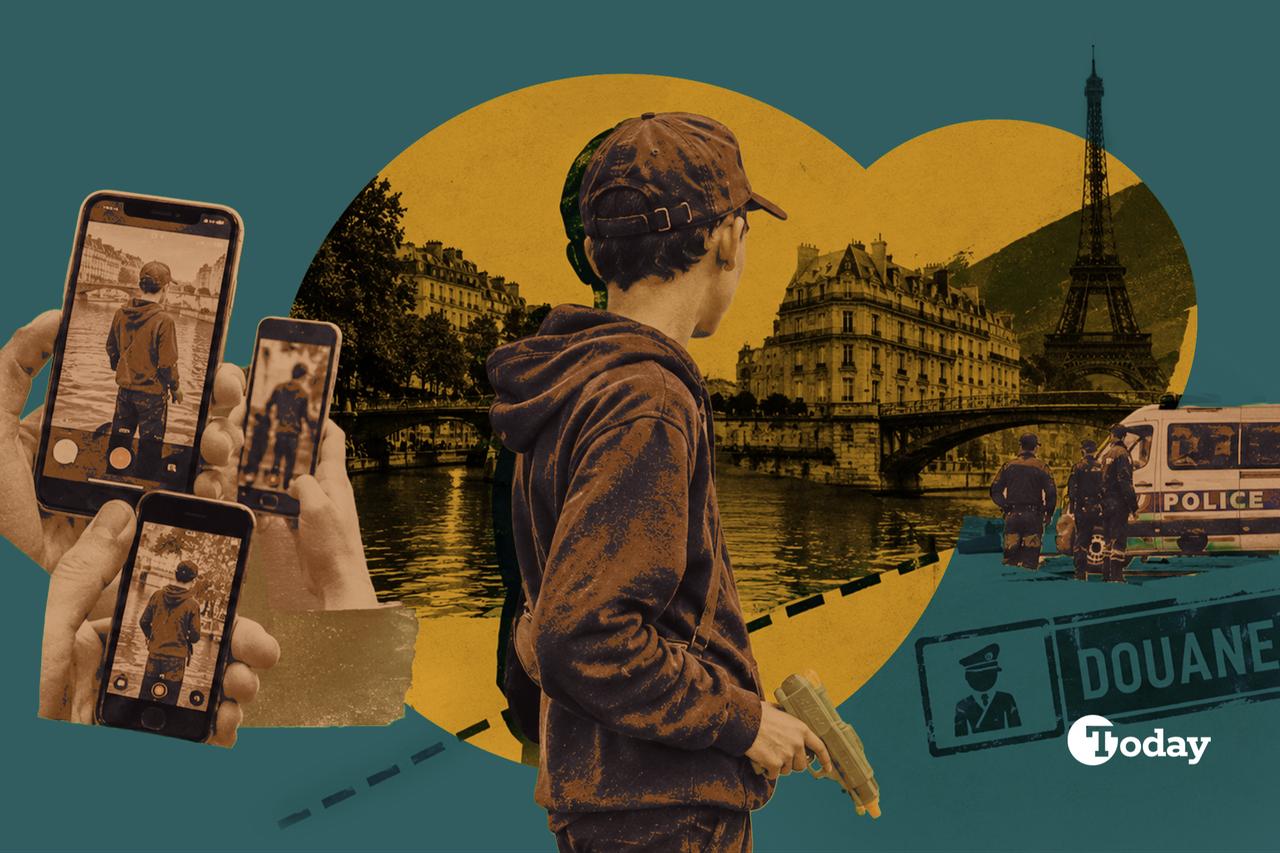
And here the camera must stop. La Douane is 14. French juvenile-justice law restricts publication concerning the identity and personality of juvenile offenders. Whatever images already circulate online, reporting about allegations involving a child should not turn his face into permanent merchandise. So there is no photograph here, only a silhouette: boy, canal, dampness-delivery system, police van and everywhere telephones raised like votive candles.
Adolescents can now name and broadcast themselves, building identities for millions of strangers to interpret. Chicago calls them takeovers. Paris calls this one La Douane. In Bakirkoy, Istanbul, prosecutors have a darker term for youth gangs recruiting through the screen: “new-generation criminal organizations.”
Here in Paris, the boy charged €2 to cross an imaginary frontier. The real crossing cost more: La Douane passed from childhood into infamy, and the adults were too busy filming to stop him.


 Set as preferred source
 Set as preferred source


 1 min read
 1 min read