Newsletters




In 2010, Dick Marty presented a report to the Council of Europe alleging that senior leaders of the Kosovo Liberation Army had operated an organ-trafficking network. The targets were reportedly Serbian and Albanian prisoners held in the wake of the 1998–1999 war.
The allegations were grave, but the evidence was thin. No forensic proof of harvesting ever emerged, and no chain of custody for the alleged victims was established. The case rested on intelligence files and anonymous accounts—claims that were fiercely contested from the moment they surfaced.
The international community built a court anyway.

The Kosovo Specialist Chambers, established by Kosovo's own Assembly under sustained external pressure, represent one of the most elaborate accountability mechanisms ever created for a conflict of this scale. A dedicated prosecutor's office. A treaty-backed jurisdiction. Hundreds of millions in funding. A legal architecture constructed on a specific standard: reasonable suspicion, sufficient gravity, credible institutional channel. Proof is what the mechanism is for. Its creation is not the verdict. It is the precondition for one.
That standard exists. It has been applied. It is worth asking why it has not been applied again.
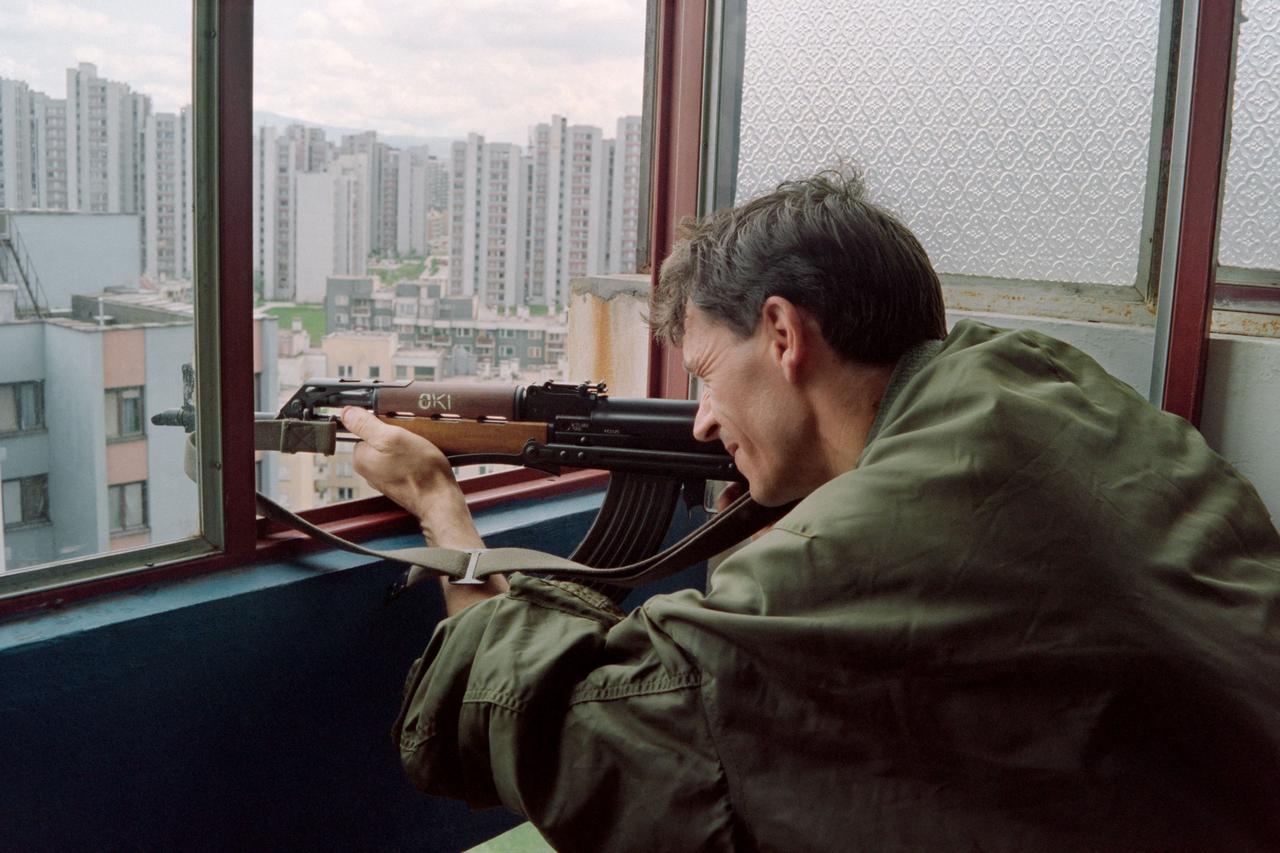
Sarajevo was besieged for 1,425 days. More than 11,000 civilians were killed by shelling and sniper fire from positions held by the Army of Republika Srpska in the hills above the city. That is not disputed. What is now emerging, through active criminal investigations in Italy, parliamentary inquiries in Austria and Belgium, and major investigative reporting in Germany, is that the siege also served as the backdrop for conduct that exceeds the scope of ordinary criminal prosecution. Wealthy foreigners paid, by some accounts, between €80,000 ($92,063.02) and €100,000 in current value, for access to sniper positions. They killed civilians for sport. A price list existed. Children cost more.
Italy's Milan prosecutor opened a formal criminal investigation in 2025. A suspect has been summoned for questioning. The legal classification is intentional homicide aggravated by cruelty. The crime carries no statute of limitations. Austrian parliamentarians have formally requested that Vienna investigate whether Austrian nationals participated. The German press has run major investigations. Multiple jurisdictions are now moving in the same direction, and the convergence of their findings points to an operation with logistics, financing, and organizational structure. Structures of that kind do not arise spontaneously.
This is where the comparison to 2010 becomes uncomfortable for those who built the Chambers and consider that construction a point of pride.
Marty's report named individuals. It was built on intelligence sourcing. It was disputed on evidentiary grounds by the government whose nationals it implicated. The international community said: reasonable suspicion exists, the gravity is sufficient, the institutional channel is credible. A mechanism will determine the facts.
The Sarajevo Safari allegations now meet that same threshold. They name individuals. Aleksandar Vucic has acknowledged in his own words, in a 1994 interview with the Belgrade weekly Duga, that he was present at the Sarajevo front as a volunteer. He has placed himself, in his own account, in proximity to the positions from which these crimes are alleged to have been conducted. That fact alone—a sitting head of state self-placing at the scene—would in any comparable proceeding be sufficient to trigger formal inquiry. It is not a verdict. It is a threshold question. The KSC standard requires only that the question be asked.
Vucic says he was there as a journalist and translator. That may be true. The mechanism is precisely the instrument for determining whether it is.
The asymmetry is not incidental. Serbia's path to EU accession, however, stalled, remains politically managed in Brussels. Vucic remains an interlocutor in the Belgrade–Pristina dialogue, a process the EU has invested significant institutional capital in sustaining. A dedicated accountability mechanism for Sarajevo Safari, at the level of organized state-adjacent operations, would complicate that investment. It would raise questions about whether the current architecture of Western Balkan diplomacy is not designed to absorb.
We built the Specialist Chambers because the alternative was losing visa liberalization and EU integration prospects. That pressure was applied to Kosovo's Assembly, its government, and its institutions, and we absorbed it. I am not relitigating that decision. I am noting what it took to produce one. No such pressure has been applied to Belgrade over the Sarajevo Safari. No accountability mechanism is being assembled. Those of us who sat under that pressure know precisely what it takes to mobilize the international community, and precisely who has chosen not to.
This is what selective justice looks like when it operates at the institutional level. It does not announce itself. It works through the calibrated application of different standards to similar facts, depending on which facts are politically convenient to pursue.
Thirty years after the siege ended, a man in northern Italy has been summoned for questioning about killing children from a hilltop above Sarajevo.
That is not a mechanism. It is not a standard. It is one man, one prosecutor, one jurisdiction, trying to fill a void.
The blueprint for what comes next was already written in 2010. It was applied to Kosovo, and it has not been misplaced.
It has been withheld.
The Council of Europe has the institutional memory to produce it. The European Parliament has the political weight to demand it.
What neither has produced is a reason.
The decision is the reason.
This article was first published on the Kosovo Dispatch website.
DISCLAIMER: The views and opinions expressed in this article are those of the author and may not necessarily reflect the editorial policy of Türkiye Today.


 Set as preferred source
 Set as preferred source



 7 min read