Newsletters


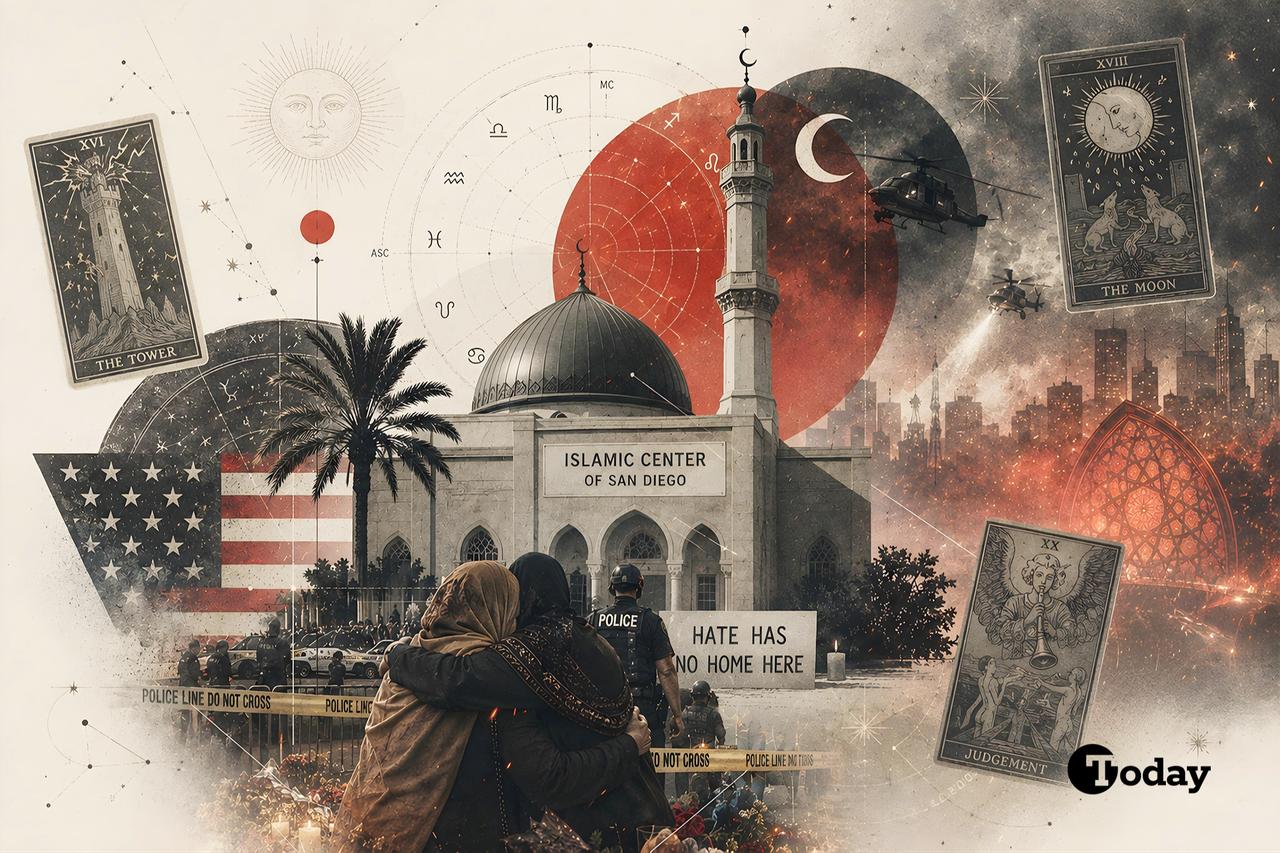


The old magicians promised that history moves in cycles—ages of reason collapsing into ages of omen, republics mutating into cults, rational states devolving into trembling tribes consulting entrails before battle.
America, that loud Protestant machine powered by gasoline and quarterly earnings reports, once believed itself immune to this sort of medieval relapse. The national religion was efficiency. The saints wore lab coats. The oracles sat at the Federal Reserve.
Now look at the place.
The republic staggers through a fluorescent dusk, haunted by invisible powers. Every political event arrives wrapped in apocalyptic vocabulary. Every weather system becomes a sign. Every election a cosmic struggle between angels and vermin. America is living through what medieval scholars would recognize immediately: a crisis of enchantment.
The New York Times recently pointed out how sociologists assured that modernity would bleach the supernatural out of public life. Max Weber called it “the disenchantment of the world.”
Science would replace superstition; bureaucracy would replace myth. But the machine has malfunctioned. The wires are sparking. Americans increasingly suspect that material explanations are no longer sufficient for the surrounding chaos. The atmosphere feels charged, uncanny, electrically theological.
The evidence is not subtle.
In 2024, Pew Research found that nearly 30% of Americans consulted astrology, tarot cards or fortune tellers at least once a year. According to the paper, younger women and LGBTQ Americans reported even higher participation rates.
Crystals, moon rituals, witchcraft aesthetics, manifestation cults, TikTok prophets, psychedelic shamans—all flourishing amid collapsing institutional trust. The country that once exported IBM and Norman Rockwell now exports conspiracy mysticism by livestream.
This is what happens when empirical reality ceases to feel emotionally adequate.
And presiding over it all is Donald Trump: Caesar by way of casino lounge, a man whose political existence has always resembled a séance inside a collapsing shopping mall.
Trump does not merely govern America; he animates its fever dream. His rallies operate less like political events than revival meetings crossed with Roman executions. The language surrounding him turns openly theological. He is portrayed either as a national redeemer or an antichrist, depending on which side of the barricades one occupies.
The strain on him is now visible even to loyalists. The nation is at war abroad. The economy he promised to revive trembles like an over-leveraged carnival ride. His approval ratings slide downward with the inevitability of a stone dropped into black water.
Democrats openly question his psychological fitness. Senator Chuck Schumer called him “an extremely sick person," while Representative Hakeem Jeffries described the president as “unhinged” and “out of control.” Some invoke the 25th Amendment with the desperation of medieval bishops discussing exorcism rites.
Polling released last week found 59% of Americans doubt Trump possesses the mental sharpness to govern. Republicans, meanwhile, insist the emperor remains vigorous and omnipotent. The White House dismisses concerns with the aggressive confidence of palace astrologers, denying that the comet overhead means anything at all.
But this is no longer ordinary political theater.
America’s emotional vocabulary has shifted into something older and darker, a new and wretched “Back to the Future” sequel based on what historians call ancestral medievalism.
“We see this across Europe when they cosplay as crusaders at anti-immigrant rallies, as they wield spray-painted shields with 'Deus Vult' at rallies in Virginia,” explained Matthew Gabriele, a professor of medieval studies at Virginia Tech University.
“They want to return to their imagined Middle Ages,” added David Perry, a professor of history at the University of Minnesota. “Wherever you find white supremacists, you’ll find medievalism, and you’ll almost always find murder.”
Indeed, when the official narrative ceases to persuade, myth rushes into the vacuum like floodwater.
Which brings us to the mosque in San Diego.
Yesterday, two teenage gunmen opened fire at the Islamic Center of San Diego, killing three men before apparently taking their own lives. A security guard died attempting to stop the carnage, which authorities are investigating as a hate crime.
Children at the mosque school evacuated hand in hand past police barricades and television helicopters—the sort of image that would have looked perfectly at home in Bosnia or Beirut but now passes as routine American iconography.
The attack emerged amid rising threats against religious institutions across the country. In March, a synagogue outside Detroit was attacked by a man wielding a truck. Mosques, synagogues and churches now harden themselves like feudal fortresses anticipating siege. Worshippers scan rooftops before prayer.
After San Diego, the familiar ritual unfolded with ghoulish precision.
Politicians condemned the violence. Police departments announced increased patrols around houses of worship. Tazheen Nizam of the Council on American-Islamic Relations declared that “No one should ever fear for their safety while attending prayers or studying in elementary school.”
Baloney. Fear itself has become America’s dominant liturgy.
Back in 1170, the physician Maimonides first noticed the trend. In “The Guide for the Perplexed,” the good doctor argued that humans become susceptible to confusion and fanaticism when they cannot reconcile contradictory realities.
Reason alone, he warned, cannot soothe societies convulsed by existential instability. The perplexed mind seeks symbols, signs, and cosmic explanations.
America in 2026 is profoundly perplexed.
A nation raised on technological triumph now experiences reality as if governed by invisible curses. Information moves instantaneously across continents—a kind of secular teleportation so commonplace we scarcely notice its sorcery anymore.
Artificial intelligence generates hallucinated realities indistinguishable from truth.
Presidents rant online like prophetic kings descending into madness. Teenagers radicalize themselves in algorithmic catacombs before emerging armed for holy war. The border between the material and the metaphysical has become porous.
And perhaps that is the true story beneath the Trump era. Not merely authoritarianism, corruption or democratic erosion—though there is plenty of each—but the return of enchantment under conditions of technological overload.
Americans no longer experience politics as administration. They experience it as possession.
This is why every catastrophe now acquires occult resonance. The economy is not merely unstable; it is cursed.
The president is not merely erratic; he is hexed, senile, chosen, or damned. Violence at a mosque is not merely criminal but sacrificial, another eruption from the nation’s collective subconscious.
America has gone fully professionally weird. The republic now wanders through its own hallucination, carrying assault rifles, smartphone talismans and fragments of shattered civic faith.
The old secular confidence is gone. In its place stands a frightened, enchanted nation staring into the electronic abyss, searching desperately for omens.


 Set as preferred source
 Set as preferred source


 7 min read