Newsletters





This article was originally written for Türkiye Today’s weekly economy newsletter, Turkish Economy in Brief, in its Mar. 30 issue. Please make sure you are subscribed to the newsletter by clicking here.
As the war in the Middle East completes its first month, clashes continue despite the ongoing ceasefire talks.
The Strait of Hormuz, a key focal point for markets, remains closed. The last ships that passed through the strait before March have now reached their destinations, and no new shipments are on the way.
If current conditions persist, supply constraints in oil could become more pronounced in April. This outlook played a role in oil closing last week at $112.50 per barrel.
The conditions for markets to turn positive are clear: an end to the conflict, reopening of the Strait of Hormuz, and a rapid normalization in commodity trade, especially oil.
Any signal in this direction would support market sentiment. However, expectations of $60 oil prices are no longer on the table. The market now wants to see the worst-case scenario and then reprice accordingly.
Looking at domestic markets, exchange rates continue to show a stable outlook. The Central Bank of the Republic of Türkiye’s (CBRT) total reserves declined from $210.3 billion in the week of Feb. 27 to $177.5 billion in the week of March 20.
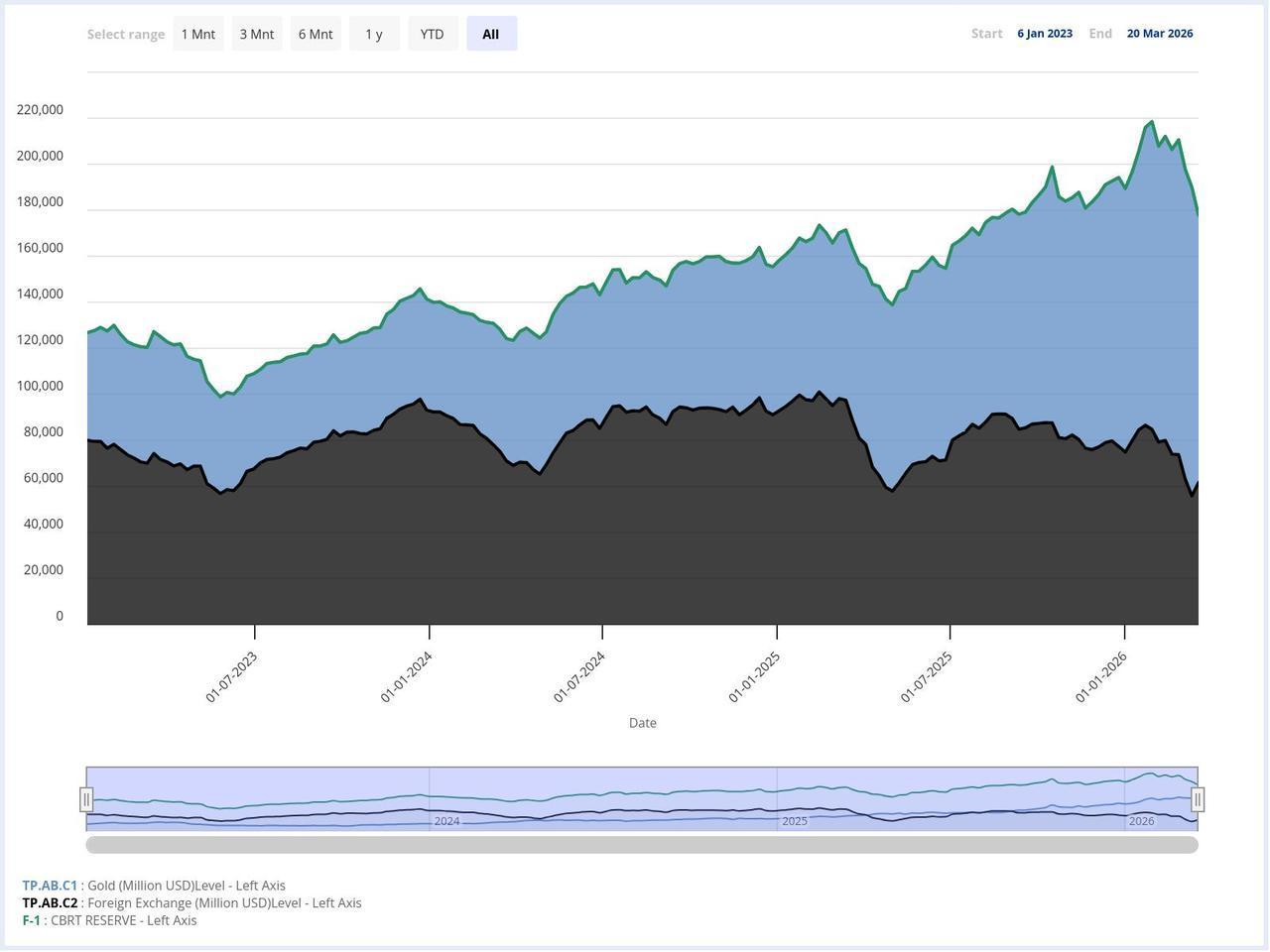

During the first three weeks of the war, global markets experienced some of the sharpest fluctuations in recent years, risk appetite declined worldwide, and demand for dollars increased amid rising commodity prices. Despite this, the CBRT has maintained domestic market balance in Türkiye thanks to its strong reserve buffer.
In this process, it is quite normal for the CBRT to use its gold reserves, which it has accumulated over the years and generated significant profits from. According to calculations, the CBRT’s gold holdings decreased by 56.6 tons over the past two weeks. Based on international reserves and liquidity data, 34.4 tons of this amount were used for gold/dollar swaps, while 22.2 tons were sold.
These transactions represent a professionally executed and managed liquidity operation. As a result, the Turkish lira has ranked among the least depreciating currencies since the beginning of tensions in the Middle East.
Measures such as activating the fuel tax escalator system to limit the pass-through of rising oil prices to fuel pumps and increasing the CBRT’s funding rate from 37% to 40%, also stand out as proactive steps taken to curb inflationary pressures.
In March, the BIST 100 index on Borsa Istanbul declined by 7.43%. The index, which closed in February at 13,718 points before the war, ended last week at 12,698.
While a low of 12,433 was tested this month, the latest close was closer to that level. Due to the potential macroeconomic impacts of rising oil prices, Borsa Istanbul has shifted into a defensive range of 12,400–13,400. In the short term, this range stands out as key support and resistance levels from a technical perspective.
Now, two key items stand out on next month’s agenda: the March inflation data to be announced on April 3 and the CBRT’s interest rate decision on April 22.


 Set as preferred source
 Set as preferred source



 7 min read