Newsletters




This article was originally written for Türkiye Today’s weekly economy newsletter, Turkish Economy in Brief, in its Nov. 9 issue. Please make sure you are subscribed to the newsletter by clicking here.
The fund crisis that erupted in Türkiye's markets in mid-September continues to unfold, with nearly 180,000 investors now having recovered their full net investments.
Treasury and Finance Minister Mehmet Simsek shared the latest figures, saying that ₺130.2 billion ($2.6 billion) had been paid into 614,874 accounts across 108 funds. The payments have reached 420,031 individual investors, including 179,449 who have recovered their entire net investment amounts.
The Capital Markets Board (SPK) has ordered the liquidation of 131 funds, which have approximately 456,000 investors. Under regular liquidation procedures, 93 funds have paid ₺68 billion into 71,899 accounts. Under extraordinary liquidation procedures, 15 funds have made interim payments totaling ₺62.2 billion into 542,975 accounts as of Nov. 4, 2026.
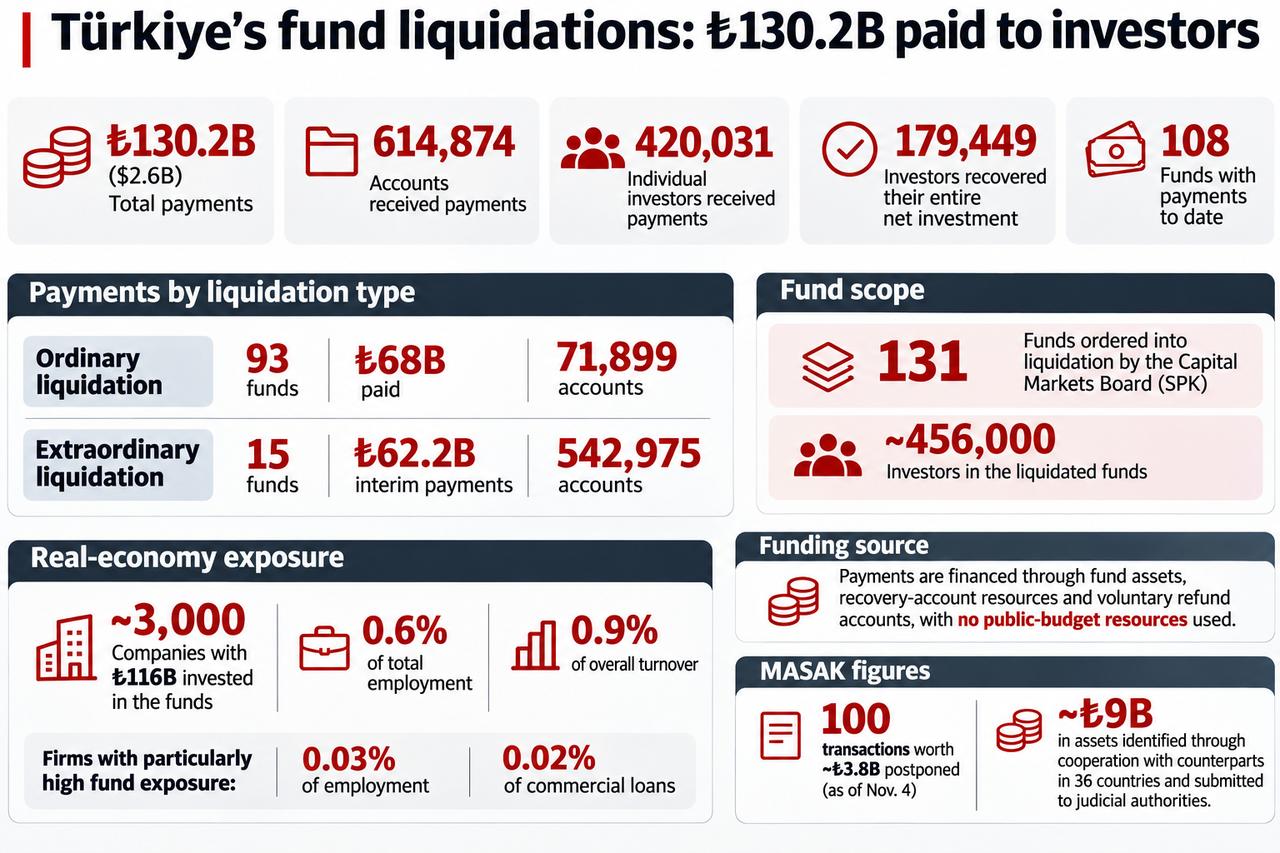

Simsek stressed that the payments are being financed through the funds' own assets, resources in recovery accounts, and amounts held in voluntary refund accounts, with no transfers from the public budget.
Addressing the potential impact on the real economy, Simsek said approximately 3,000 companies had ₺116 billion invested in the funds undergoing liquidation. These companies account for 0.6% of total employment and 0.9% of overall turnover. Firms with particularly high exposure to the funds represent just 0.03% of employment and 0.02% of commercial loans.
Simsek said authorities were also working on new regulations to strengthen investor confidence and improve the functioning of capital markets. Planned measures include tougher penalties for market manipulation, deterrents against coordinated transactions by investment funds, independent verification of free-float ratios and more effective market surveillance.
On the legal side, Justice Minister Akin Gurlek also updated the public on the fund investigations, saying authorities had uncovered an extensive criminal network rather than a case limited to stock market manipulation or fraud.
"The network that infiltrated our high-level oversight mechanisms has become quite evident as of today," Gurlek said.
Among those implicated in the alleged criminal network are former Borsa Istanbul CEO Korkmaz Enes Ergun, who was arrested on bribery charges earlier this week, and former Family and Social Services Minister Fatma Betul Sayan Kaya, who was arrested following Gurlek's remarks on alleged violations of capital markets legislation and membership in a criminal organization.
Former Capital Markets Board Chairperson Ibrahim Omer Gonul, meanwhile, was released under judicial control and handed a travel ban.
The benchmark BIST 100 index gained 6.72% last week, closing at 11,482 points and ending its seven-week losing streak. The recovery came as one of the main sources of uncertainty surrounding the fund crisis began to ease.
Sales of BIST 30 stocks held by funds undergoing liquidation were completed last week, removing an important source of potential selling pressure on the market. With the liquidation-related sales behind them, investors had fewer reasons to worry about further forced disposals of major stocks, helping restore buying appetite on Borsa Istanbul.
Developments surrounding the U.S.-Iran war also improved the outlook for Türkiye's markets, particularly through their impact on energy prices.
The Democrats' victory in securing a majority in Congress following the U.S. midterm elections strengthened expectations that the conflict could come to an end. The prospect of an end to the war eased concerns over disruptions to global energy supplies, sending Brent crude down more than 15% last week to around $98 per barrel.
For Türkiye, where energy imports account for a substantial share of the external financing bill, a sustained decline in oil prices could provide relief on several fronts. A lower import bill would help contain the current account deficit and reduce the economy's exposure to energy-related external pressures. Cheaper energy would also feed into production, transportation and operating costs, potentially easing some of the cost pressures that have complicated the fight against inflation.
The implications extend to monetary policy and financial markets. If lower oil prices help bring inflation down and improve the external balance, they could give the Central Bank of the Republic of Türkiye (TCMB) greater room to continue cutting interest rates.
At the same time, a more favorable inflation and current account outlook could improve investor appetite for Turkish assets, including equities.
These developments offer the first indications that the worst of the turbulence in Türkiye's markets may be starting to pass.


 Set as preferred source
 Set as preferred source



 6 min read