Newsletters


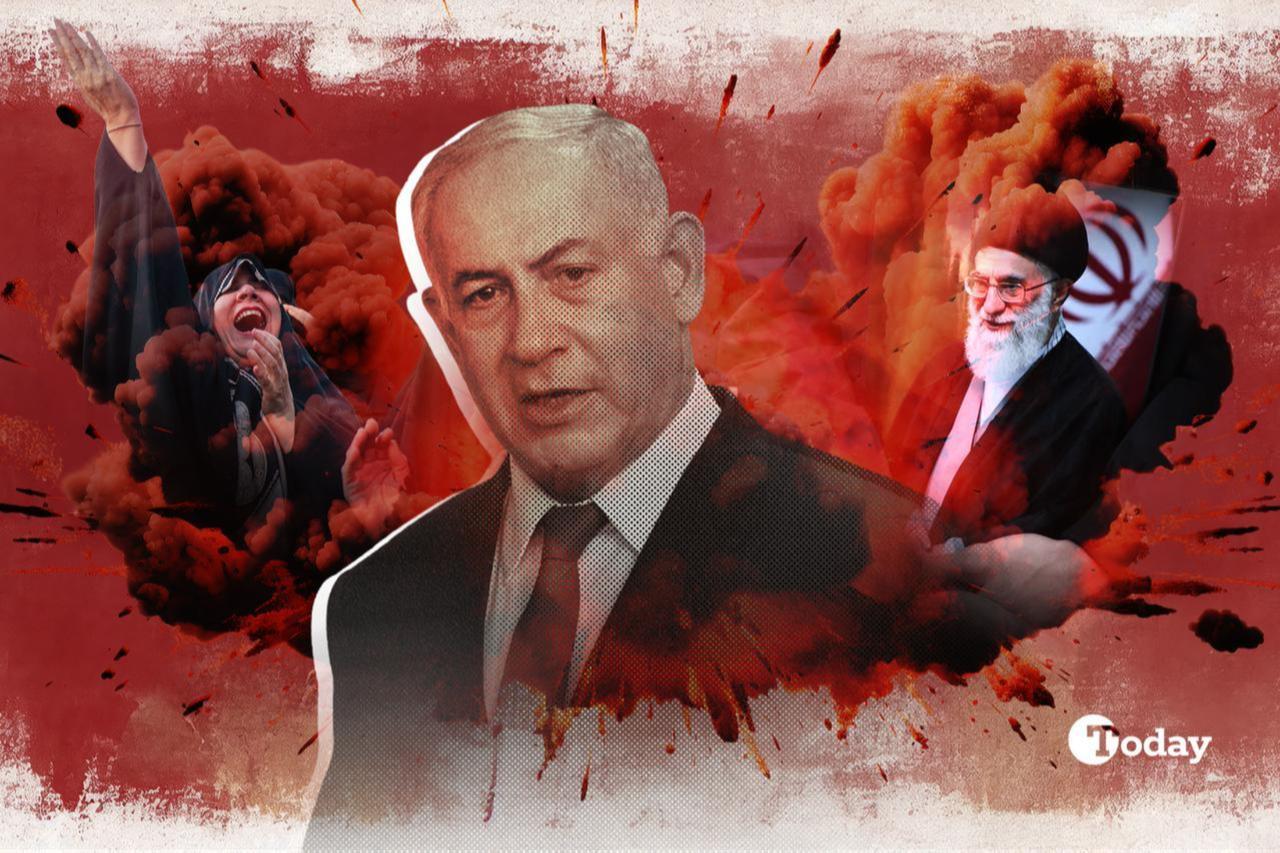


From the blasted boulevards of Tehran to the luxury resorts along the southern coast of Cyprus, the bickering children of Abraham begin the week hoping to recuperate from Operation Epic Fury, a jamboree of Israeli ghosts, American munitions, and Iranian mullahs.
The carnival’s ringmasters didn’t cross a threshold so much as kick it off its hinges, set it on fire, and declare the rubble and smoke a victory party for civilization.
Somewhere in the swamp between cable news graphics and the Pentagon PowerPoint, we’ve stumbled back into the old tropical nightmare Joseph Conrad dubbed "The Heart of Darkness," only this time it’s lit by drone footage, blue-glow iPhones, and American and Israeli politicians describing the celebration as a righteous crusade.
They always do that, at first, before the festival ends in a haunting procession of “unintended consequences,” that favorite bureaucratic narcotic, the phrase that turns blood into bookkeeping and rubble into regrettable data.
Somewhere in the command bunker, the spirit of Colonel Kurtz is taking notes. Western power, bloated on its own slogans, is staring into the mirror and seeing nothing but abstractions. Freedom. Security. Preemption.
These are big, steroidal nouns flexing under hot TV studio lights. The show must go on. And hovering over the production like a bad smell nobody wants to claim is the most dangerous abstraction of all.
Exit strategy.
Those are the two words whispered after midnight, when the Mar-a-Lago champagne goes flat and the “perceptive pixel” maps on CNN’s “Magic Wall” don’t make sense anymore. That’s when the world realizes America has once again driven a convoy of good intentions straight into the jungle—and the jungle, as always, is wide awake.
Reality is seldom a pretty story. This one is filled with jet fuel, sanctimony, and the high metallic tang of inevitability. Somewhere in the agitated imagination of Washington strategists and Israeli schemers, the map of the Middle East still looked clean and geometric. On the ground, where bureaucrats dare not tread, the diagram flows like Conrad’s river. Winding, swollen, and hungry.
Tehran lit up before dawn on Feb. 28, the sky flashing with the sterile brilliance of American hardware. Operation Epic Fury (Roaring Lion, if you’re Israeli and prefer your apocalypses spiced with a soupcon of Old Testament flourish) roared into existence with the confidence of men who have rehearsed the speech of victory long before the first rocket leaves the rail.
The U.S. and Israel struck deep.
Command centers, missile arrays, and the bureaucratic nerve endings of a state long designated malignant. And in the center of that gale, the confirmed death of Ali Khamenei and a boxcar load of his pals, decapitations delivered with clinical resolve and broadcast to the world before the smoke had time to settle.
President Donald Trump framed the strikes as an “opportunity,” a word so elastic it can stretch over rubble. Regime change, liberation, strategic recalibration.
The old lexicon was polished and rolled back out like ceremonial silverware. In certain precincts of American political life, the wholesale elimination of an adversarial leadership is spoken of as if it were municipal sanitation. A grim but necessary civic duty. Community service, in a geopolitical key.
And this is where the real madness begins.
The U.S. has been here before. Vietnam was once described as a limited engagement, a necessary stand, and a domino held in trembling fingers. Fifty-eight thousand Americans dead later, along with millions of Vietnamese casualties, and more than $168 billion in 1970s dollars. The figure that metastasizes into the trillions once you account for inflation and the lifelong care of veterans.
“Limited” nonetheless became the archetype of escalation.
The war did not simply consume Southeast Asia; it hollowed out trust at home. What began as containment evolved into immersion. What was unintended became normalized. Afghanistan followed, then Iraq, each conflict introduced as swift, precise, and almost surgical.
Each expanded into decades-long odysseys of insurgency, reconstruction, collapse, and deja vu. Trillions spent. Governments were erected and dissolved. The fall of Kabul in 2021, after years of official optimism, was labeled by some as a luckless byproduct of an otherwise successful withdrawal. An unintended consequence: history as a laboratory mishap rather than a human catastrophe.
But those are hoary bedtime stories for children.
Now the Gulf is humming with retaliation. U.S. bases from Bahrain to Kuwait have taken fire. Iranian missiles arc toward residential districts in Israel and neighboring states. American service members are dead or wounded. Luxury shoppers and Instagram influencers in Dubai and Abu Dhabi are cowering in the Amzaan Fashion Boutique and under The Road at Etihad.
Civilians are again the raw ledger entries in a conflict that was advertised as precise. Precision, it turns out, is a trendy word with remarkable suppleness under pressure.
The language of the military spokesmen in Washington and Jerusalem is antiseptic: “calibrated response…limited objectives…strategic necessity.”
This is the sinkhole at the center of modern warfare. Intention is marketed; outcome is negotiated after the fact. American journalist and satirist H. L. Mencken once wrote that conscience is the inner voice warning us that someone may be looking.
Today, everyone is looking. The images stream in real time. The global public watches not as a distant audience but as a wired, reactive organism. There is no jungle deep enough to hide in anymore. Colonel Kurtz would have needed a media team.
And then there’s the bill.
War is not merely an explosion; it is an annuity. Aircraft carriers and stealth fighters are only the visible instruments. The true cost explodes quietly: long-term medical care, interest on borrowed trillions, oil shocks, market tremors, and the permanent garrisoning of foreign soil. Since Vietnam, the United States has maintained a global military posture that operates as a kind of planetary insurance policy, one whose premiums rise with every new crisis.
But the deepest erosion is not fiscal. It is conceptual.
Democratic societies are supposed to wrestle openly with consequences. They are meant to confront the distance between what was promised and what was delivered. When civilian deaths are linguistically bleached, when “decapitation” is reframed as benevolence, when blowback is treated as unforeseeable weather rather than structural probability, something essential begins to corrode.
And so the river winds on.
The strikes cannot be unlaunched. The dead cannot be resurrected by a press conference. The deceased on every side become permanent citizens of memory, whether acknowledged or not.
Welcome to The Heart of Unintended Consequences, the predictable offspring of grand designs imposed on volatile terrain. To euphemize them is to anesthetize the national conscience. And once that anesthesia takes hold, the threshold is not merely crossed.
It disappears.


 Set as preferred source
 Set as preferred source


 7 min read