Newsletters





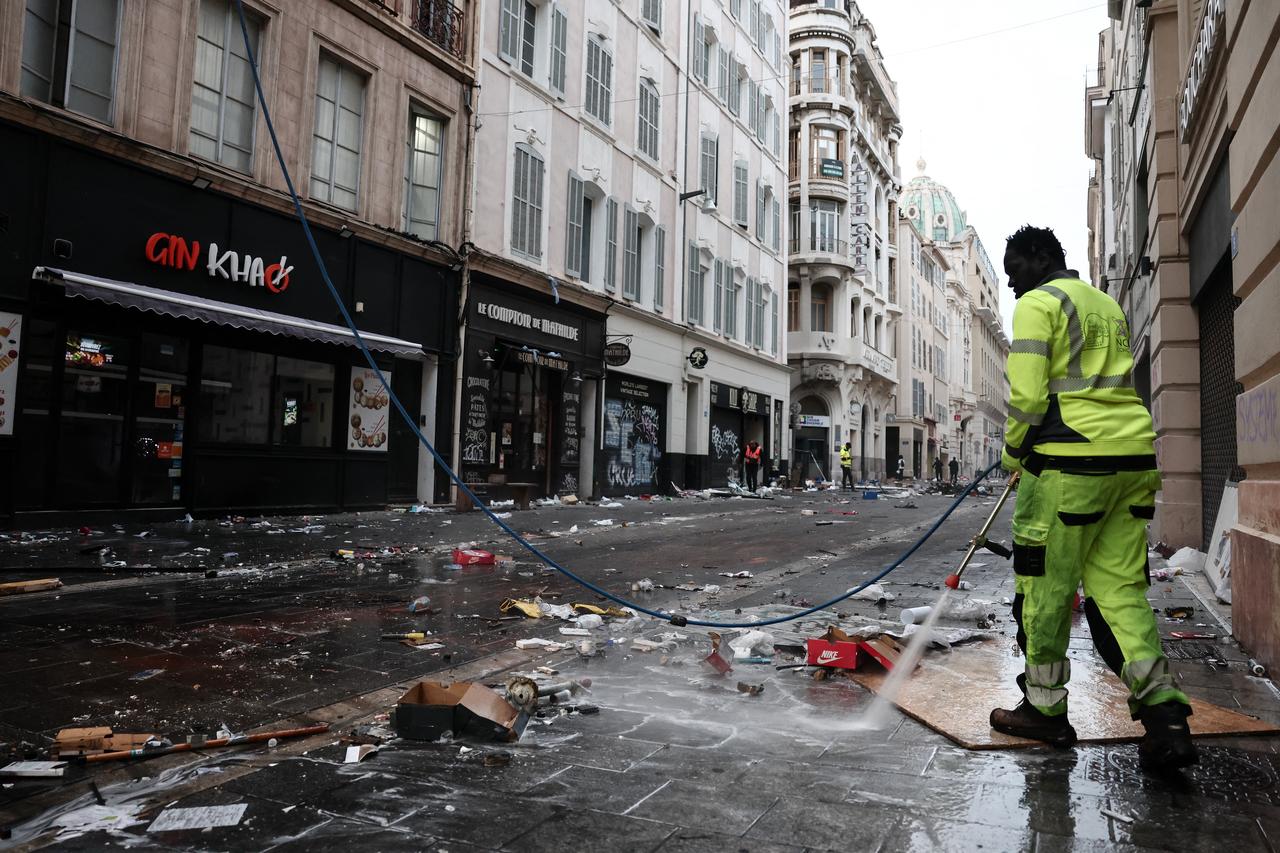
France has been witnessing ongoing unrest across the country for weeks. It started with the cost of living and escalated with a strike by students and teachers demanding additional staff and resources in September.
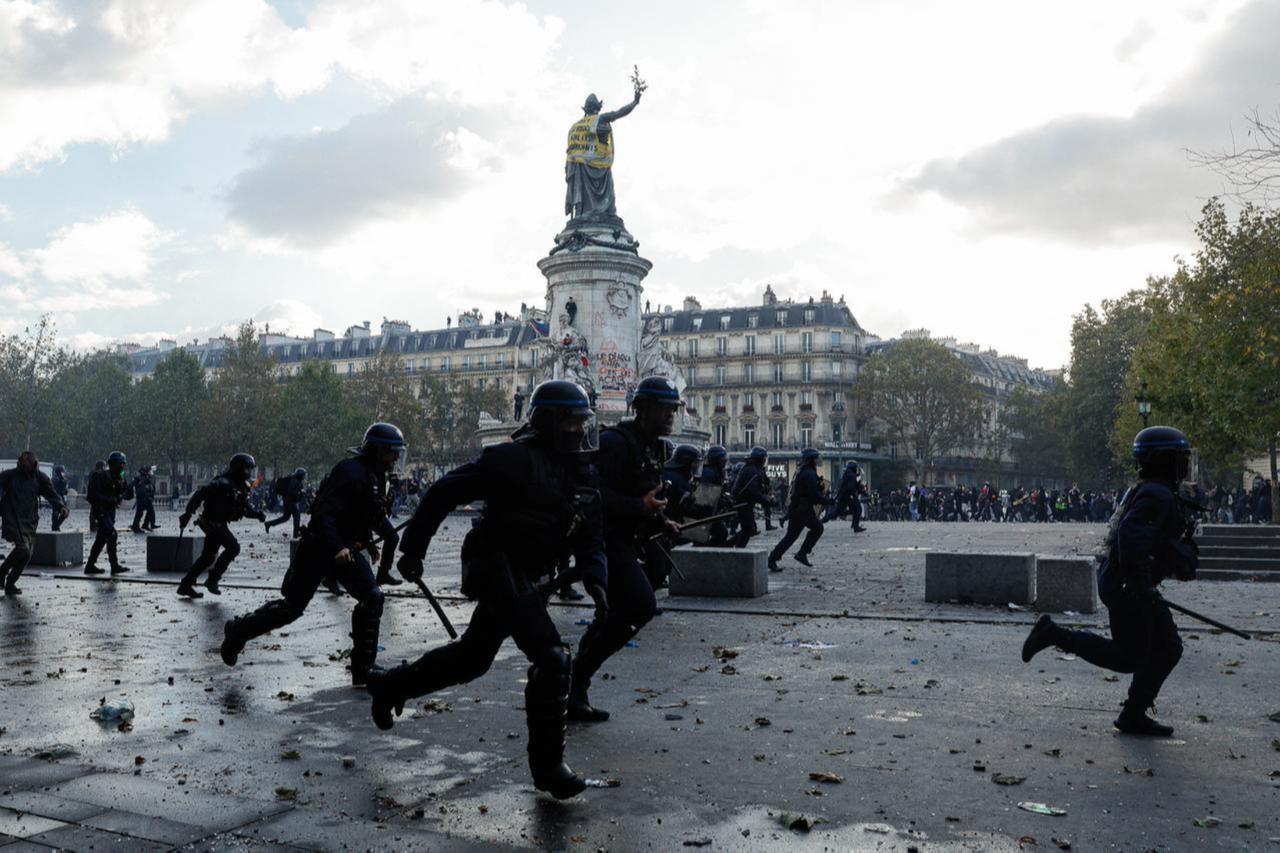
When authorities met the demands, the action inspired similar protests nationwide. Public anger grew over the police response, and worker unions also joined the demonstrations.
More than 500,000 people participated across France, over 2,400 were arrested, and almost 1,000 police and gendarmes were injured, according to the Interior Ministry.
The protests also ignited another debate: is there any relationship between the protests and migrants? According to United States President Donald Trump, yes.
“If Europe doesn’t close its borders and bring the criminals out, like the people that are protesting, Europe is finished,” he said at the White House on Monday, Oct. 19.
“When I look at France, when you look at Italy, when you look at all the turmoil and the hatred, that’s not about school. That’s about people coming into the countries that hate the country,” he continued.
Even though French President Emmanuel Macron dismissed the remarks as “stupid comments by many, including foreign leaders,” the questions remained.

To understand the issue, it helps to go back. The share of immigrants in France's population was 7.3% in 1990 and the same in 1999.
It was 8.1% in 2006 and started to rise further: 9.3% in 2015, 10.2% in 2020, and 11.6% in 2025, according to the French National Institute of Statistics and Economic Studies (INSEE).
But France is an attractive country; to determine if this trend is anomalous, comparing it with other European countries is beneficial.
In Germany, the share was 16% in 2005 and rose to 26.3% in 2025, according to the German Federal Statistical Office (Destatis). In Sweden, the share was 11.3% in 2000 and rose to over 20% of the population in 2025. Norway only had 6.3% in 2000; the figure climbed to 11.4% in 2010 and 17.5% in 2026.
According to the numbers, France is not the only country experiencing this trend, nor does it have the highest number of immigrants. Therefore, if one wants to explain the protests, immigration does not appear to be the main reason.

“Cost-of-living” is a popular phrase this year. Almost in every protest, the term is mentioned by demonstrators. To assess whether the cost of living has actually changed, comparing the cost of everyday purchases over time would be beneficial.
In France, everyday spending that cost 1,000 units in 2000 costs about 1,510 units in 2025, according to INSEE. The same comparison for Germany gives 1,615 units, according to Destatis.
In Sweden, it rose to almost 1,603 units, according to Statistics Sweden (SCB). Finally, in Norway, it climbed to 1,825 units, according to Statistics Norway (SSB). But these numbers don’t represent the real burden on people.
Rent that cost 1,000 units in 2000 rose to about 1,485 in France, 1,400 in Germany, 1,725 in Sweden and 1,935 in Norway, according to the Organization for Economic Co-operation and Development (OECD).
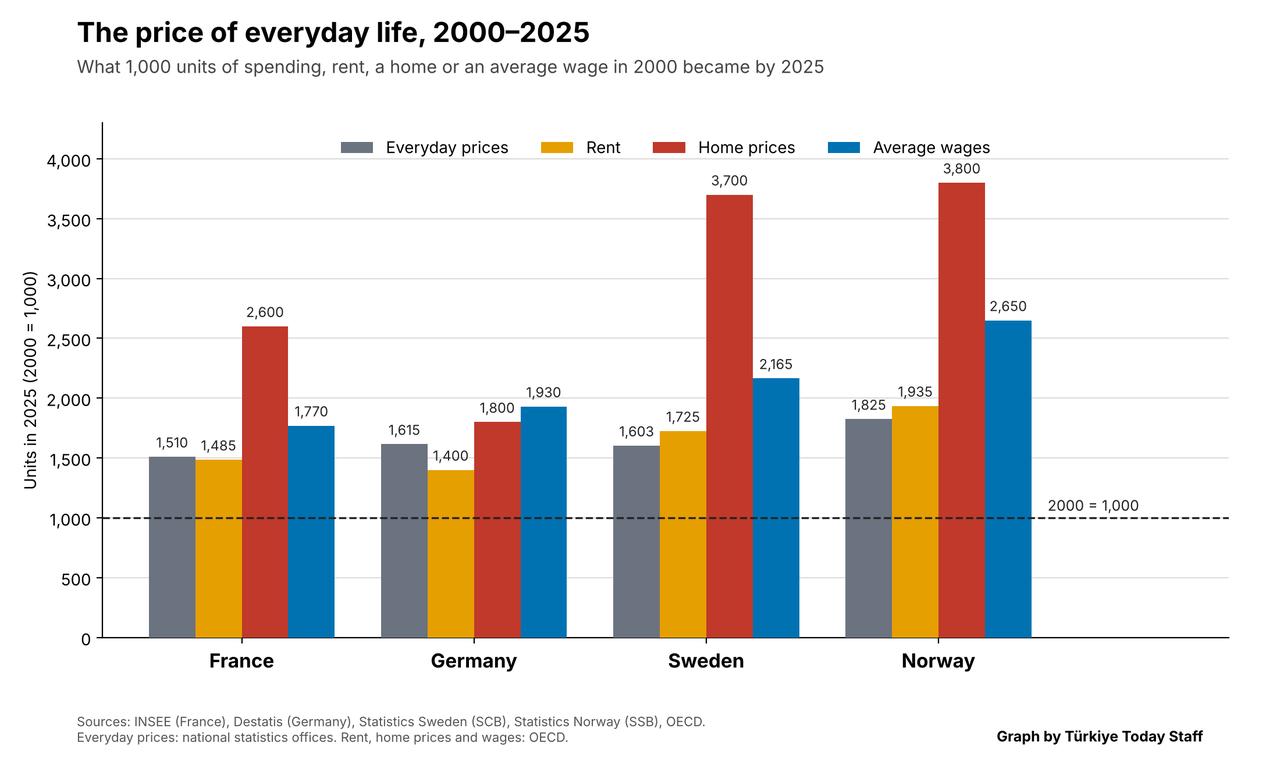
Buying a home became far more expensive than renting one. A home that cost 1,000 units in 2000 would have cost about 2,600 units in France by 2025 and about 1,800 units in Germany.
The increases were much steeper in the Nordic countries: about 3,700 units in Sweden and about 3,800 units in Norway.
Housing was the exception: in France, Sweden and Norway, where home prices rose far faster than wages, while in Germany, they rose slightly more slowly.
Average wages rose faster than everyday prices in all four countries. An average annual wage of 1,000 units in 2000 would have grown to about 1,770 units in France and 1,930 in Germany by 2025 and to about 2,165 in Sweden and 2,650 in Norway.
Set against the price increases described above, this means the average worker’s purchasing power was roughly one-sixth higher in France, nearly one-fifth higher in Germany, one-third higher in Sweden and nearly half higher in Norway.
These are averages across all employees, however, and say little about how earnings are distributed, according to the OECD.
These numbers don’t reflect disparities between the middle and lower classes or other variables like transportation or education.
On the other hand, explaining the protests through only immigration or the economy is an oversimplification. Rather than settling for a single, quick explanation, it is essential to focus on the broader societal shifts.
Trying to understand the true roots of unrest across Europe will ultimately be more productive than relying on quick assumptions.
Ultimately, at the core of this unrest lies a generation dealing with shifting job markets, economic uncertainties, and broader global changes.
Whether the protesters’ demands will be understood and addressed, or whether the unrest will continue to grow, remains to be seen.


 Set as preferred source
 Set as preferred source


 1 min read


 1 min read