Newsletters




Iran's Islamic Revolutionary Guard Corps (IRGC) claimed it launched another round of drone attacks on U.S. military facilities in Kuwait on Friday, while a report suggested the Pentagon is considering reducing its troop presence in the Gulf country.
The IRGC said the strikes marked the 27th phase of its "Saegheh" operation and were launched in retaliation for recent U.S. attacks on Iran and a strike on a residential home on Qeshm Island that killed three members of a family, including a child.
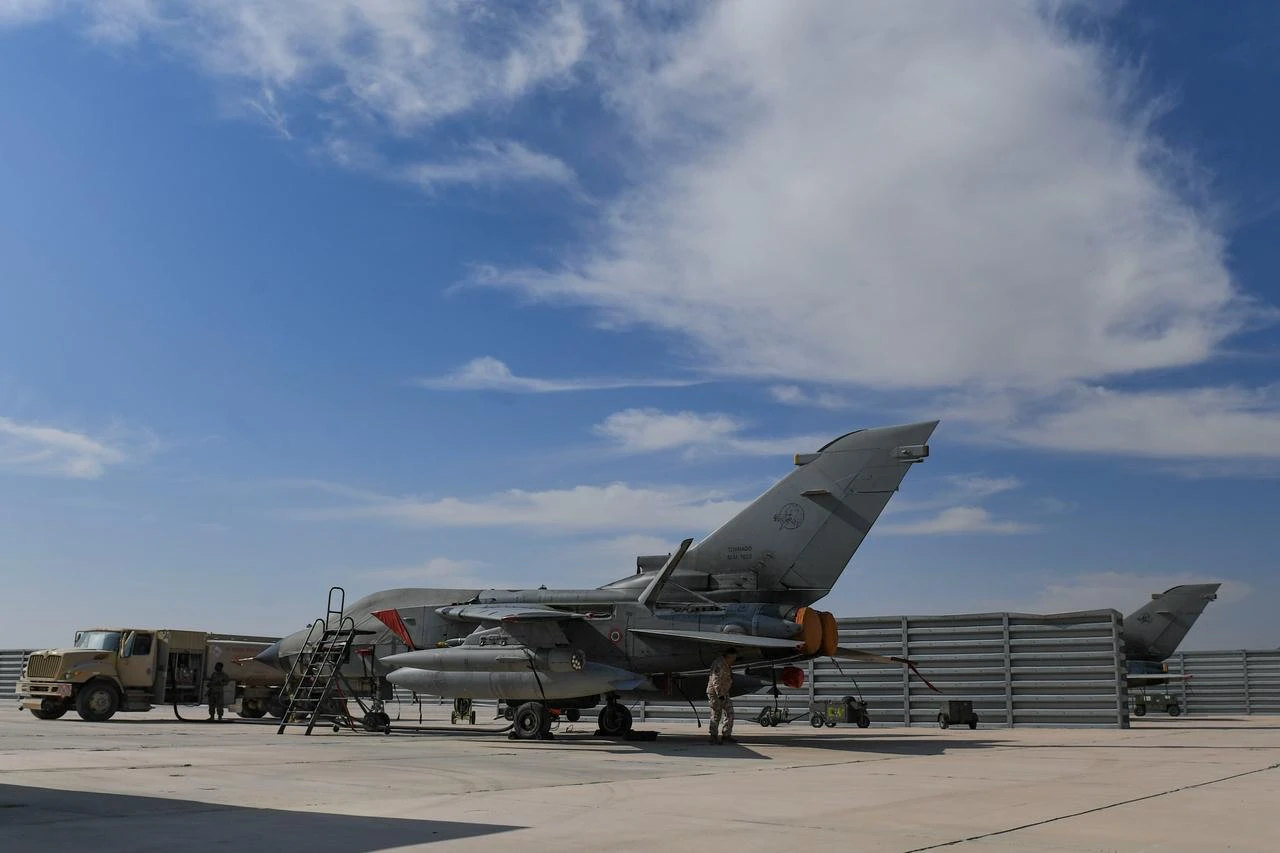
According to the statement, drones targeted aircraft shelters, satellite communication systems and equipment storage facilities at Ahmad al-Jaber Air Base in Kuwait.
The IRGC described the base as a key hub for U.S. air and surveillance operations, adding that it also serves as a major logistical center for American forces.
The force further claimed that repeated operations by the IRGC and the Iranian army have made intercepting Iranian drones and missiles increasingly difficult despite advanced air defense systems.
"The enemy is therefore forced to impose strict censorship to prevent news of the damage, fatalities and injuries from being published," the IRGC claimed.
Earlier, Iranian Parliament Speaker Mohammad Bagher Ghalibaf condemned the strike on Qeshm Island, describing it as a continuation of attacks in Minab and Lamerd that Tehran also claims targeted civilians.
"Americans have become accustomed to making up for the blows they suffer on the battlefield by shedding the blood of innocent people," Ghalibaf said. "They will pay the price."
Meanwhile, The Wall Street Journal reported that Washington is reviewing its military footprint in Kuwait as the conflict with Iran continues, adding that Kuwaiti officials still regard a strong U.S. security commitment as essential.
Kuwait hosts about 13,500 U.S. troops, primarily at Camp Arifjan and Ali Al Salem Air Base, making it one of Washington's largest overseas military deployments.
The country also hosts the forward headquarters of U.S. Army Central (USARCENT) and the Combined Joint Task Force–Operation Inherent Resolve, which supports operations in Iraq and Syria.
Citing current and former U.S. officials, the newspaper said the Pentagon had been weighing troop reductions even before the war began. It added that the U.S. has already scaled back its presence in Kuwait following Iranian missile and drone attacks on American bases to reduce the risk to personnel.
The report also said Kuwaiti officials, like other Gulf leaders, were frustrated that President Donald Trump launched the war without consulting them, leaving their countries vulnerable to retaliation. Those concerns have deepened as the conflict has dragged on and oil exports have remained blocked.


 Set as preferred source
 Set as preferred source


 1 min read
 1 min read