Sign in
 Newsletters


Iranian Foreign Minister Abbas Araghchi stated that a land blockade of Iran is "almost impossible," arguing that the country's size and its border provinces' ties with neighbors can reopen what the United States seeks to close, as Washington sanctioned an alleged Iranian "shadow banking" network including a company in Türkiye.
"A land blockade of Iran is almost impossible, both because of the country's vastness and because of the many provinces, each with diverse capacities, extensive links with neighboring provinces in neighboring countries, heavy traffic, people-to-people ties and historical and cultural roots on both sides of the border," Araghchi said Monday after a seminar of the Foreign Ministry's provincial office heads.
"There are capacities in the country's provinces, especially border provinces, that can open what the enemy wants to close to us," he said.
"The duty of the entire country and the people is to make the enemies lose hope in sanctions. The best way to counter these pressures is to make those imposing sanctions lose hope of achieving their goals, so they know this tool is ineffective and will remain so," the Iranian top diplomat noted.
That does not mean abandoning the Foreign Ministry's other duty of "opening diplomatic paths for negotiations and lifting sanctions," which continues, he added.
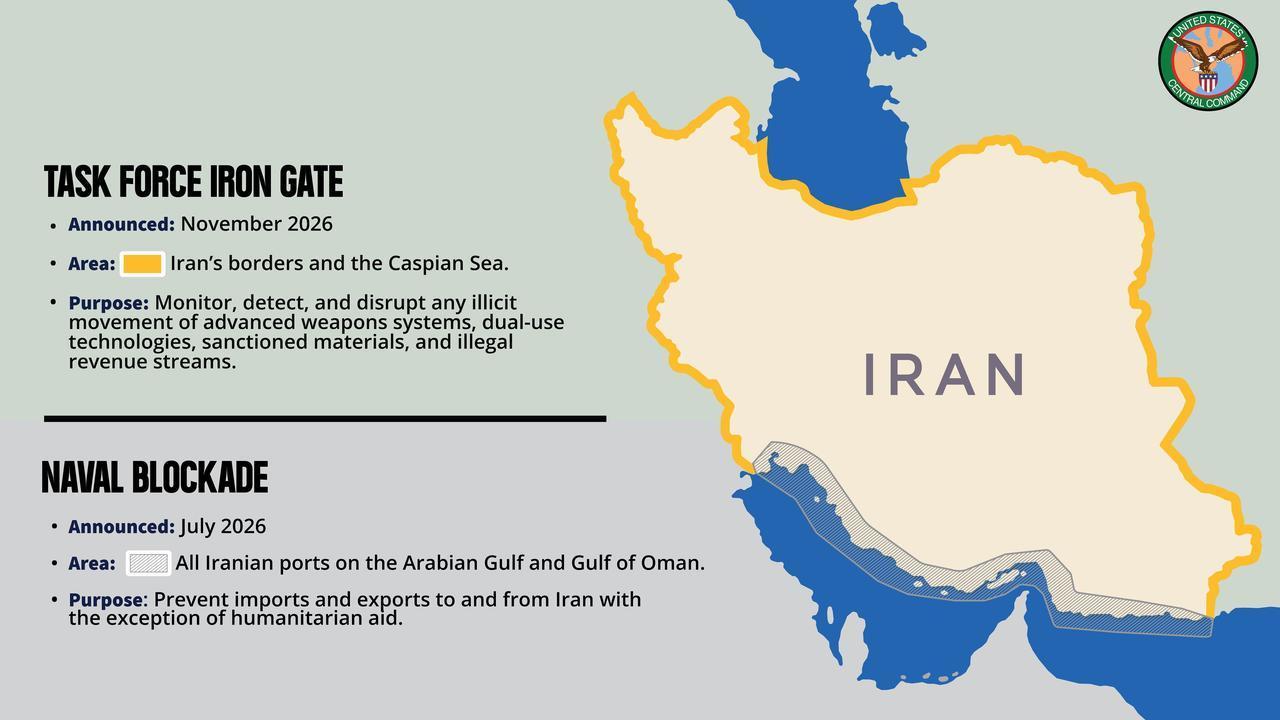
U.S. Central Command (CENTCOM) set up Task Force Iron Gate on Nov. 7 to disrupt Iranian weapons, dual-use technology, sanctioned materials and illicit revenue moving across Iran's land borders and the Caspian Sea, with a CENTCOM graphic highlighting Iran's borders with Iraq, Türkiye, Armenia, Azerbaijan, Pakistan, Afghanistan and Turkmenistan.
The team of about 20 personnel is based in Tampa, Florida.

The U.S. Treasury on Monday sanctioned more than two dozen Iranian exchange houses, alleged front companies and individuals it said form part of Iran's "shadow banking" network, including at least eight companies based in Dubai, one in Türkiye and one in Hong Kong.
The network, which Treasury said is overseen by Iran's central bank, works through Iran-based foreign exchange houses and so-called "rahbar" companies that manage sanctions evasion for clients.
Treasury's Financial Crimes Enforcement Network (FinCEN) identified about $14.7 billion in activity potentially linked to Iranian shadow banking from January 2025 to August 2026.
The most common flagged routes were from mainland China-based banks to UAE-based banks (about $2.6 billion), Singapore to the UAE (about $981 million) and the U.K. to the UAE (about $922 million), according to FinCEN.
"Financial institutions are often the first line of defense in denying Iranian regime-linked funds access to the U.S. economy," Treasury Secretary Scott Bessent said.
"Treasury will continue to sever the financial lifelines on which the regime relies to fund its military, weapons programs, and terror proxies," he added.


 Set as preferred source
 Set as preferred source


 1 min read


 1 min read