Newsletters


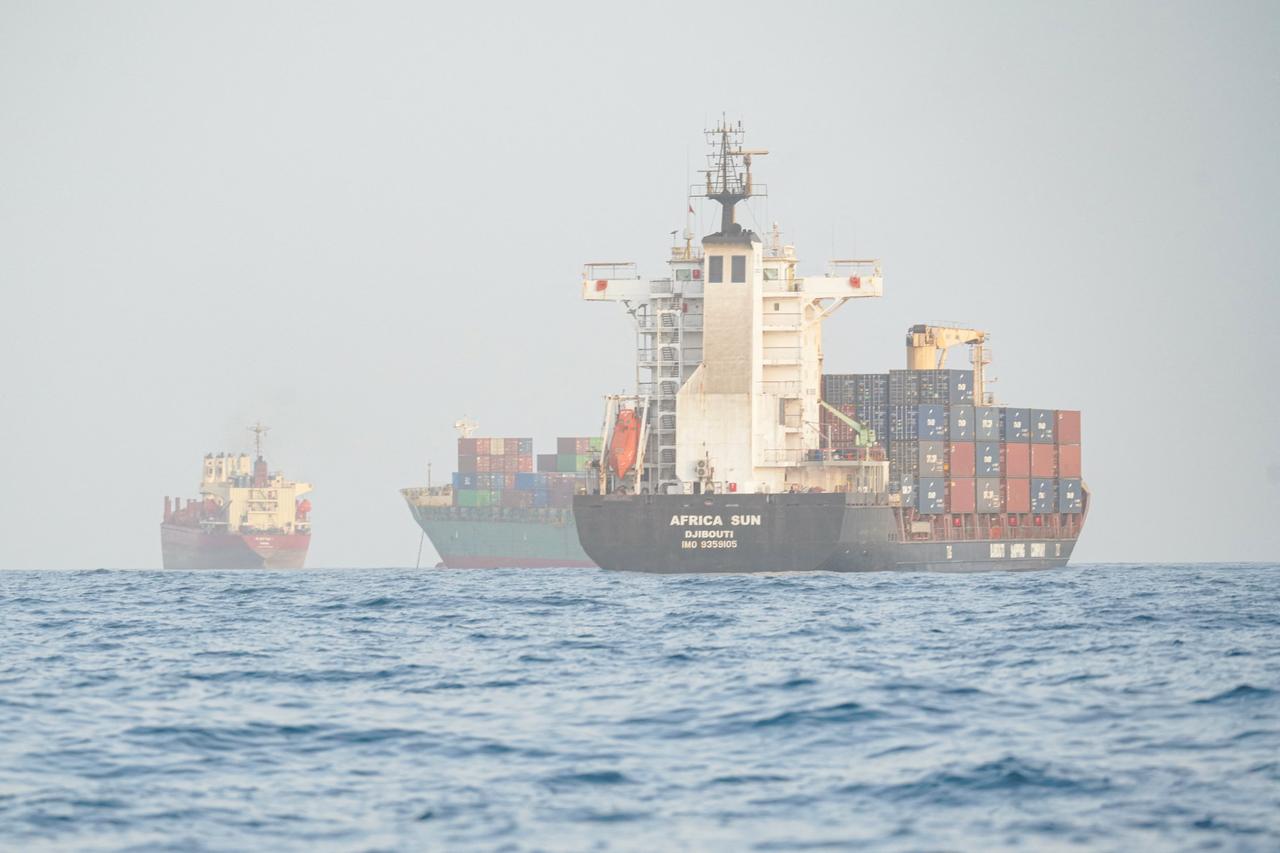


A senior Houthi official said Friday that there is "no cause for international concern" over free navigation through the Bab el-Mandeb Strait, seeking to allay fears for global shipping after fighters from the Iran-backed group completed the takeover of the strategic waterway.
"Freedom of navigation and international trade in the Red Sea and Bab el-Mandeb are safe and orderly," Houthi politburo member Hazem al-Assad told the Al-Araby al-Jadeed news outlet.
"There is no cause for international concern, as they face no danger from the Yemeni side," he said, adding that current actions are "targeted" and "defensive" in nature, and that there is no intention to impose transit fees in the Bab el-Mandeb after gaining control of it.
Yemen's Houthis seized Mayyun Island, also known as Perim, on Friday, completing their takeover of the Bab el-Mandeb area, a local government official and eyewitnesses told Agence France-Presse (AFP).
"Boats carrying armed Houthi fighters reached Mayyun Island after government forces withdrew from it yesterday," the official said, adding: "The Houthis have completed their takeover of the Bab el-Mandeb area and Mayyun Island, which is located in the middle of the strait."
An eyewitness said gunmen were "deploying along the Bab el-Mandeb shore and are driving around in military vehicles."
A Yemeni government military source separately told Türkiye's state-run Anadolu Agency (AA) that Houthi fighters had also seized the city of Dhubab in western Taiz province the same day, prompting government forces to withdraw to Lahij province.
Reuters reported that four Yemeni government sources confirmed the Houthis had reached Perim, with two sources saying government forces had withdrawn from the island.
The government official told AFP the number of fighters on Mayyun is "not large," suggesting they would likely deploy on hills overlooking the strait.
The waterway includes four strategic islands, Zuqar, seized by the Houthis on Thursday, Mayyun, and the two Hanish islands, with government sources telling AFP that more than 2,000 government troops remain besieged on the Hanish islands and have appealed for "rescue, food and water, and the lifting of the siege, which would require air support."


Saudi Arabia has responded to the Houthi offensive with dozens of airstrikes, including two that hit Mocha airport on Friday, according to Houthi media.
Houthi military spokesman Yahya Saree claimed in a statement that Saudi Arabia had launched 64 strikes on Yemen over the preceding 24 hours.
Yemeni government forces said they would deploy weapons and aircraft to eliminate Houthi movement in strategic areas, including the road leading to Mocha, with military spokesman Col. Majed al-Nazili calling on civilians to avoid the route between Taiz and Mocha.
Fighting since last week has left more than 500 people dead, mostly combatants, according to an AFP tally compiled from several sources, and has displaced nearly 20,000 people, according to the International Organization for Migration.
Farea Al-Muslimi, a research fellow at Chatham House, said Saudi Arabia had "tried everything they can to avoid this war" but no longer has a choice, arguing the Houthis have "pushed it to the limit."
A 46-year-old Yemeni who fled Mocha described an "apocalyptic" atmosphere in the port city, while another resident who fled to Aden said some families fell victim to "looting by gangs as they tried to flee."

Reuters reported that the Houthi advance down Yemen's Red Sea coast this week came with direct guidance from Iran's Islamic Revolutionary Guards Corps (IRGC), seeking to open a new front in Tehran's war with the U.S., according to Yemeni government, Iranian and regional sources.
Two Iranian sources told Reuters that Iran told the Houthis last week to escalate attacks on Saudi Arabia and promised additional funding, weapons and senior officers to assist.
Iran publicly denies directing the Houthis militarily, describing them as an ally rather than a proxy.
Satellite imagery cited by Reuters showed smoke near Saudi Arabia's East-West oil pipeline, a critical asset Aramco has used to divert crude exports from the Strait of Hormuz to the Red Sea since the wider Iran war began.
The International Energy Agency said Friday that Saudi crude supply fell 2.3 million barrels per day in August to 6 million bpd, the lowest level in more than three decades, partly due to Houthi-linked attacks on vessels transiting Bab el-Mandeb.
Global oil prices were on track to close the week above $100 a barrel for the first time since mid-May, though prices eased Friday slightly after the Financial Times (FT) reported that Middle East foreign ministers were working on a temporary deal to manage shipping through the Strait of Hormuz.
Gulf foreign ministers are expected to meet their Iranian counterpart Monday in Salalah, Oman, in a push by Oman and Iran to secure support for the arrangement, according to the FT.
"The "East-West" line; and every liter of Saudi oil, in the north of the kingdom and its south and east and west and center, may enter the kill box, should the Saudi enemy regime dare, and our leadership and armed forces decide so, with the aid of Almighty Allah," Houthi politburo member Hazem al-Assad wrote on X.

United Nations Special Envoy for Yemen Hans Grundberg called Thursday for "the active investment of every member of this body to contain what could be the precipice for a far more dangerous conflict" at an emergency U.N. Security Council meeting convened by the United Kingdom, which urged the Houthis to "de-escalate, cease their attacks, and return to a path towards peace."
Belgian Foreign Minister Maxime Prevot called the Houthi attacks a "dangerous escalation," saying Iran could not call for de-escalation while enabling forces that threaten one of the world's most vital shipping routes.
Germany's Foreign Ministry said it was "closely monitoring" developments, warning that expanded Houthi control over the Red Sea route would "naturally lead to further restrictions on oil and LNG shipments" with negative effects on global supply.
Iran's First Vice President Mohammad Reza Aref welcomed what he called the "victories of the heroic nation of Yemen," calling on regional leaders to pursue "rationality" and unity "around the flag of Islam."
Yemen relapsed into war in July after years of relative calm, when the Houthis allowed an Iranian plane to land in defiance of Saudi control of Yemeni airspace.
The Saudi-backed government retaliated by striking Sanaa airport.
The Houthis, who have controlled large parts of northern Yemen, including the capital, Sanaa, since 2014, fought a Saudi-led coalition from 2015 until a U.N.-brokered ceasefire in 2022.


 Set as preferred source
 Set as preferred source


 1 min read


 1 min read