Newsletters





The rise of technology reshaped television and changed people's behavior. It is also happening to news sources: people tend more to get news online than from classical media broadcasters like television or newspapers, and for the first time, they now prefer to use social media and video platforms (54%) rather than news organizations’ own websites and apps (51%).
According to the Digital News Report 2026 prepared by the Reuters Institute for the Study of Journalism, social media and video platforms are taking the place of traditional media as the primary way people get news.
Research was conducted by YouGov using an online questionnaire from the middle of January to the end of February 2026.
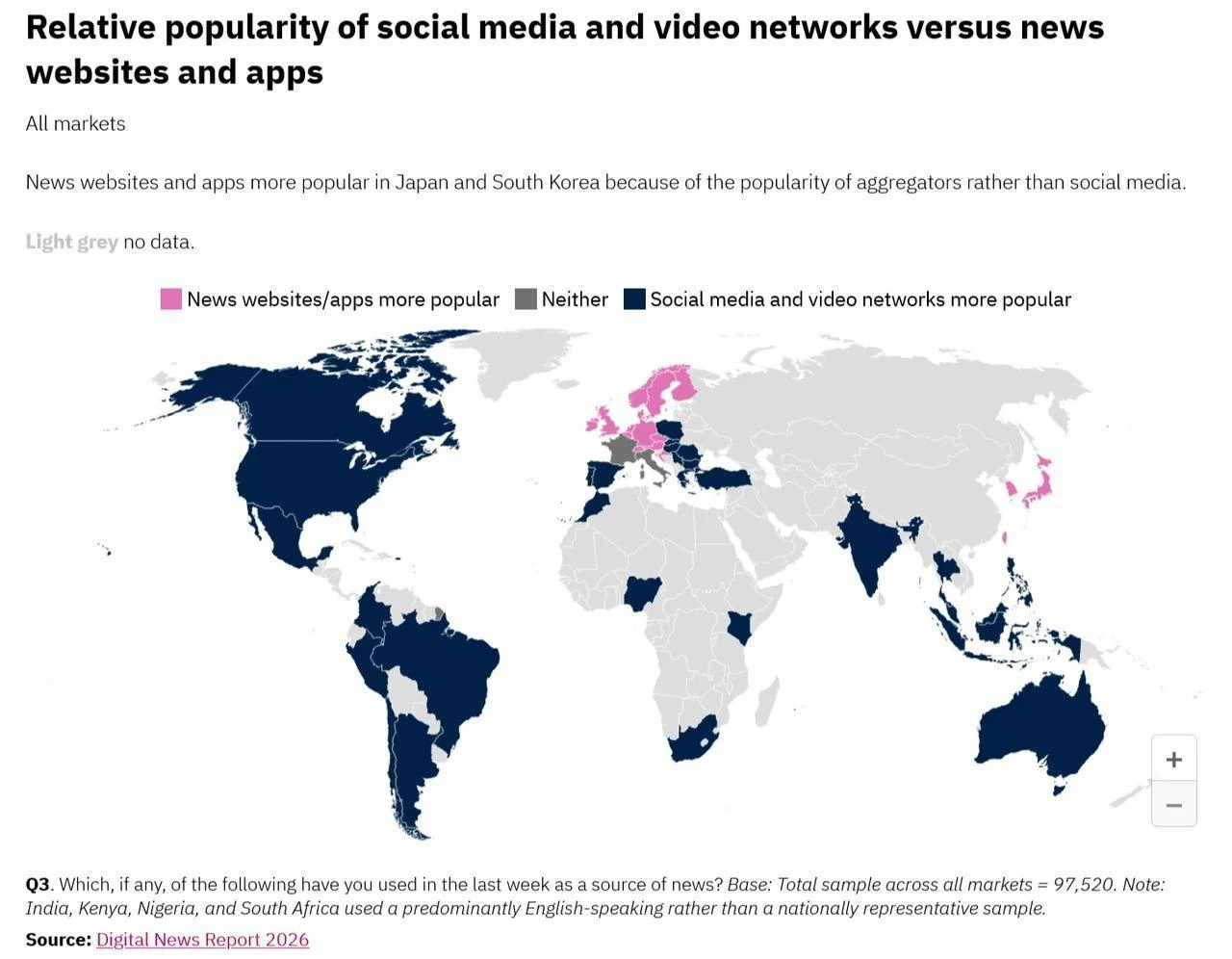

Globally, the use of social media and video-sharing platforms has increased and is driven in part by easier mobile access. As the social media and video networks take the lead in news consumption, the use of both TV news and news organizations’ websites and apps has fallen by 13 and 12 percentage points, respectively, since 2020.
Globally, 30% of people now say social media and video networks are their main source of news—it was 22% five years ago. In 30 of 48 markets, social media and video networks are more popular as a news source than owned and operated online news websites and apps.
Gen Z leads the trend (52%), but so do the age groups of 25-34 and 35-44, following social media, video networks, and AI as the main source of news, at 44% and 36%, respectively. Television is the main source for 47% of those aged 55 and above.
Alongside this, 56% of Gen Z globally say they have never regularly read a newspaper, reflecting a broader shift toward digital tools for news consumption. Social media leads as the main gateway: 43% for under-35s and 30% for those over 35.
In the United States and the United Kingdom, the Google App is the most used aggregator, which increases Google's importance in the news landscape.
Google’s and Meta’s policies also change the picture: Meta's statements about increasing the volume of news content on Facebook in 2025 and Google’s “Project Zero” reduce news outlets' visibility online. While a person searches for something on Google, search results used to include website links and news articles, but now Gemini provides direct answers to the users’ questions already, without any direction to any website.
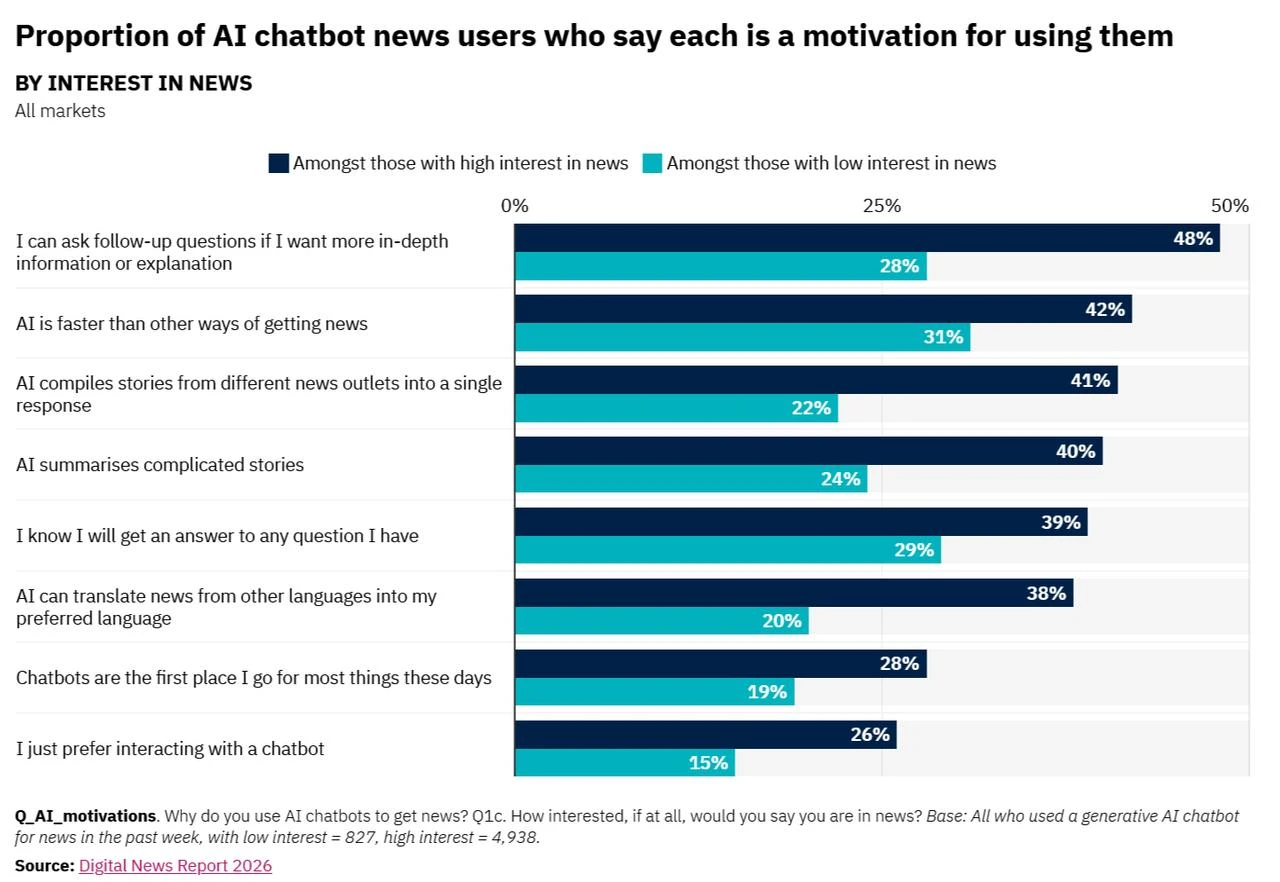
One of the interesting facts that the research highlights is that trust in answers from AI chatbots is 20% globally, while the trust in news overall, at 37%, is relatively high. People use AI chatbots for news because, according to the research, they can be active during the process to reach news and ask follow-up questions.
Social media offers this same kind of engagement. People who are used to constantly interacting on their social media accounts may want that same experience when following the news and turn to apps or platforms that offer it.
Beyond the users who want to get access to news, the global average of interest in news has fallen from 59% to 46% since the height of the pandemic. While news avoidance stood at 29% in 2017, it has risen to 42% on average in 2026. In four countries—Bulgaria, Croatia, Greece and Türkiye—60% or more of the population now say they avoid the news sometimes or often.
The percentage of people globally saying they trust news overall dropped to 37% after three years of steadiness at 40%. According to the report, this is the lowest figure since they started measuring trust in 2015. Trust in news accessed via search engines, social media, and AI answers is lower than the overall trust, at 32%, 22%, and 20%, respectively.
Broader skepticism about political and social institutions, an international trend of falling trust in representatives such as governments and political parties, plays a significant role in this situation.
Following the doubt about political figures/groups, people think media owners, parent companies, and politicians have the most influence on the news.
After presenting global data, the report also examines each country individually. For Türkiye, it first notes that advertising revenues are concentrated among global technology companies and mainstream media outlets. In parallel, after Google’s algorithm updates, independent online outlets’ traffic was reduced by up to 80%.
TV and print were the most commonly used news sources in 2015, at 75% and 50%, respectively. Both have since declined sharply, with TV falling to 53% and print to 15%. Social media and overall online news use also declined, dropping from 67% and 88% in 2015 to 49% and 71% in 2026, respectively. This overall decline may be explained by the news avoidance rate, which is 60%, the second-highest among all countries in the research.
While the understanding of news and sources is changing, Türkiye is following its own way. Traditional sources lost interest but are still resisting, and new tools for accessing news -such as social media, mobile apps, websites, AI bots- are gaining ground.


 Set as preferred source
 Set as preferred source


 1 min read


 1 min read