Newsletters


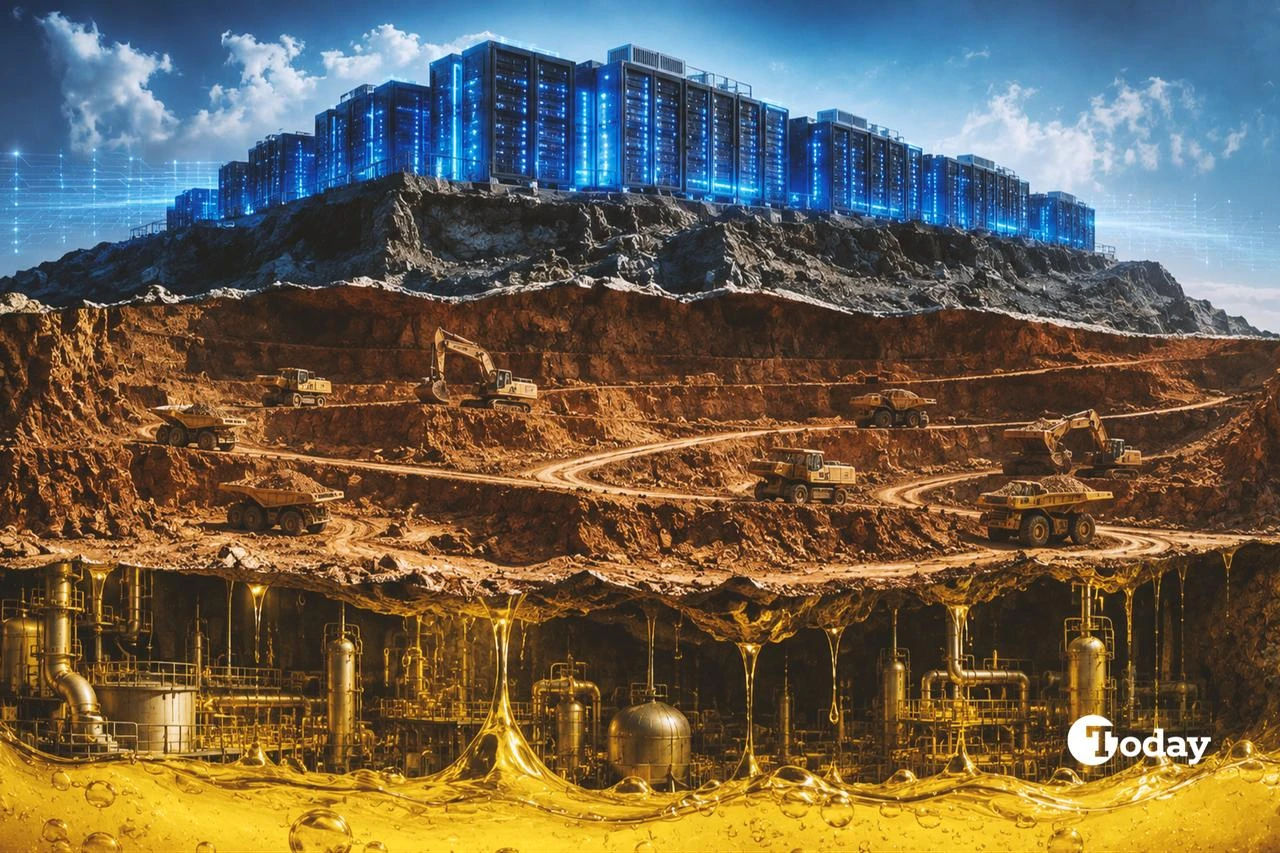


Ergani, in the hills of Elazig province, has been producing copper for roughly 4,000 years, with Assyrian traders working these deposits around 2000 B.C., floating ore down the Euphrates to Uruk.
Etibank mechanized the site in 1939, welding Ottoman-era galleries onto an industrial open pit, and it has been mined more or less continuously since—one of the longer unbroken production runs of any metal deposit on the planet.
The mine's output now sits inside the same global system as a chemical plant thousands of kilometers away in Jiangxi and a data center thousands of kilometers in the opposite direction—a linkage that would have meant nothing to the miners of 1939 but means quite a lot now.
The basic formula underpinning the system: artificial intelligence needs electricity, electricity needs copper, and the part of copper production that actually turns ore into usable metal needs sulphuric acid. None of those three facts is new. What's new is how fast the first is growing and how little attention anyone has paid to the third.
Start with growth. Gartner expects global data-center power demand to rise by roughly a quarter this year alone, from about 104 gigawatts to 132, on its way to roughly 290 gigawatts by 2030.
Trafigura puts the additional copper demand from AI and data centers specifically at around a million tonnes by decade's end—not the largest driver of copper demand (plain old electrification and grid build-out still dwarf it) but the fastest-accelerating one, landing on top of a system that was already tight before anyone had heard of a GPU cluster.
Copper itself is not the constraint. Adam Simon, professor of earth and environmental sciences at the University of Michigan, puts the mineable copper resource at currently accessible depths at 6,598 million tonnes—enough, on his numbers, to support demand growing from roughly 20.4 million tonnes in 2018 to somewhere between 37 million and 91 million tonnes a year by 2050, depending on how aggressively the world electrifies.
"There is plenty of copper available to mine," he says, in the tone of someone repeating an answer he's given many times to people who wanted a more dramatic answer. The rock is not the problem.
Getting a mine permitted, financed, and producing takes on the order of 18 years, largely unchanged by whatever the demand curve is doing above ground—a timeline no funding round or ministerial urgency shortens.
The next layer down moves faster but in the wrong direction. China built roughly half the world's copper smelting capacity over the past two decades, and that capacity now exceeds what the world's mines can feed it.
Treatment charges—the fee a smelter is supposed to collect from a mine for turning ore into metal—have collapsed toward zero and, in places, gone negative, meaning a smelter now effectively pays to keep the ore flowing rather than the other way around.
"This is smelting economics turned on its head," says Tom Moerenhout of Columbia's Center on Global Energy Policy, who argues that years of Western attention on mine ownership missed the layer where China had already won.
The fastest clock belongs to the smallest, least glamorous input of the three. Sulphuric acid is what turns low-grade oxide ore into copper cathode in leaching and electrowinning operations, and in China—the acid's largest exporter—it is a byproduct of copper and zinc smelting, not a thing anyone can simply decide to make more of.
Through the first four months of 2026, Beijing had already cut its export quota to 700,000 tonnes, down from 1.3 million over the same period a year earlier. On May 1, it stopped exporting the ordinary industrial grade entirely, ending a year in which China had still shipped out 4.7 million tonnes.
Fiona Boyd, U.S. director at Acuity Commodities, reads the price surge as governments hoarding a strategic material as much as any straightforward shortage.
Both acid and the sulphur used to make it, she notes, are largely inelastic on the supply side—produced as byproducts of industries with their own separate logic: oil and gas refining in sulphur's case, and copper and zinc smelting in acid's. Nobody can order a smelter to make more of its own exhaust, and the exhaust just became the thing everyone needs.
Ankara is not a bystander in this particular chokepoint. Since the Iran war closed Hormuz in late February, cutting off Middle Eastern sulphur, Türkiye has joined Russia and the Democratic Republic of Congo among the countries tightening their own sulphur exports rather than absorbing the shock for everyone else—one more valve closing on a system that had very few of them open to begin with.
A country that mined copper at Ergani before Uruk existed is, in 2026, a net copper importer too—exposed on the reagent side and the metal side of the same bottleneck.
None of this was really a secret. Sulphuric acid has quietly priced fertilizer, silver, nickel and copper for a century without anyone outside a handful of trading desks paying attention to it, for the same reason nobody remembers the tin caravans behind a Bronze Age sword: the metal in your hand is always more interesting than the unglamorous input that let someone make it.
Benjamin Roberts, associate professor of archaeology at Durham University, calls tin the critical mineral of the ancient world—scarce, scattered across Central Asia and Cornwall, and usually thousands of kilometers from the smiths who needed it. Copper, even at Ergani, was never really the hard part. It was always whatever had to travel a long way to turn copper into something anyone could use.
Silicon Valley can still build a chatbot in 18 months. It cannot open a mine in less than 18 years, and as of this May, it cannot make China export a chemical it has decided to keep.
The rock was never the bottleneck. It's the layer beneath it—the one with no press office, no ticker, and now, one fewer export license.


 Set as preferred source
 Set as preferred source



 4 min read