Newsletters


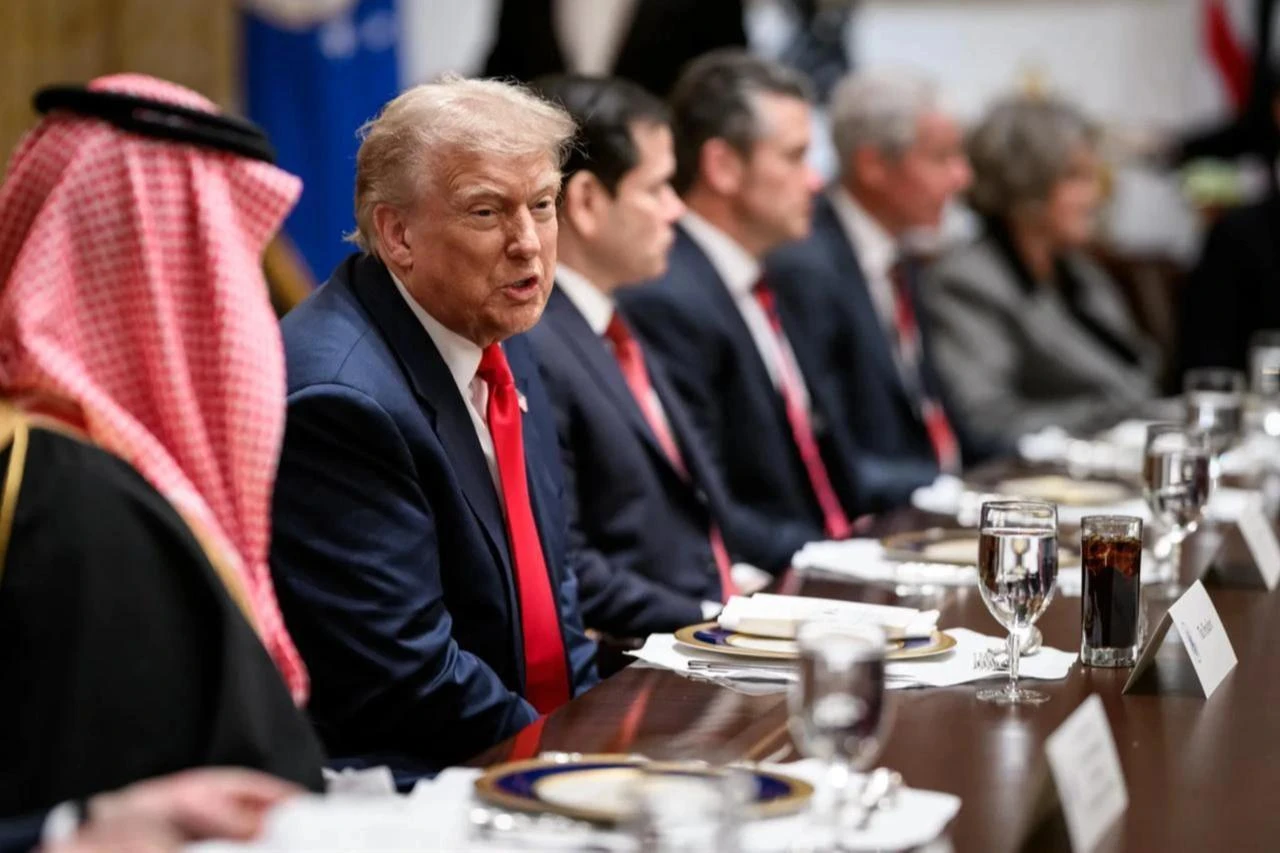


The White House said Wednesday that a landmark civilian nuclear cooperation agreement with Saudi Arabia is contingent on the kingdom joining the Abraham Accords, the normalization framework President Donald Trump brokered during his first term, adding a significant diplomatic condition to a deal already drawing scrutiny over nuclear proliferation concerns.
Press secretary Karoline Leavitt told reporters the two issues are directly linked, saying Trump "wants to see these countries sign the Abraham Accords" and describing the accords as "one of the most historic accomplishments of his first term."
She said the president's long-term goal is to "expand those accords to ultimately come to a place where the Middle East can be a peaceful and stable region," adding that the energy deal "is contingent on this condition as far as the president is concerned."
Trump reinforced the message hours earlier in a Truth Social post, writing that the nuclear agreement "is totally subject to Saudi Arabia joining the very respected and successful Abraham Accords."
The nuclear cooperation agreement, formally signed Wednesday by Energy Secretary Chris Wright and Saudi Energy Minister Prince Abdulaziz bin Salman, is structured under Section 123 of the Atomic Energy Act of 1954, a legal framework the United States uses to govern civilian nuclear partnerships with foreign nations.
The Department of Energy described it as a "decades-long, multi-billion-dollar partnership" that would give American companies access to Saudi Arabia's nuclear energy program, boosting exports of U.S. technology and expertise.
The deal's most contentious provision would allow Saudi Arabia to pursue domestic uranium enrichment, contingent on the findings of a joint U.S.-Saudi study into whether such enrichment is commercially warranted.
Under the terms of the agreement, American companies, not Saudi entities, would construct any such facility, and the deal bars Riyadh from independently developing its own enrichment technology. Energy Secretary Wright argued that the agreement "uphold[s] the highest standards of nuclear safety and nonproliferation," while Secretary of State Marco Rubio said the U.S. "is not going to reach any agreement with any country in the world that leads to the risk of proliferation."
Critics have nonetheless raised alarms. Democratic lawmakers, including House Foreign Affairs Committee ranking member Rep. Gregory Meeks of New York, voiced "deep concerns" about the accord's regional implications.
The deal notably does not include the International Atomic Energy Agency's Additional Protocol, which permits more extensive monitoring and inspections, a provision nonproliferation advocates consider a baseline standard.
The agreement now goes to Congress for a mandatory review period, during which lawmakers could jointly disapprove it, though a two-thirds majority would be required to override a presidential veto.
The Abraham Accords, signed in 2020 during Trump's first term, established normalization of relations between Israel and four Arab nations, the United Arab Emirates, Bahrain, Sudan, and Morocco.
Saudi Arabia, the Arab world's largest economy and the birthplace of Islam, has long been considered the most consequential potential signatory, given its religious and political influence across the Muslim world.
A Saudi-Israeli normalization agreement has been a goal of successive U.S. administrations, and under former President Joe Biden, talks toward that end were tied to a broader package, including potential civilian nuclear cooperation. Those negotiations stalled in the wake of the Gaza conflict.
The Trump administration had initially revived nuclear discussions with Riyadh while decoupling the deal from normalization requirements, but Wednesday's statements from both the president and his press secretary indicate that condition has been reintroduced, at least from the White House's perspective.
The signing comes as the United States is conducting military operations against Iran, with a stated objective of preventing Tehran from acquiring nuclear weapons capability.
Critics have questioned the consistency of that posture alongside an agreement that could, however conditionally, provide a second Middle Eastern nation with uranium enrichment technology.
Saudi Arabia has previously stated it would seek a nuclear weapon if Iran were ever to acquire one, a statement that has amplified concerns among arms control advocates about the region's proliferation trajectory.
The deal's legal framework will be reviewed by Congress before it can take full effect, leaving open the question of whether lawmakers will accept the arrangement, and whether Riyadh will agree to Trump's Abraham Accords condition.


 Set as preferred source
 Set as preferred source


 2 min read
 1 min read