Newsletters


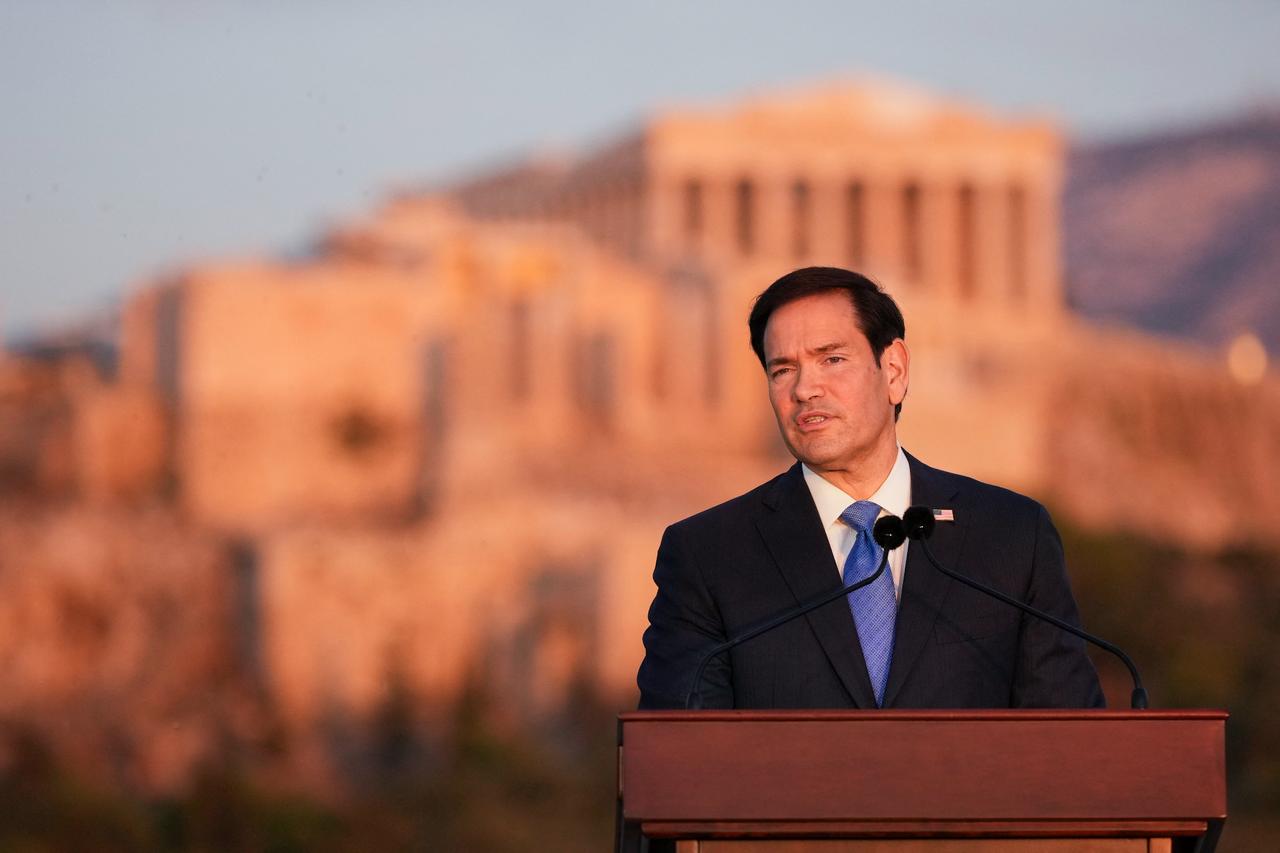


Marco Rubio’s speech in Athens had practically nothing to do with Greece.
Thinking the view of the Acropolis behind him would add gravitas to his words, he made some superficial nods to civilizational history: “Athens gave us democracy, Plato and Aristotle gave us Western philosophy.”
He tipped his hat to the Greek influence on the Founding Fathers, noted that Philadelphia is a Greek name, and pointed out that Greek columns are carved into Washington's architecture.
Beyond that, the core of his speech was connecting ancient thumos, the primal Greek spirit of relentless competition and drive, to modern MAGA ideology.
The iconic Parthenon became a high-concept backdrop for 21st-century American populism. Rather than centering on bilateral diplomacy or regional affairs, the Parthenon served as a symbolic setting to frame contemporary nationalist policies, from industrial protectionism and border enforcement to technological competition, as the natural heir to classical antiquity.
At the heart of the Secretary's address was an explicit integration of classical philosophy into contemporary political strategy: the Greek concept of thumos. Classically understood as the spirited drive for honor, courage, and excellence, Rubio defined it as "the fire of passion, strength, courage, [and] pride" that propels nations forward. He used this concept to frame a broader critique of contemporary Western governance.
In Rubio’s diagnosis, post-war internationalism has fostered a risk-averse political culture focused on a "world of perfect safety." He argued that modern institutions too often hold exceptional achievement "hostage to the average, the ordinary, the mediocre," prioritizing risk mitigation over national ambition.
The key conceptual move in the speech was tying this classical mandate directly to the administration’s domestic and foreign policy goals. Reclaiming thumos, in Rubio's framework, requires tangible shifts in national power: re-industrializing the domestic manufacturing base, securing critical supply chains, establishing dominance in artificial intelligence and microchips, and projecting power into new frontiers like space defense. Through this lens, economic nationalism and technological sovereignty are presented not merely as political platform points, but as essential tools for preserving Western vitality.

The Secretary’s address also constructed a historical lineage to illustrate his thesis. Rather than confining the Western inheritance to democratic governance or classical philosophy, Rubio assembled an expansive pantheon of figures spanning millennia, linking mythic heroes, scientists, conquerors, and explorers into a singular narrative of civilizational ambition.
The speech drew on classical archetypes of sacrifice and struggle, invoking Socrates refusing to abandon truth, the 300 Spartans at Thermopylae, and Achilles choosing mortal glory at Troy over a quiet life. But the narrative did not stop with ancient Greece.
It traced an unbroken line through European Christendom and the Scientific Revolution, linking Michelangelo, Copernicus, Galileo, and Newton to global exploration and conquest.
The Secretary grouped the conquests of Alexander the Great alongside Julius Caesar, Charlemagne, and Hernan Cortes, extending that lineage to Christopher Columbus, the American frontier, and Apollo 11.
He then tied this legacy of expansion directly to his political identity. Framing his ancestry around early colonization rather than modern immigration, he defended his MAGA stance, despite his parents and relatives being non-citizens when he was born: "As the great-grandson of settlers who arrived in the New World from Spain, I stand here to testify," he declared.
By placing Spanish conquistadors and imperial rulers alongside Athenian philosophers and NASA astronauts, the address defines "the West" with historical figureheads of raw power and expansion being retrofitted into a unified tradition of Western exceptionalism.
Presenting a critique of the post-Cold War multilateral order, the Secretary’s address then turned its focus to rejecting the notion that "enlightened foreign policy means prioritizing the global community over one's own people".
In Rubio's analysis, decades of globalist integration have eroded democratic self-governance. He argued that Western nations have progressively outsourced their sovereignty to "global bureaucracies far beyond the reach of our control", mistaking international consensus for security. Pointing to the return of great power competition, territorial conflict, and energy vulnerability, he asserted that "national interest did not vanish in the face of international institutions".
Ironically, territorial conflicts and great power competition intertwined with ideological appeals to antiquity were the defining features of the last two world wars, both of which took place less than a century ago.
Rather than advocating total isolationism, the speech outlined a transactional, state-centric vision for international alliances. In Rubio’s framework, alliances like NATO or bilateral pacts exist solely to bolster and defend the sovereignty of member states, not to diminish it.
He pointed to recent defense commitments in Greece and a tripartite U.S.-Denmark-Greenland Arctic agreement as examples of a "win-win" security model built on national self-interest. By invoking the ancient Greek city-states, Rubio reframed national self-preservation, military deterrence, and border enforcement not as departures from Western values, but as the foundational practices of classical statecraft.
Finding the right stage to talk about civilization, underpinning the Secretary’s address was a framing of contemporary Western societies as experiencing an existential crisis of confidence. In Rubio’s diagnosis, the primary threat to the West is not merely external geopolitical adversaries, but an internal erosion of cultural and civilizational conviction.
The speech argued that post-war prosperity led to a spirit of self-loathing, where Western democracies became "embarrassed" by their own historical achievements. In his view, a society that apologizes for its past inevitably forfeits its capacity to secure its future.
By presenting current debates over immigration, industrial policy, and national identity through this civilizational lens, the address presented an urgent ultimatum: Western nations must either reclaim an unapologetic sense of national purpose or accept a trajectory of gradual atrophy and geopolitical subordination.
Instead, the Secretary presented a vision of the West defined by raw ambition, national strength, and competitive drive. Whether this synthesis of classical antiquity and 21st-century populism resonates with transatlantic partners remains an open question, but Marco Rubio came close to Europe for them to hear.
What made the address unambiguous, however, is Washington’s intent to redefine the narrative of Western leadership for the era of great power competition.


 Set as preferred source
 Set as preferred source


 1 min read

 1 min read