Newsletters




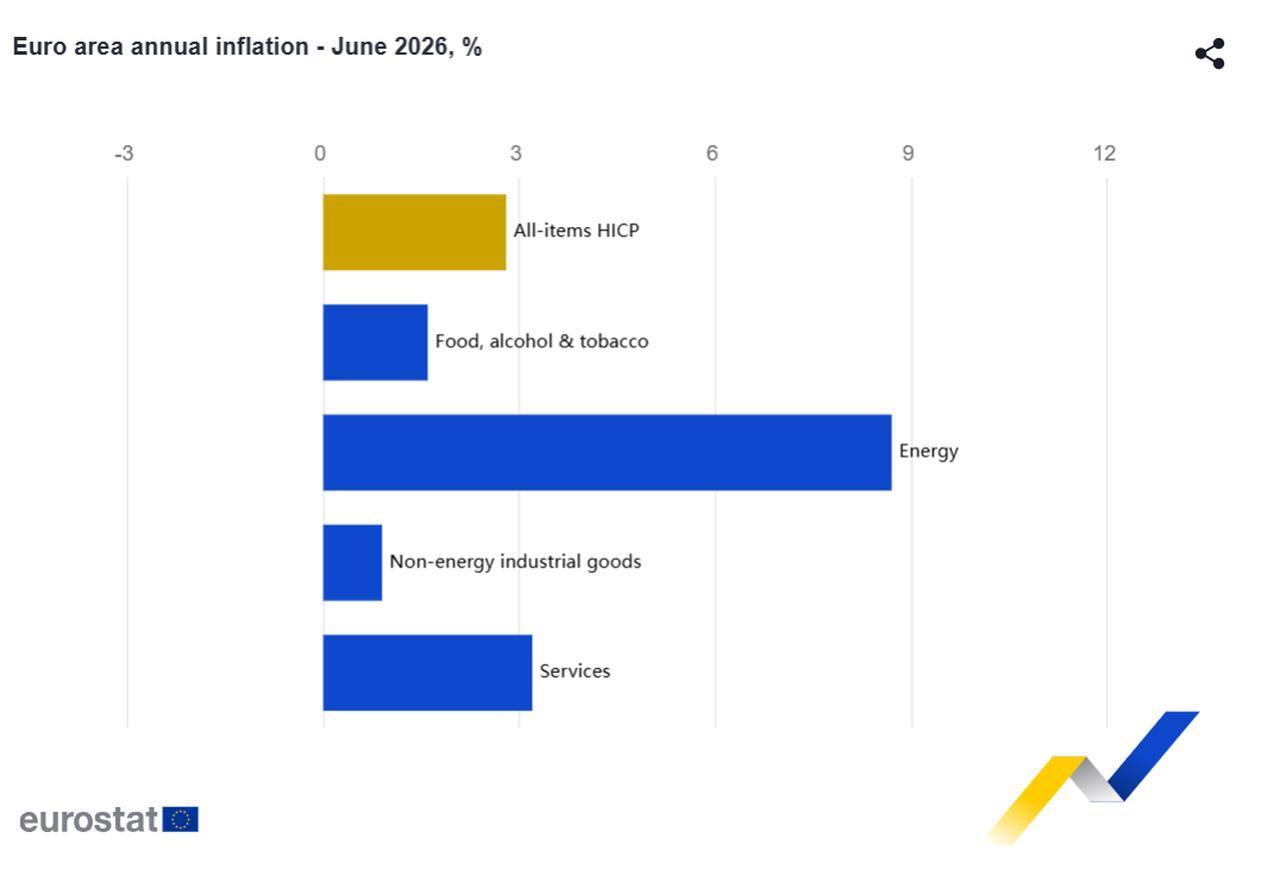
Eurozone inflation slowed more than expected in June, with annual consumer price growth easing to 2.8% from 3.2% in May, while consumer prices fell 0.1% month-on-month, Eurostat reported on Wednesday.
The figures showed energy remained the largest contributor to inflation, although annual energy price growth slowed to 8.7% in June from 10.8% a month earlier, as lower oil prices following the U.S.-Iran deal helped cool overall inflation across the currency bloc.
Services inflation, a closely watched measure for the European Central Bank (ECB), eased to 3.2% from 3.5% in May. Inflation for food, alcohol and tobacco also slowed to 1.6% from 1.9%, while non-energy industrial goods inflation held steady at 0.9%.
Core inflation, which excludes energy, food, alcohol and tobacco, eased to 2.4% in June from 2.6% in the previous month.
The figures come as the ECB gauges whether its recent monetary tightening has been enough to curb inflation after the earlier surge in oil and natural gas prices linked to tensions in the Middle East.
Financial markets continue to expect one additional 25-basis-point interest rate hike before the end of the year, which would lift the ECB's deposit rate to 2.5%, although expectations for further tightening have eased as energy markets cooled.

Among the eurozone's four largest economies, Germany's annual inflation slowed to 2.4% from 2.7%, while France's rate dropped to 2% from 2.8%, returning to the ECB's target.
Italy's inflation edged down to 3.1% from 3.2%, while Spain's annual rate held steady at 3.6%. Lithuania posted the highest annual inflation rate among countries with available data at 5.5%, followed by Bulgaria at 5.3%, Croatia at 4.2%, Cyprus at 4% and Greece at 3.9%.
The lowest annual inflation rates were recorded in Malta at 1.9%, followed by France and Estonia at 2%, Germany at 2.4% and Finland at 2.7%.
On a monthly basis, Malta recorded the strongest increase in consumer prices at 1%, followed by Cyprus at 0.8%, while Spain and Lithuania each posted a 0.6% rise.
Belgium, Bulgaria, Estonia and Luxembourg registered the sharpest monthly declines, with prices falling 0.4%. France, Austria and Finland each recorded monthly decreases of 0.3%.


 Set as preferred source
 Set as preferred source


 1 min read
 1 min read