Newsletters





A broad market sell-off intensified on Wall Street on Friday as disappointing technology earnings reignited concerns about the returns on massive artificial intelligence investments, while surging energy prices added to inflation worries and sent precious metals lower.
The Nasdaq Composite, which is heavily weighted toward technology companies, plunged 3.3% to 25,309.31 as of 6:10 p.m. GMT. The Dow Jones Industrial Average fell 1.1% to 51,763.76, while the S&P 500 dropped 2.1% to 7,558.41.
The latest losses came as investors grew increasingly wary of the enormous sums technology companies are pouring into AI infrastructure, including data centers and computing capacity, without clear evidence that the spending will generate sufficient returns.
Disappointing forecasts and mounting AI-related costs sent technology stocks tumbling, as investors questioned whether the sector's heavy spending would deliver sufficient returns.
Intel shares plunged nearly 29% on Friday after the chipmaker warned it would burn cash this year, while Amazon came under pressure as investors weighed its earnings against its aggressive AI investment plans. Together, the two companies stood to lose around $200 billion in market value.
The declines followed Alphabet's record sell-off on Thursday, when the Google parent lost nearly $500 billion in market capitalization after its shares slumped about 13%, marking the second-largest single-day market-value loss in stock market history.
The broader rout put the Nasdaq-100 on track to shed just over $1 trillion in market value on Friday, with losses for October expected to exceed $2 trillion as investors reassessed the returns on massive AI investments.
Higher borrowing costs also threaten to make data centers, chips, and other capital-intensive AI projects more expensive to finance, increasing pressure on technology companies to show that their spending can translate into stronger earnings and cash flow.


European equity markets also ended Friday mostly in negative territory as pan-European The Stoxx Europe 600 fell 0.4% to 646.75 points. Germany's DAX 40 lost 0.9% to 25,818.21, while Italy's FTSE MIB 30 declined 1% to 49,500.97.
France's CAC 40 was mostly flat at 7,969.42, while the U.K.'s FTSE 100 rose 0.1% to 10,729.78. Türkiye's benchmark BIST 100 index fell 3.64% to close at 10,759.56 points.
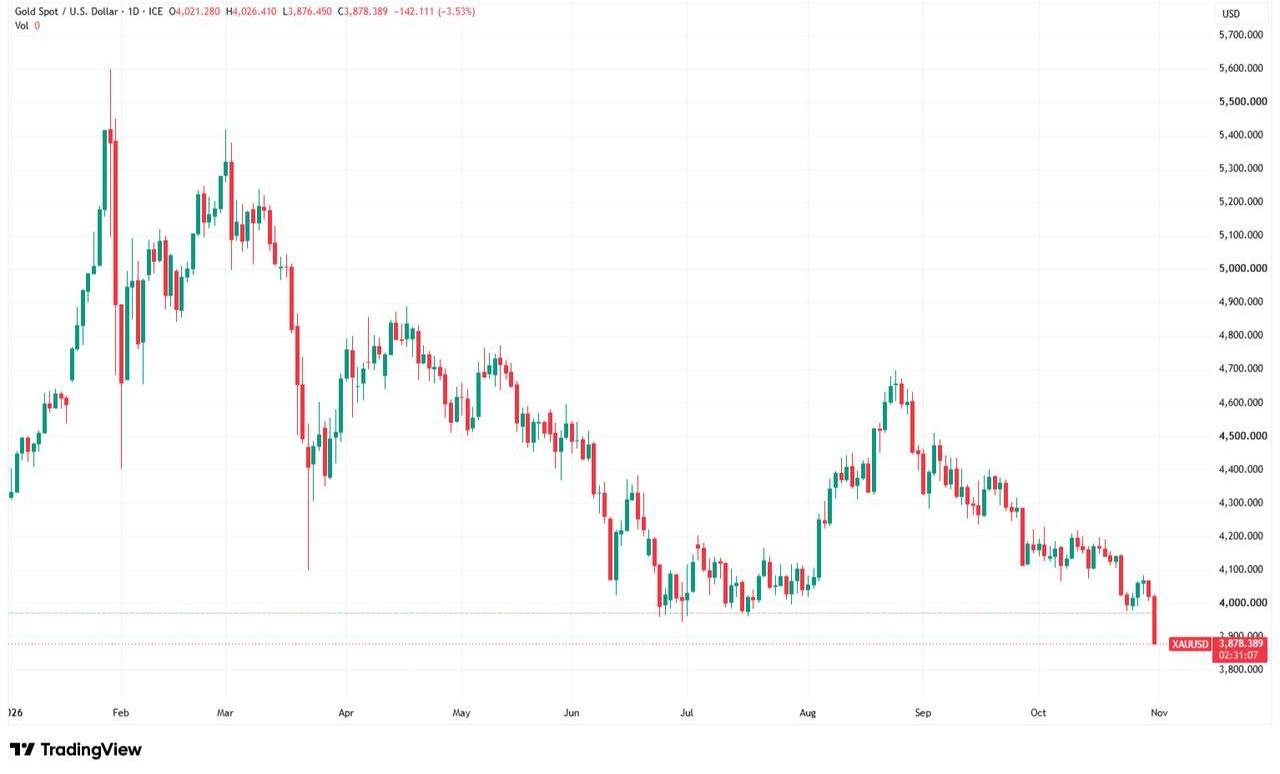
Gold prices dropped below $3,900 an ounce Friday as rising energy costs and expectations of higher U.S. interest rates weighed on the precious metals market.
Spot gold traded at $3,880 an ounce as of 6:10 a.m. GMT, down 3.5% on the day. The metal had declined 7.14% over the past month and 10.19% over the past year.
The decline came as rising oil prices reinforced concerns that inflation could remain elevated, potentially forcing the Federal Reserve to keep interest rates higher for longer or tighten monetary policy further.
Higher interest rates tend to weigh on gold because the metal does not pay interest, making it less attractive when investors can earn higher returns from interest-bearing assets.
Gold also came under pressure amid a wider sell-off in financial markets, with reports pointing to concerns about AI investment returns and the possibility of forced asset sales contributing to the decline.
Silver dropped 6% to $49 an ounce, extending its year-on-year decline to 31.1%. Palladium fell 2.5% to $974.5 an ounce, while platinum lost 3.7% to $1,425.
Energy prices moved in the opposite direction, with crude oil and European natural gas remaining elevated amid concerns about potential supply disruptions in the Middle East.
Brent crude futures for December delivery rose 2.7% to $117.9 a barrel, while U.S. benchmark West Texas Intermediate crude traded at $104.3.
The gains came as tensions surrounding the U.S.-Israeli war on Iran heightened concerns about the security of energy shipments through the Strait of Hormuz, a key route for global oil and liquefied natural gas supplies.
A reported attack on a tanker in the strait, along with attacks claimed by Yemen's Houthi group against Saudi energy facilities, added to fears that further escalation could disrupt regional exports. Oil prices were also on course for a fourth consecutive monthly gain.
European natural gas prices stood at €103.5 ($115.4) per megawatt-hour, hovering near their highest level since late 2022.


 Set as preferred source
 Set as preferred source


 1 min read

 1 min read