Newsletters





Central Bank of the Republic of Türkiye (CBRT) Governor Fatih Karahan said recent outflows from investment funds after September's market rout have not significantly weakened domestic residents’ preference for Turkish lira assets, as the bank maintains tight monetary policy to bring inflation down.
Speaking at the International Monetary Fund (IMF) and World Bank annual meetings in Bangkok on Oct. 14, Karahan outlined Türkiye’s economic outlook, pointing to easing underlying inflation, cooling domestic demand and measures to contain risks from recent financial market stress.
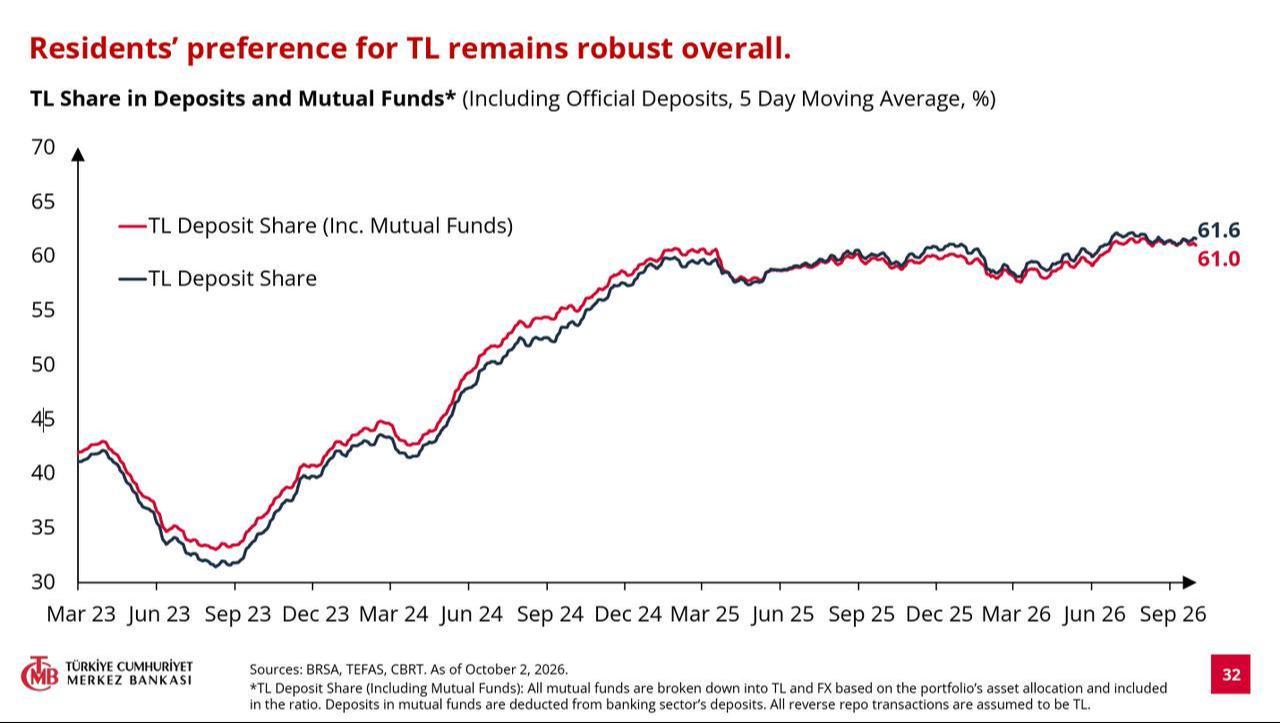
"Domestic residents’ preference for the Turkish lira remains generally strong," Karahan said, adding that proactive measures have limited the risk of financial stress spreading from funds subject to trading restrictions.
Central bank data showed Turkish lira deposits rose by ₺209 billion ($4.2 billion) and foreign-currency deposits by ₺158 billion between Aug. 28 and Oct. 5, after adjusting for price and exchange-rate effects.
Money market funds saw ₺363 billion in outflows, while participation and hedge money market funds recorded a combined decline of ₺289 billion. Foreign investors withdrew ₺287 billion from funds over the same period.
The lira’s share of total deposits and mutual funds, including official deposits, stood at 61.6% on Oct. 2, compared with 61% for lira deposits alone.
The CBRT outlined measures to contain market stress and prevent it from spreading through the financial system. It accelerated outright purchases of Turkish lira reference-rate securities, increased repo funding, eased borrowing limits and collateral haircuts, and introduced flexibility in lira reserve requirements for banks exposed to funds facing trading restrictions.
The bank also raised the credit growth cap for small and medium-sized enterprises to 5% from 4.5% to mitigate potential deterioration in credit quality. Karahan said timely outright purchases helped limit the impact of the market stress.
The presentation also highlighted gold-price fluctuations as a source of volatility in international reserves. Gross international reserves, excluding gold price effects, stood at $197 billion on Oct. 9, down from $210 billion before the conflict.

Karahan said energy prices and other supply-side shocks had slowed disinflation, although underlying price pressures continued to ease.
Annual inflation fell to 29.7% in September from 33.3% a year earlier, while energy inflation rose to 46.1% from 34.7%. Services inflation eased to 37.7%, food inflation to 27.6% and core goods inflation to 15.9%.
The CBRT’s underlying inflation measure fell to an annualized three-month average of 23.7% in September from 32.6% in May. Monthly services inflation dropped to a seasonally adjusted 1.85%, its lowest in five years. September inflation expectations stood at 23.7% among market participants, 32.5% among firms and 45.6% among households.
Cooling domestic demand helped offset supply pressures, Karahan said. GDP grew 2.3% year over year in the second quarter, while final domestic demand growth slowed to 2.2% from 4.1% in the first quarter. High-frequency indicators pointed to further weakness in the third quarter, and annualized real credit growth stood at 24% as of Oct. 7.
Despite weaker external demand, the current account deficit remained contained. Tourism revenues held at $39.2 billion in January-August, while visitor arrivals fell to 40.9 million from 41.8 million a year earlier.
Karahan reiterated that the CBRT would maintain tight monetary policy until price stability is achieved, with decisions guided by actual and expected inflation and its underlying trend. The bank could tighten further if the inflation outlook deteriorates significantly.
The CBRT’s next rate decision is scheduled for Oct. 22, after it kept its policy rate at 37% in September.


 Set as preferred source
 Set as preferred source


 1 min read

 1 min read