Newsletters





Türkiye is managing the economic impact of rising energy prices and geopolitical tensions linked to the Iran war, with policy buffers helping limit volatility despite growing external risks, according to an ING analysis.
The report pointed to Türkiye’s continued reliance on a controlled exchange rate framework and a broad policy toolkit, which together support the country’s disinflation process while cushioning the effects of market stress.
ING estimated that every $10 increase in oil prices expands Türkiye’s current account deficit by $4–5 billion. The country closed 2025 with a $30.1 billion deficit, which is projected to reach $45 billion in 2026.
To contain the inflation impact, the government reinstated a fuel tax adjustment mechanism that absorbs roughly 75% of oil price shocks, limiting the direct pass-through to consumer prices. Even so, inflation is expected to exceed 25% this year, down from 31.5% in February.
The report highlighted a strong market reaction to the geopolitical shock, with Türkiye’s CDS premium rising above 300 basis points, the highest in nine months, as bond yields climbed, equities weakened, and offshore funding costs increased. In March, foreign investors withdrew $7.3 billion from bond and equity markets, while about $15 billion in carry trade positions were unwound. It warned that prolonged uncertainty could trigger further outflows.
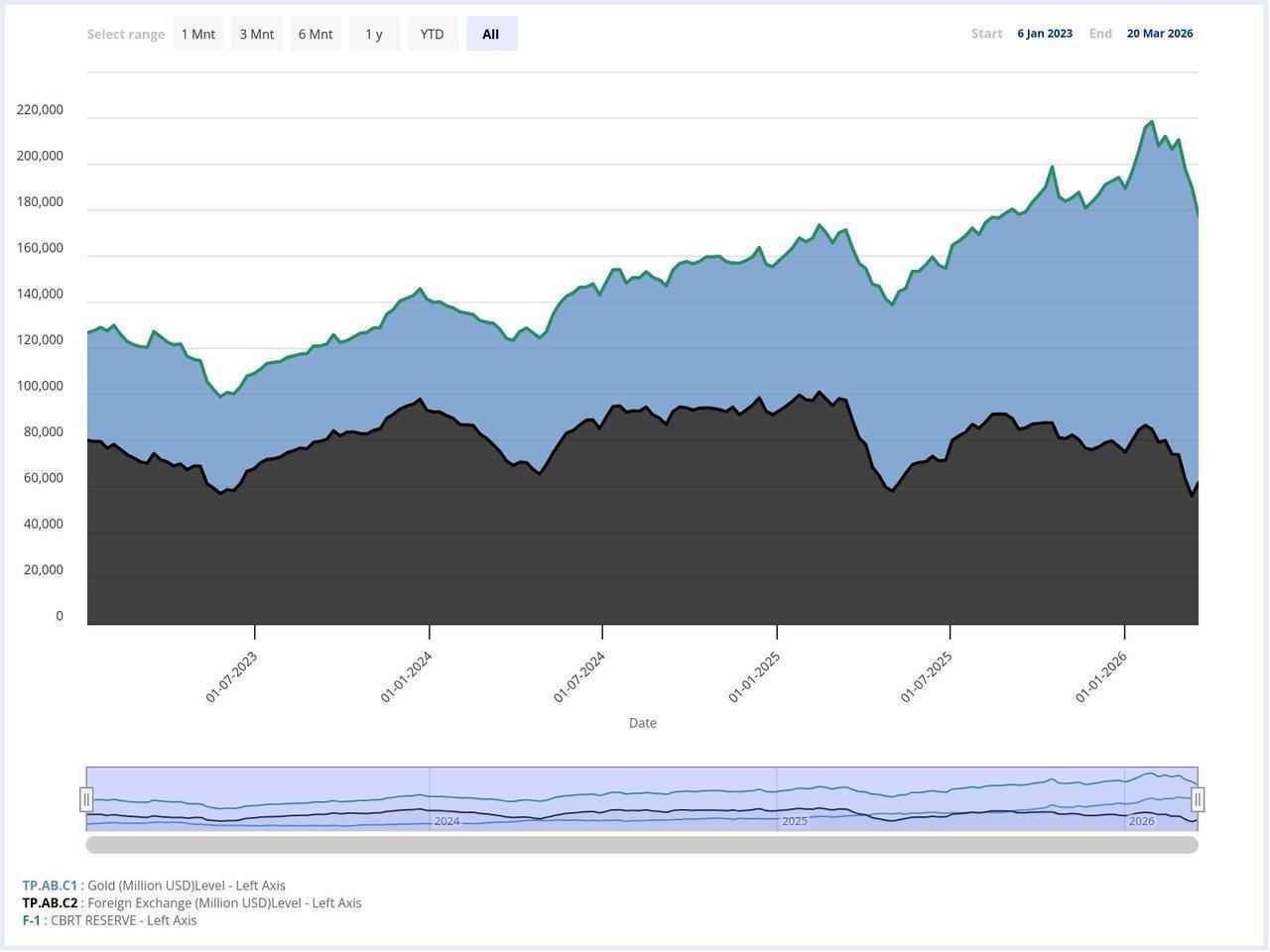
Nevertheless, policymakers responded with foreign exchange interventions, liquidity steps and macroprudential measures to stabilize markets, while reserve levels remain sufficient to absorb potential outflows and limit volatility in the lira, the report assessed.
Despite the risks, demand for foreign currency among residents has remained contained, with no significant increase in FX deposits or mutual fund demand. Authorities are expected to prioritize financial stability through targeted measures rather than aggressive tightening, unless inflation or external balances deteriorate significantly, the analysts noted.

Economists at Goldman Sachs said the CBRT is treating the current shock as temporary and managing the process through overnight interest rates.
They added that if the conflict persists or energy prices remain elevated, stronger inflation pass-through and deeper reserve losses could push the central bank to raise its policy rate toward the overnight rate or higher. A return to one-week repo auctions is also seen as likely, allowing funding costs to ease to the 37% policy rate from 40%.
Commerzbank economist Tatha Ghose pointed out that the Turkish lira had already been on a weakening trend before the conflict, with recent developments adding further complexity. He described the central bank’s renewed use of swap instruments after a one-year pause as a "defensive action" aimed at limiting volatility in foreign exchange markets.
The report outlined key tools used by the CBRT, including lira swaps against foreign currency, gold-for-foreign currency swap operations to support liquidity, and forward foreign exchange sales settled in lira to ease pressure in spot markets.
Since the start of the war, the central bank is estimated to have sold $44 billion from its reserves to prevent volatility in the Turkish lira by supplying foreign currency to the market.


 Set as preferred source
 Set as preferred source


 1 min read

 1 min read