Sign in
 Newsletters


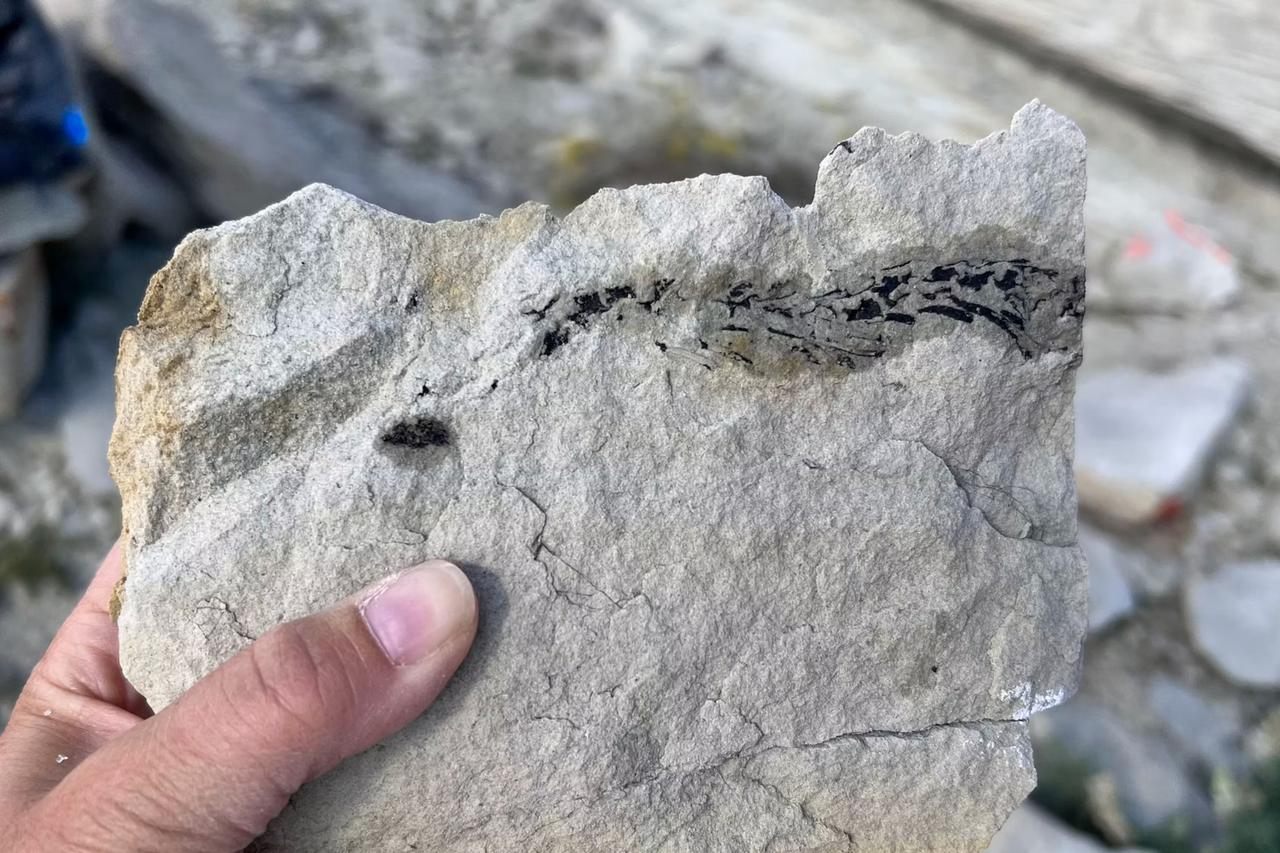


A fossil that left experts unsure whether it was a baby dinosaur, a prehistoric snake or something else has turned out to be a previously unknown species of reptile, Swiss scientists said.
Researchers at the Paul Scherrer Institute (PSI) used neutron imaging to see inside a slab of Wyoming sandstone holding a 156-million-year-old skeleton. Combined with X-ray scans, the technique revealed a horned reptile about 45 centimeters (18 inches) long that lived during the Jurassic period.
The team named it "Meilynodraco amonamarthi," partly in tribute to the Swedish death metal band Amon Amarth.
In January 2023, PSI materials scientist Pavel Trtik visited the Aathal Dinosaur Museum near Zurich with his three sons and left his business card, offering to help if staff ever needed something investigated. Ten days later, the museum called.
Its excavation team had found the small, partly exposed skeleton in August 2022 at the Meilyn Quarry in Wyoming. Much of it remained buried in rock, and nobody could identify it.

Neutrons are especially sensitive to hydrogen, which is found in a mineral in bone, Trtik said. That helps distinguish fossilized bone from the surrounding sandstone.
"The two techniques provide different kinds of information," he said, referring to neutron and X-ray imaging. "Only by combining them can we get the clearest picture."
An international team led by Trtik and University of Zurich paleontologist Torsten Scheyer analyzed tens of thousands of cross-sectional images. They found pelvic bones, parts of a hind leg, and a tiny skull with two dragon-like horns at the back of the head.
The skull’s braincase, less than 2 centimeters (0.8 inches) across, was almost completely preserved. It showed the animal belongs to the crocodilians, a group of extinct reptiles whose place on the evolutionary tree has long been unclear.
 1 min read
Tiny bones in the inner ear resemble those of the "crown group" of reptiles, which includes all living reptiles, Scheyer said. That could suggest choristoderes are more closely related to living reptiles than earlier fossils indicated.
The animal is the most complete early-branching member of the group found so far, and the oldest record of choristoderes in North America, the researchers said.
Scheyer, a fan of "The Lord of the Rings" and hard rock, said the find deserved a spectacular name.
"Meilynodraco" means "Dragon of Meilyn," after the quarry. "Amonamarthi" honors Amon Amarth, a band whose name comes from the Elvish term for Mount Doom in J.R.R. Tolkien’s books.
The fossil will go on display in early 2027 at the Aathal Dinosaur Museum as part of a traveling exhibition called "Rock Fossils on Tour."


 Set as preferred source
 Set as preferred source


 1 min read