Newsletters




Despite recent rainfall across Türkiye, several regions continue to face drought conditions, according to a leading climate expert who evaluated the country’s latest precipitation data.
Prof. Dr. Mikdat Kadioglu, a faculty member at Istanbul Technical University’s Department of Climate Science and Meteorology Engineering, assessed the Meteorological General Directorate’s (MGM) May Standardized Precipitation Index (SPI) maps and said that short-term rainfall improvements have not eliminated long-term water deficits in some areas.
He noted that drought assessments must go beyond daily or monthly rainfall totals, emphasizing that SPI indicators measure precipitation anomalies over different time scales by comparing current rainfall with long-term historical averages.
Kadioglu stated that Tekirdag in the Marmara region continues to exhibit drought characteristics despite recent rainfall.
He said the region has not sufficiently recovered and still shows moisture deficits even in short-term indicators, highlighting ongoing stress in soil and water systems.
He also drew attention to the Konya Closed Basin, one of Türkiye’s most water-sensitive regions. While recent precipitation has provided partial relief, long-term indicators still show signs of mild drought.
According to Kadioglu, the primary concern in the region is not only rainfall variability but also intensive groundwater extraction driven by agricultural demand. He warned that short-term rainfall increases are insufficient to offset long-standing depletion of underground water resources.
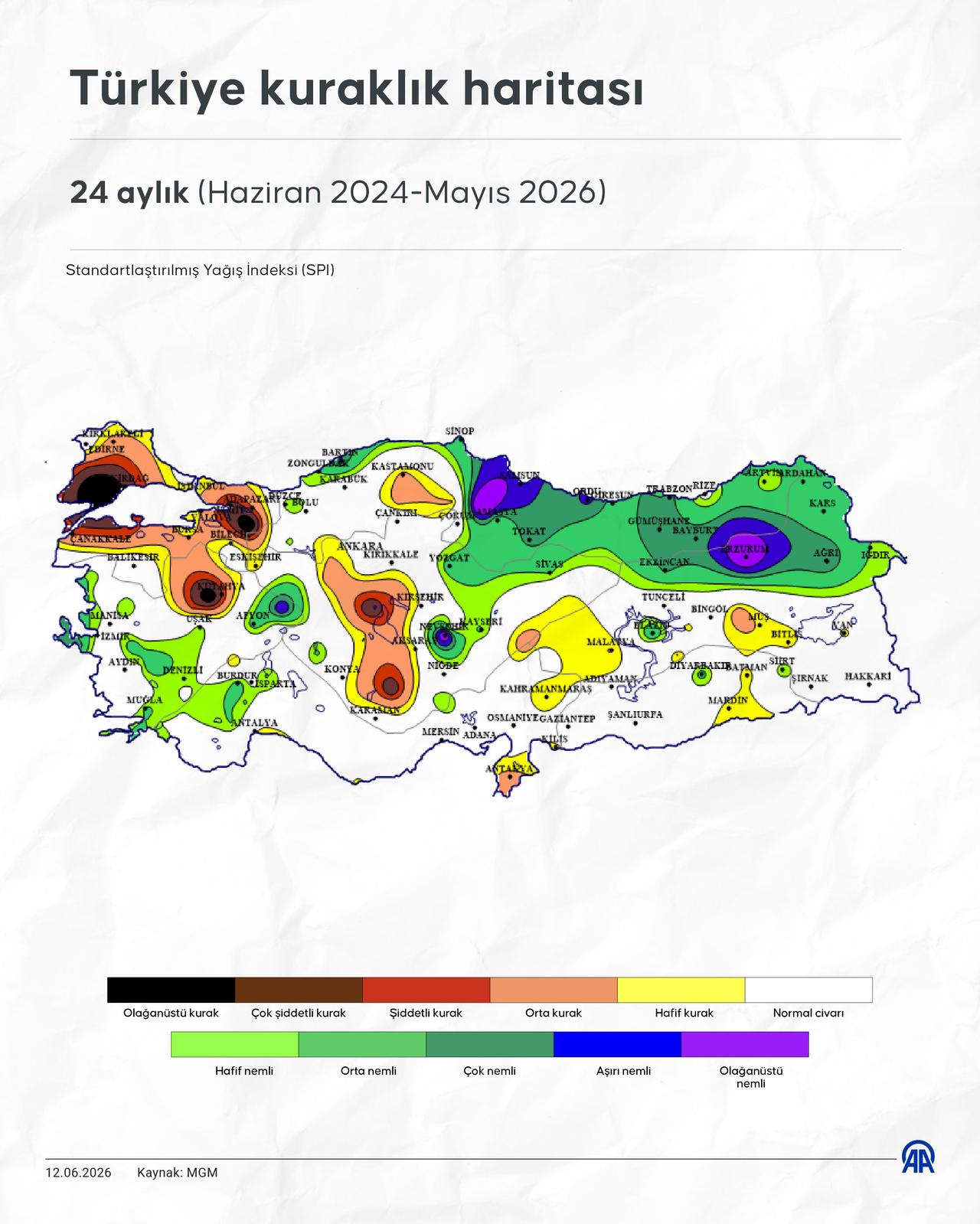

Kadioglu added that parts of Central Western Anatolia, particularly Eskisehir and its surroundings, continue to appear in long-term drought assessments. He said persistent precipitation deficits in the region require careful planning in both agricultural production and water resource management.
In contrast, Eastern Anatolia presents a significantly different hydrological picture. The region, including Erzurum and the surrounding areas, is classified as humid in long-term analyses. Kadioglu noted that consistent precipitation and snow accumulation make Eastern Anatolia a key natural water reservoir for Türkiye.
Emphasizing the importance of long-term monitoring, Kadioglu said drought should not be viewed solely as a meteorological event. He stressed that even when rainfall returns to normal levels, it takes considerable time for groundwater reserves, reservoirs, and soil moisture to recover.
He further explained that the Standardized Precipitation Index (SPI) is a scientific tool used to compare current precipitation levels with long-term averages, where negative values indicate drought conditions and positive values indicate above-average rainfall.


 Set as preferred source
 Set as preferred source


 2 min read
 1 min read