Newsletters


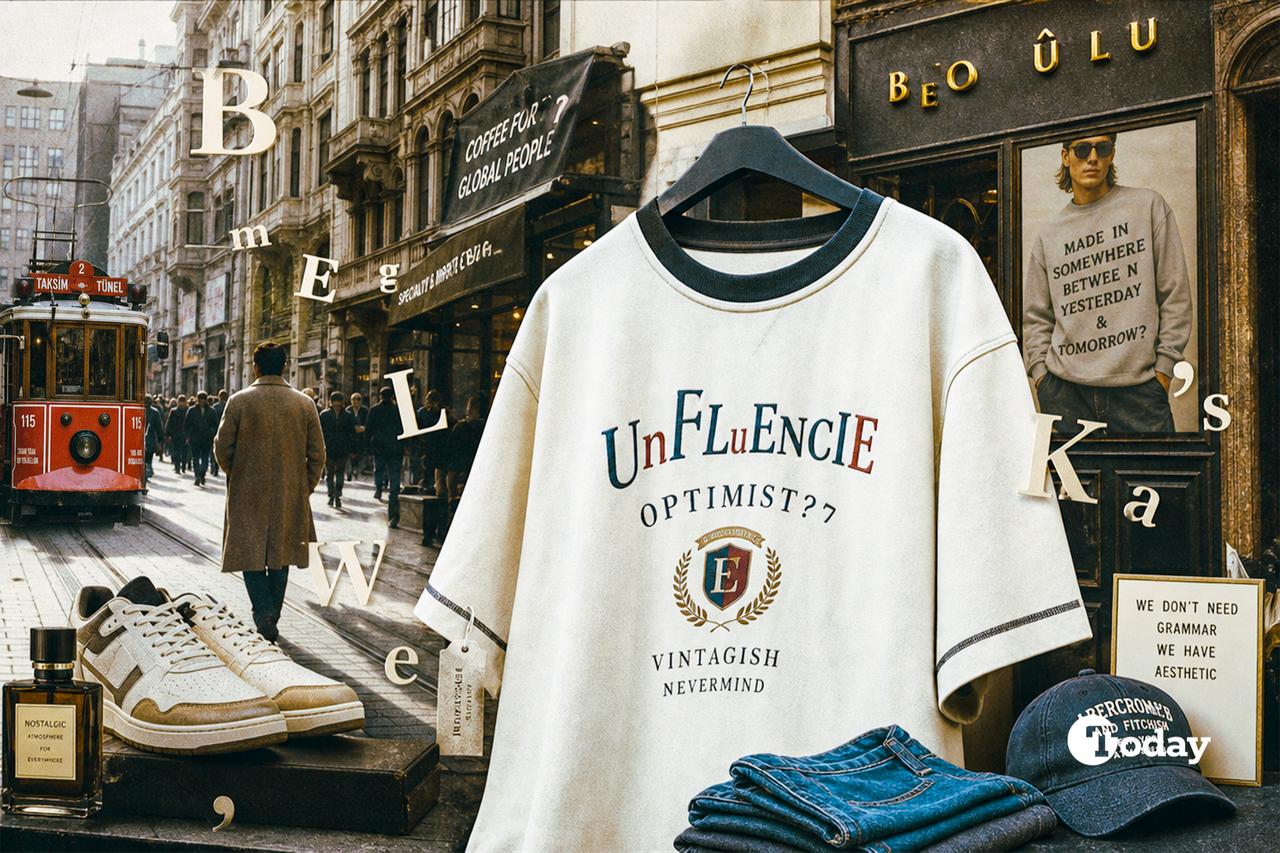


English has a good job on Istiklal Avenue. It sells blue jeans.
It also sells sneakers, coffee, perfume, apartments, and haircuts, and, judging from some of the merchandise in the windows, a peculiar philosophy of life in which you must DREAM YOUR HAPPY and never surrender your ORIGINAL FREEDOM.
There is no escaping it.
Walk down Istanbul’s famous pedestrian thoroughfare, and English comes at you from every direction. There is LC Waikiki at No. 66. Mavi is up at No. 123-A. OXXO occupies another stretch of the avenue. Dilan Clothing does business inside the Beyoglu Is Merkezi at No. 187.
The merchandise changes. The message does not.
English is cool. Correct English is apparently optional.
This distinction has produced one of the more exuberant corners of Istanbul commerce: a linguistic free-fire zone where nouns mate with adjectives, verbs wander away from their sentences and apostrophes turn up in places where no responsible grammarian would leave them overnight.
Some folks—that would include me—have gone looking for this stuff and returned with specimens.
In one study of signs in Beyoglu, scholars encountered a lingerie shop that had performed a small act of linguistic engineering. It combined the Turkish word "çamaşır"—underwear—with the English word “city.”
The result was "Çamaşırcity." Underwear is now a municipality.
Nearby in the linguistic record was "Tshirtium," apparently constructed from “T-shirt” with an ending that made the humble garment sound either Roman or radioactive.
We must take these things seriously. We have to. This is data.
Turkish merchants have tinkered with foreign languages for a long time, but English enjoys special privileges. It is the language of international business, pop music, software, airports, and much of the internet. Put it above a doorway and an ordinary shop can acquire the faint electrical hum of globalization.
This works even when nothing global is happening inside.
A barber becomes a “Hair Studio.” A café acquires a “Coffee Corner.” A shop has a “concept.” An apartment building becomes a “residence.” Somewhere in this linguistic bazaar, English has developed a Turkish commercial dialect whose governing principle appears to be that foreign nouns are worth more.
Clothing is where things get dangerous.
The ingredients are familiar. Take NEW YORK. Add BROOKLYN. Sprinkle liberally with COLLEGE, ORIGINAL, VINTAGE, UNIVERSITY or ATHLETIC. Then add a number—1987 is excellent, whether or not anything happened in 1987—and arrange the whole business in large collegiate letters.
The garment now has a biography. It may not have a sentence.
This doesn't necessarily matter because the customer isn't buying an English composition. He is buying the atmosphere surrounding one.
Linguists have a less feverish explanation. Foreign languages can carry symbolic value independent of literal meaning. My slapdash study of Istanbul's commercial signs has found English being used for associations with modernity and foreign culture. Foreign languages can do useful work even when nobody much cares what the words mean.
John Wendel, a sociolinguist and professor emeritus at Dokkyo University in Japan who has studied Istanbul’s linguistic landscape, found English being deployed “for cachet of modernity and foreign cultural references” and only minimally for the information it carried. Elsewhere, he puts the matter even more plainly: English on Istanbul’s signs is often used “more for its symbolic value than for true informational purposes.”
In other words, the mistake native English speakers make is reading English.
Let’s return to the borough of Çamaşırcity. An English speaker might object that there is no such place. The merchant says there is now.
Commerce becomes superbly weird once English enters the supply chain. A phrase passes from designer to supplier to printer. A letter disappears somewhere outside Bursa. Another mysteriously doubles. Capitalization becomes emotional. By the time the language reaches Istanbul, it may look as though it crossed the Bosphorus in a washing machine.
“Decoration” becomes “Decoartion.” “Goods” becomes “GOods.”
And a perfectly innocent product label arrives announcing: “USed on GOods and Decoartion.”
My editor has now triggered a five-alarm grammar emergency. To somebody manufacturing 8,000 tote bags, it’s Friday.
And here is the maddening part: the English may still be doing its job.
A 2019 count at Istanbul's IstinyePark shopping center recorded 105 of 280 shop names—37.5%—as entirely English, with still more mixing Turkish and English. English wasn't merely helping tourists order coffee. It had become commercial scenery.
Native English speakers should resist feeling superior.
Americans have spent decades walking around with Chinese and Japanese characters on their backs without the slightest idea whether they say “eternal wisdom” or “municipal drainage department.”
English restaurants have committed atrocities against the French. Real estate developers have built “Tuscan villages” in places where Tuscany would seek diplomatic protection.
Türkiye has merely discovered that English can be abused like any other successful international commodity.
Back on Istiklal, the evidence hangs in windows and marches past on sweatshirts: fragments of America, Britain and an imaginary international republic where everyone is forever VINTAGE, ORIGINAL and pursuing THE DREAM.
English came to Türkiye, selling to the wider world. Türkiye looked it over, adjusted the capitalization, dropped a vowel, and put it on a T-shirt.
The shirt sold anyway.


 Set as preferred source
 Set as preferred source



 7 min read