Newsletters




The 2026 Iran war has placed a number of world leaders in tricky dilemmas. President Trump, who campaigned on lower inflation and ending “forever wars,” cannot seem to terminate a war that has driven a spike in global energy prices and dented his inflation goals.
U.S. allies have absorbed significant economic pain but hesitate to break ranks too openly with Washington for fear of long-term consequences. Moscow and Beijing no doubt enjoy the opportunity to distract global audiences from Russia’s aggression against Ukraine, but presumably don’t want the conflict grinding on long enough to risk Iranian collapse.
The Kingdom of Saudi Arabia (KSA) and its ruling Crown Prince, Mohammad bin Salman (MBS), have been placed in a particularly sharp conundrum.
MBS invested a lot in his relationship with Trump, but was not consulted in detail before the launch of the war and has borne high costs over the war's eight months.
The ambitious development plans of Saudi Vision 2030 have been set back by reduced energy revenue and battered investor confidence, while potential gains from Abraham Accords accession have vanished as the reputational risks of normalizing with Israel increased.
The binary choice of Israel or Iran implied by the war was an easier choice for UAE President Mohammed bin Zayed (MBZ) and the Emirates, but MBS and Saudi elites imagined a more autonomous foreign policy than that binary allows.
KSA and MBS face three rough options, each with costs and benefits. The first is to double down on Western alignment and security integration—press for more aid from the U.S., France, the United Kingdom, Greece, and perhaps even Israel, in order to deter and punish Iranian or Houthi attacks.
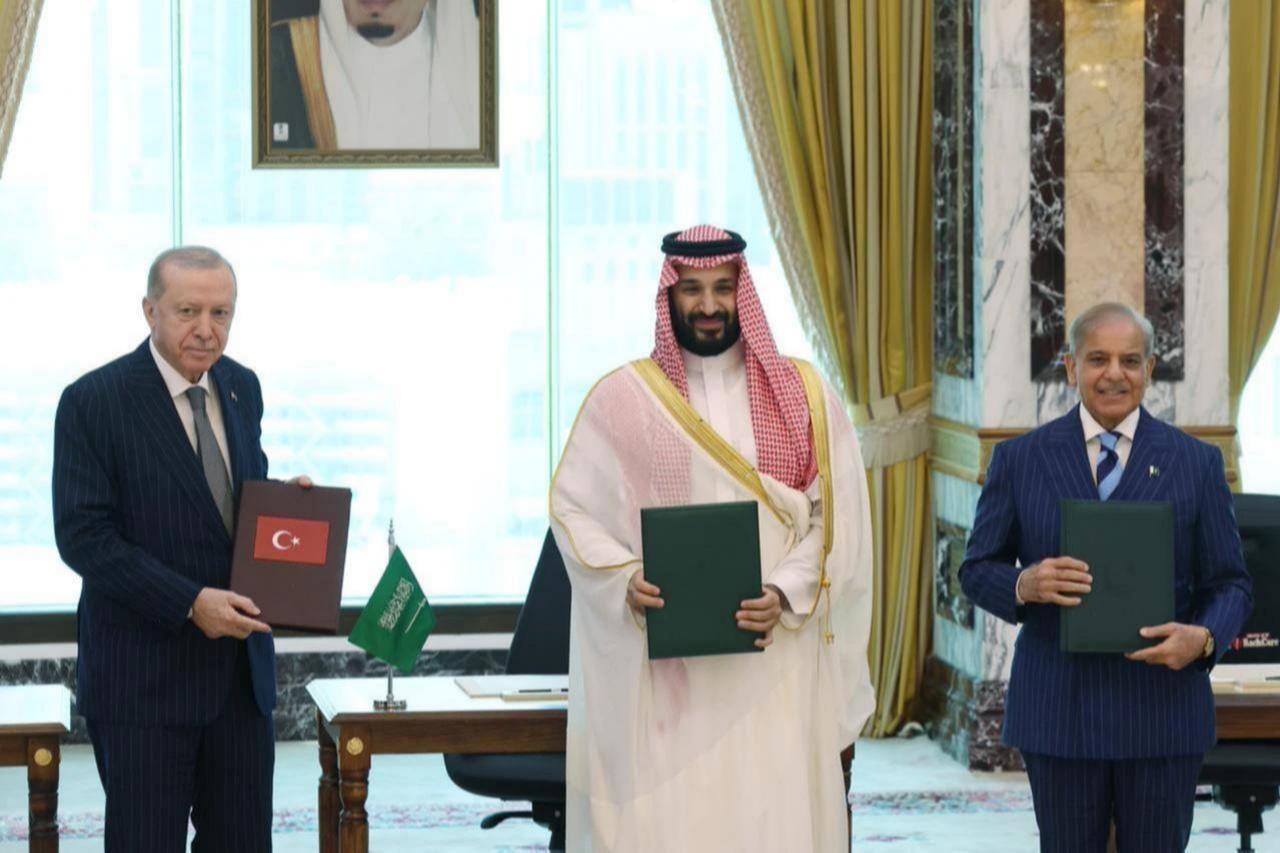
The second is to strengthen ties with regional allies that can help boost organic defense capabilities—as envisioned with Pakistan and Türkiye in the Mecca agreement—in order to maintain some distance from both belligerent sides.
The third would be to cut a deal with Iran and its backers in Beijing and Moscow to shift from a strong pro-Western stance to strategic neutrality, embracing not only trade ties with China but a regional modus vivendi with Iran, more akin to the neutrality of Oman than the open pro-Western stance of the UAE.
The ripple effects of the war in Iran will take years to fully unfold, but it’s a safe bet that the kingdom will need to implement one of these approaches effectively to protect itself—or perhaps to incorporate elements of all three.

Can the kingdom still count on Western security guarantees? It is the oldest bargain in the Middle East: since the February 1945 meeting between President Roosevelt and King Abdul-Aziz Al-Saud, one side guaranteed oil and the other protection.
U.S. arms sales, advisory presence and regional deterrence have long protected KSA despite fairly limited national military capabilities. Yet in 2026 the country was attacked dozens of times by Iranian drones and missiles in the spring, and was hit by an even more damaging wave of attacks from Iranian-backed Houthis in Yemen in the fall.
In 1991, the U.S. deployed half a million troops to defend KSA from attack, but much has changed since then. U.S. Presidents have increasingly avoided direct military support to Riyadh, though air defense support has been fairly robust.
The Trump administration has deepened the trend toward American support that is transactional and conditional. As military technology and regional multipolarity have increased the range of threats to Riyadh, Washington’s assurances remain necessary but not sufficient for Saudi security.
Israel has relevant capabilities and has contemplated providing more direct support, but there would be both domestic and foreign policy complications in accepting such aid. MBS sees KSA’s role as that of a regional leader rather than a follower, and is unlikely to fully align with the U.S./Israel campaign against Iran when other options are available.
Can the kingdom develop more local partnerships to fill the gaps left by Western guarantees? The Mecca pact signed last August represents an effort by U.S. allies to do exactly that—provide mutual aid in armaments, deployments, and diplomatic coordination that can no longer be assumed from Washington.
The R4 mechanism adds Egypt to the Mecca pact countries as a team for conflict management in the region, filling another gap.
One major obstacle to effective regional security cooperation for KSA has been geopolitical rivalry with the UAE that extends along an arc from Yemen across the Red Sea to Sudan and down to the Horn of Africa.
Israeli Prime Minister Benjamin Netanyahu has briefed a map showing Israel and the UAE leading a “Hexagon Alliance” in the broader Middle East in competition not only with Iran but also with a “Sunni Diamond Alliance,” which shows how far the region is from cooperative security architecture.
Initiatives to unify the region around a pro-Israel/anti-Iran architecture via the Abraham Accords or the Middle East Air Defense Alliance won’t work without KSA and can’t work for KSA if the cost is erasing Saudi concerns over the Palestinian file and the UAE, and sacrificing its latitude for balancing and hedging maneuvers in a complicated geopolitical context.
Riyadh’s local options therefore come with limitations of their own. Local security arrangements help address gaps and uncertainties, but conditions prevent regionally comprehensive solutions.
Is there a scenario in which the 2026 war leads to a fundamental reorientation of the kingdom away from the American orbit? China thinks there should be.
In Beijing’s view, the war has revealed a mismatch between Riyadh’s economic and military vulnerability and the realities of the region as it now exists. Better to follow up on the 2023 China-brokered rapprochement with Tehran than fully align against it, per this logic.
Or, as one pro-Beijing outlet puts it, “addressing regional security anxieties collectively, outside Washington’s framework of bloc rivalry, is the only viable path to definitively securing Saudi borders.”
A prominent Chinese role in shaping the outcome of the present war and the nature of the regional system moving forward presents risks for the West and for Sunni states, and especially for KSA.
If the Saudis—and perhaps others among the Gulf states, atop so much of the world’s energy supplies—come to believe that they cannot rely on Western or local collective arrangements and have to pay off the Chinese and the Iranians in order to survive, we enter a changed and very dangerous regional paradigm.
China and Iran, each in their own way, have made a habit of developing long-term control over states in the Middle East (and for China, in Africa). For Iran, it has mostly been the use of proxy groups fracturing Sunni-majority states.
For China, it has been the development of economic dependency through predatory investment strategies. Yet as long as China is a major player in the region economically and Iran retains coercive power militarily, it will be a hard sell to Saudi leaders or the Saudi public that they should not engage with or listen to China's and Iran's arguments.
The Middle East in 2026, particularly as viewed from Riyadh, validates the view of regional and global order as a “fragmented, contested, multipolar set of arrangements” in which the West cannot dictate outcomes but still wields considerable, or even predominant, influence.
There are no absolute guarantees or ironclad solutions in such a system, only sustained struggle and a need to deal pragmatically with all comers.
KSA’s dilemma is therefore more likely to be managed than resolved. Management probably looks like an “all of the above” approach to security: press for more Western aid, lay the groundwork for more substantive regional cooperation—especially with the Mecca pact/R4 powers—and avoid being drawn into fully antagonistic relations with Tehran and its key supporters.
The key is to use all three tools to lessen the vulnerabilities revealed by this year’s attacks, and the unspoken imperative is to increase costs for the Houthis and Iran for carrying out those attacks.
KSA faces an era not of deterrence but of perpetual conflict, with on-again, off-again wars that last for years without clear termination. The Chinese got one thing right: strict bloc behavior is unlikely to produce satisfactory results in such an environment.
With eyes wide open about the shortcomings of friends and rivals on all sides, then, Riyadh will have to tread a very careful path to get off the bullseye it currently occupies.


 Set as preferred source
 Set as preferred source


 2 min read

 1 min read