Newsletters




This article was originally written for Türkiye Today’s weekly economy newsletter, Turkish Economy in Brief, in its Oct. 26 issue. Please make sure you are subscribed to the newsletter by clicking here.
Last week was a turbulent one for Turkish markets. Stocks continued to fall, investment fund liquidations progressed, and problems emerged with some private-sector debt payments, even as the Central Bank of the Republic of Türkiye (TCMB) delivered its first interest rate cut in nine months.
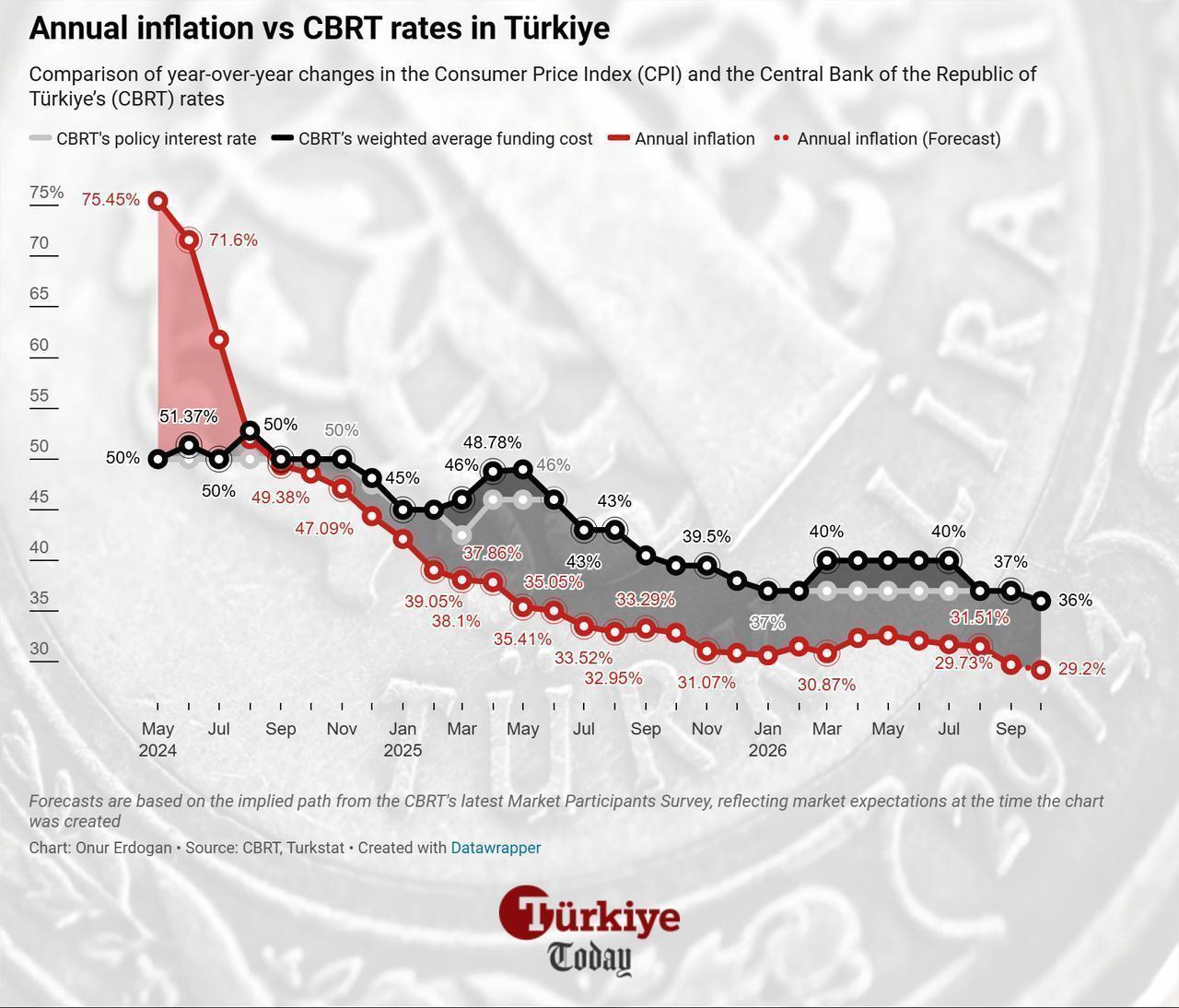
At its October Monetary Policy Committee (MPC) meeting, the CBRT cut its policy rate by 100 basis points, from 37% to 36%, as markets had expected. However, changes to the wording of its policy statement sparked fresh debate over the outlook for further rate cuts.
In its previous statement, the CBRT said it would take a cautious approach to monetary policy, making decisions at each meeting based on the inflation outlook. The revised statement makes clear that both the size and timing of future rate moves will depend on inflation and be assessed at each meeting.
Markets viewed the change as a more dovish signal, with the reference to the “size of steps” suggesting that further rate cuts remain possible.
However, the CBRT kept its cautious stance and maintained its warning that it could tighten monetary policy if the inflation outlook deteriorates significantly and persistently. In other words, further rate cuts are not guaranteed.
Citi and Is Yatirim say the new wording gives the central bank more flexibility to respond to incoming economic data. A sharper economic slowdown could pave the way for larger cuts, while a rise in oil prices or turmoil in bond markets could force the bank to pause its easing cycle.
Following the decision, financial institutions updated their year-end forecasts. HSBC, Citi, ING and Is Yatirim expect the policy rate to fall to 35% by the end of the year, while Akbank sticks to its 36% forecast.
ING expects another 100-basis-point cut in December. BBVA Research, meanwhile, warns that the CBRT may hold off on further cuts until inflation shows a clear decline.
Despite the rate cut, stocks continued to come under pressure on Borsa Istanbul last week, showing that investor sentiment depends on more than just monetary policy.
The benchmark BIST 100 index fell 5.16% over the week to close at 11,116.99 points. It marked the index's sixth consecutive weekly decline and pushed it into negative territory for the year for the first time in 2026. The index ended 2025 at 11,261 points.

Developments in the investment fund liquidation process and warnings from global index provider Morgan Stanley Capital International (MSCI) also weighed on the market. The continued sell-off despite the rate cut highlighted how cautious investors remain.
An important step in the fund liquidation process came last week when the Turkish parliament passed a bill on certain investment funds ordered to be liquidated after September’s market rout, bringing it into law.
The law allows investors to receive interim payments, which will be deducted from their final liquidation proceeds.
Under the new rules, the Central Securities Depository of Türkiye (MKK) will calculate each investor's net investment based on the cash they put into and withdrew from the fund.
Investors with net investments below ₺1 million ($20,119) in the affected funds can receive interim payments up to the amount of their net investment. Those with net investments of ₺1 million or more can receive up to ₺1 million. In either case, the payment cannot exceed the investor's net investment.
For funds other than money market funds, the interim payment also cannot exceed the total value of the investor's fund shares at the previous day's close.
The number of funds subject to liquidation has now fallen to 47, while a total of ₺49.7 billion has been paid into 55,755 accounts so far.
The new law is expected to help clarify investors' rights and provide a clearer framework for completing the liquidation process.
One key provision for investors is that the law also covers orders submitted to the Turkish Electronic Fund Trading Platform (TEFAS) on or before Sept. 17, 2026, that were never executed.
This is particularly important for investors who have been waiting for clarity on their rights after their orders failed to go through.
Orders that could not be completed because a fund defaulted or failed to announce its unit price will also fall under the liquidation rules.
Problems with private-sector debt payments added to pressure on Turkish markets last week.
According to notifications from the Central Securities Depository of Türkiye (MKK), redemption and coupon payments due on four debt instruments on Oct. 23, 2026, could not be made.
Zorlu Enerji, the energy subsidiary of Zorlu Holding, also announced Thursday that it had asked bondholders to approve a six-month delay in a $60.5 million coupon payment. The move follows an announcement by the group's electronics arm, Vestel, which unveiled a $500 million bond restructuring plan days earlier, offering investors the option to extend maturities at lower interest rates or exchange existing bonds for new debt at a 45% reduction in principal value.
The developments have heightened concerns about the private-sector debt market.
Treasury and Finance Minister Mehmet Simsek said earlier this week the private-sector bond market is worth around ₺1 trillion, with ₺26.5 billion in debt due to mature by the end of the year.
He said the market accounts for a relatively small share of the Turkish economy. Simsek added that the government could look favorably on a proposal for the Credit Guarantee Fund (KGF) to establish a credit facility for private-sector bonds using its own resources.
“There will be no Treasury guarantee or funding,” Simsek said.


 Set as preferred source
 Set as preferred source



 7 min read