Newsletters




This article was originally written for Türkiye Today’s weekly economy newsletter, Turkish Economy in Brief, in its July 13 issue. Please make sure you are subscribed to the newsletter by clicking here.
Türkiye's financial markets are currently navigating three major developments.
The first is the renewed conflict between the United States and Iran, which has reignited geopolitical risks.
Following the latest escalation, Brent crude briefly climbed above $80 per barrel last week before settling at $75.2, marking a 4.6% weekly increase. This also ended a four-week decline in oil prices.
Uncertainty across the Middle East remains high, particularly after Iran announced the closure of the Strait of Hormuz again. The current "neither war nor peace" environment is making it increasingly difficult for markets to establish a clear direction.
We know that persistently high oil prices create additional pressure on the Turkish economy, particularly through inflation, the current account balance, and the Central Bank of the Republic of Türkiye's (CBRT) monetary policy.
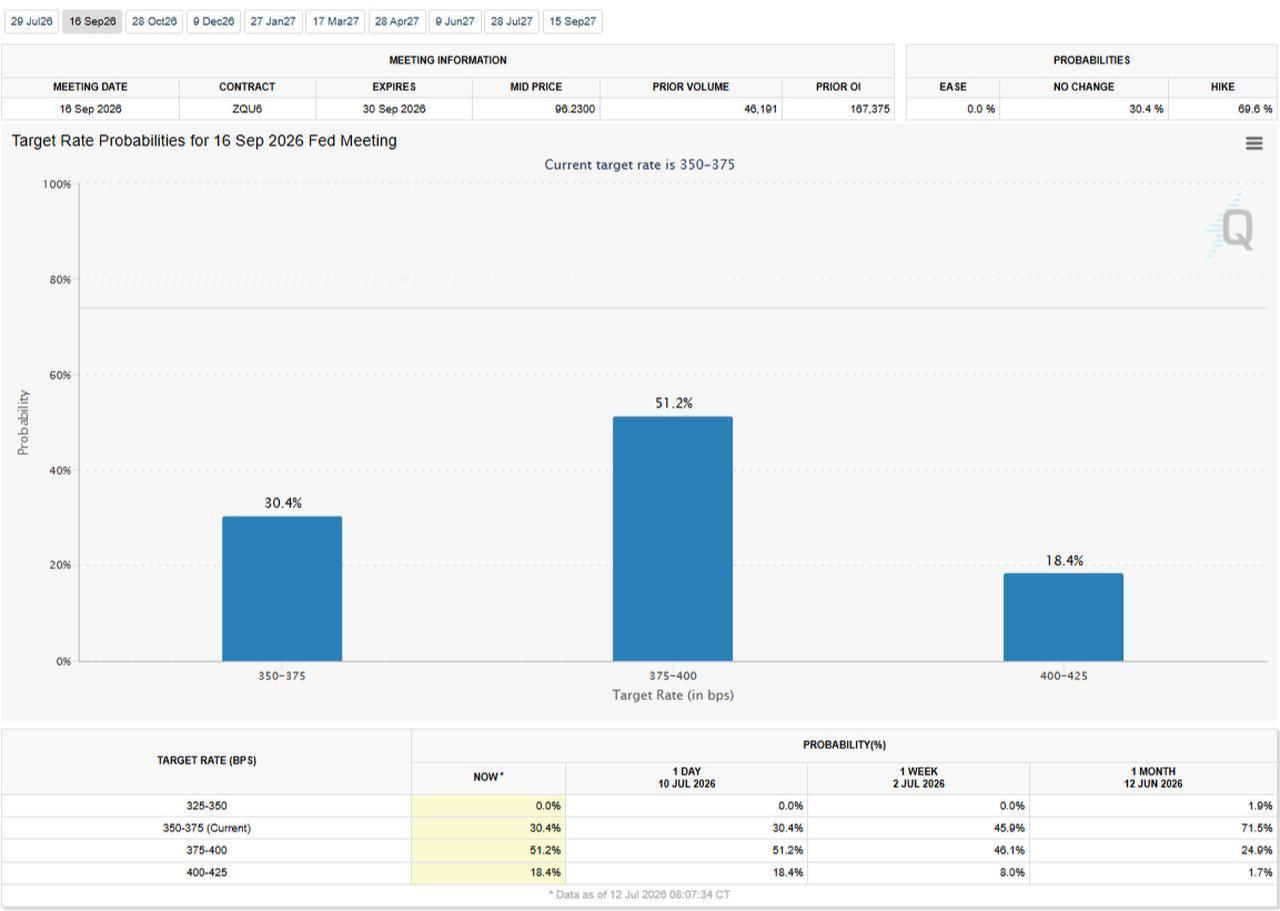
The minutes from the U.S. Federal Reserve's June policy meeting were also published last week.
Citing the surge in demand driven by artificial intelligence and the conflicts in the Middle East as key risks, the Fed removed the phrase "monetary easing" from the statement. The minutes also showed that some policymakers favor raising interest rates.
Markets continue to price in at least one rate hike this year.
The U.S. June inflation data, due on Tuesday, will be closely watched. Annual consumer inflation rose to 4.2% in May, and if inflation remains sticky, markets could begin pricing in an even more hawkish Fed. Such a scenario would likely weigh on precious metals and reduce investors' appetite for risk across emerging markets.

Another important development for Turkish markets—particularly in terms of attracting foreign investment—was S&P's decision to place Türkiye on its watch list for a possible classification change, following similar warnings from MSCI.
This has introduced another layer of uncertainty for investors.
The BIST 100 index ended last week 0.67% lower at 14,321. During the week, the index failed to break through the 14,600 resistance level but successfully held above the 14,000 support level. Both levels are expected to remain important in the near term.
According to Assoc. Prof. Filiz Eryilmaz of Uludag University's Faculty of Economics, foreign institutions have been significant net sellers in Turkish markets over the past two weeks.
"Investors appear to be reducing their positions because of risks stemming from MSCI. Of course, some foreign institutions are simply short-term traders, but when I look at the broader picture, I believe the MSCI warning has been the main driver. Once similar concerns from S&P were added, pressure on the market intensified. In particular, the possibility of Türkiye being downgraded to a lower classification has hurt investor sentiment."
Eryilmaz also noted that recent initial public offerings (IPOs) have absorbed liquidity from the market.
"Second-quarter corporate earnings are also expected to be weak. Given these developments, I expect foreign investors to remain cautious. Markets are simultaneously pricing in oil prices and geopolitical risks while trying to gauge how hawkish the Fed will remain. The latest Fed minutes did not provide a clear signal of a rate hike, but they made it clear that the possibility remains on the table. In particular, policymakers are closely monitoring whether inflation continues to prove sticky."
She added that Tuesday's U.S. consumer inflation data could offer clearer signals on whether "the worst is behind us." If inflation remains persistent, expectations for a more hawkish Fed are likely to strengthen further.
As markets head toward the CBRT's interest-rate decision on July 23, geopolitical risks, the trajectory of oil prices, expectations surrounding the Fed, and the recent warnings from MSCI and S&P are all expected to remain key drivers.
Meanwhile, the 36th NATO Summit, held in Ankara on July 7-8, delivered significant diplomatic, economic, and defense industry gains for Türkiye.
Türkiye hosted a NATO summit for the first time in 22 years, welcoming the leaders of all 32 allied countries and once again becoming a major center of international diplomacy.
More than $50 billion worth of NATO defense agreements were announced during the summit.
At the accompanying Defense Industry Forum, Turkish companies showcased products including drones, armed drones, electronic warfare systems, and armored vehicles directly to allied countries. The event is expected to strengthen the export potential of Türkiye's defense industry.
Meanwhile, U.S. President Donald Trump said after he met with President Recep Tayyip Erdogan that he would lift CAATSA sanctions on Türkiye.
If implemented, the move would represent a breakthrough. It would reopen the door for Turkish defense exports to the United States and could accelerate joint defense projects between the two countries.
The current state of Türkiye-U.S. relations is widely seen as an important step toward restarting negotiations and reducing political obstacles. Attention will now turn to the political and legal steps to be taken by the U.S. Congress.


 Set as preferred source
 Set as preferred source



 7 min read