Newsletters




James Baldwin warned “the fire next time” would not simply be a matter of flame.
It would be a reckoning—a combustion born of moral failure, racial division, spiritual bankruptcy, and political cowardice. He understood that civilizations rarely burn because they lack matches. They burn because they spend generations piling dry timber around themselves while congratulating one another on the architecture.
Europe today smells unmistakably of smoke.
Not the romantic smoke of cafes along the Seine or vineyard chimneys in Beaune, but the acrid taste that settles on the tongue long before flames reach the horizon.
Catastrophe announced its arrival with 3,000 square kilometers (and growing) of vaporized land in Spain and France. Over 300,000 people were forced to abandon homes and businesses.
Unlike France and Spain, Türkiye has mostly avoided a calamitous 2026 wildfire season, despite remaining highly vulnerable because of a prolonged heat and drought that has so far burned some 81 square kilometers of land, according to the European Forest Fire Information System Copernicus.
Sunsets across the Mediterranean are the wrong color. Gray is the new orange. Smoke scratches throats, exercise has stopped, and surgical masks are back in vogue.
Something is unsettling about watching a continent celebrated for planning and regulation discover that the atmosphere refuses to recognize administrative boundaries. Fire does not stop at provincial lines or pause for parliamentary debate. It leaps from ridge to ridge with complete indifference to ideology.
Yet amid the smoke, another Europe emerged.
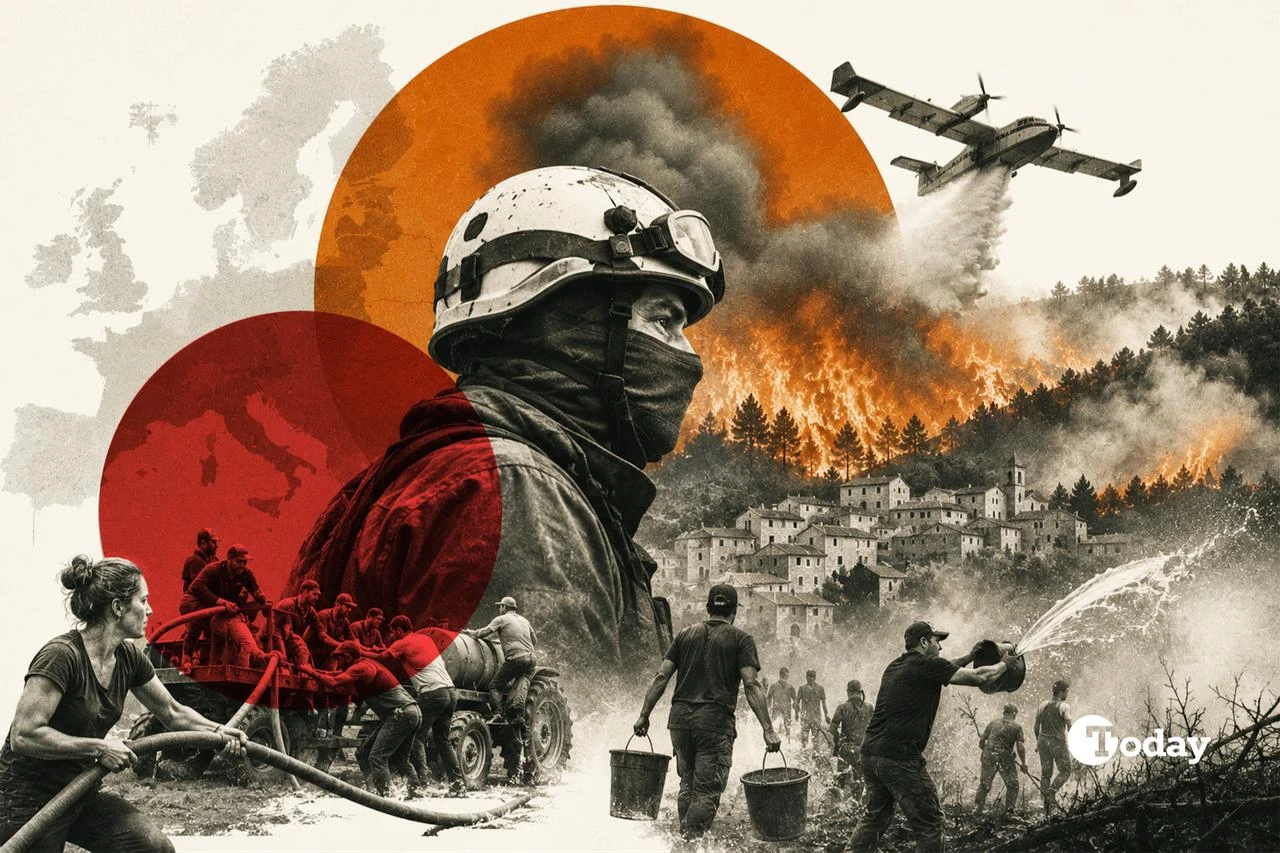
Farmers hauled water tanks toward the flames. Construction workers borrowed equipment and rushed to save strangers' homes. Forest owners stayed behind after sending their families to safety. Shopkeepers became firefighters. Neighbors became scouts. In village after village, ordinary citizens built an emergency response that bureaucracy alone could never assemble.
Indeed, pay no attention to the summer blockbuster Hollywood heroics on screen in “The Odyssey.” The newspaper reports and video footage from the fire lines are Homeric in scale.
Guillaume Bos watched pine forests vanish beyond the horizon while spending sleepless nights dousing embers. Alexandre Bidau left the fire line only because his wife had gone into labor.
Nina Rosazza joined scores of volunteers hauling pumps and trailers because, as she told reporters, "It's a massacre."
That’s what people do when catastrophe strips away politics. They stop asking who governs and start asking where the water is.
Governments, predictably, asked whose fault it was.
Spain's political class quickly turned the fires into another front in its ideological war. Ministers accused Madrid's conservative leadership of weakening emergency services before seeking national help. In France, President Emmanuel Macron faced attacks from both left and right over the pace of deploying military aircraft against the Gironde fires.
One almost expected the flames to pause politely until everyone had finished posting on social media.
The old instinct survives every disaster: if smoke rises, immediately search for someone else's chimney.
Yet this is no ordinary wildfire season. The French president has described the conditions as the country's most severe since World War II. Spain is enduring the worst fires in its recorded history.
Entire communities have been evacuated. Climate scientists have spent decades warning that hotter, drier summers would produce precisely these conditions. The forecasts have become headlines.
The political argument is no longer whether climate change exists. It is whether democratic governments possess the institutional maturity to behave as though they believe their own scientists.
Because the winds driving these infernos are not merely meteorological.
They are political.
Years of delayed infrastructure. Endless battles over public spending. Emergency services stretched thin in the name of fiscal restraint.
Forest management was postponed because the electoral payoff lies beyond the next campaign. Governments treating climate adaptation as if it were an optional expense rather than the premium on an insurance policy they can no longer afford to neglect.
The forests ignite in August. The conditions were prepared over decades. This is Baldwin's territory.
His enduring insight was that denial itself becomes combustible. Refusing to confront uncomfortable truths does not diminish danger; it stores energy until the inevitable spark arrives.
Today's leaders remain trapped inside permanent campaigns. Conservatives accuse progressives of ideological excess. Progressives accuse conservatives of calculated neglect. Populists accuse everyone else of betrayal. Each side arrives armed with polling data while the atmosphere rewrites the operating manual for an entire continent.
Nature, unlike politics, does not negotiate. Water, unlike political rhetoric, remains refreshingly bipartisan.
But volunteer courage is not climate policy. Heroism cannot substitute for resilient infrastructure, modern firefighting fleets, healthier forests, coordinated emergency planning, or governments willing to invest beyond the next election cycle.
A thousand brave citizens with sprinklers cannot compensate for institutions that have spent years arguing while the landscape itself became more combustible.
The question is whether political leaders are prepared to extinguish the political winds that have helped feed these environmental disasters long before the first spark ever lands.
Baldwin's warning was never about an apocalypse.
It was about choice.
Fire is both destroyer and revelation. Europe's skies are sending smoke signals visible from space. The people on the ground have already answered with courage, cooperation, and sacrifice.
European leaders are still arguing over who should hold the hose.


 Set as preferred source
 Set as preferred source


 4 min read