Newsletters




"You Turks thrive on order," an Iranian official once told a Turkish diplomat in Tehran, "but we have learned to thrive on chaos." Seven months into the U.S. and Israel's war on Iran that was meant to put a stop to Tehran's nuclear ambitions, chaos seems to be winning.
President Trump’s military campaign against Iran and its proxies has not gone as expected.
Airstrikes, a naval blockade, tightened economic sanctions, threats, and negotiations have so far failed to achieve stated war objectives—renunciation of the nuclear arms program, capitulation, collapse—and even the fallback aim of restoring the status quo ante in the Straits of Hormuz seems elusive.
Damaging Iran’s nuclear weapons drive may have been sufficient justification for military intervention, but it remains the case that a U.S. President who abhors “forever wars” now is mired in one.
Iran has taken a well-deserved beating, but emerged weakened and oddly emboldened at the same time. Its “mosaic strategy” of dispersing military and political targets has rendered the regime very hard to kill—while greatly reducing its cohesiveness and functionality for the Iranian people.
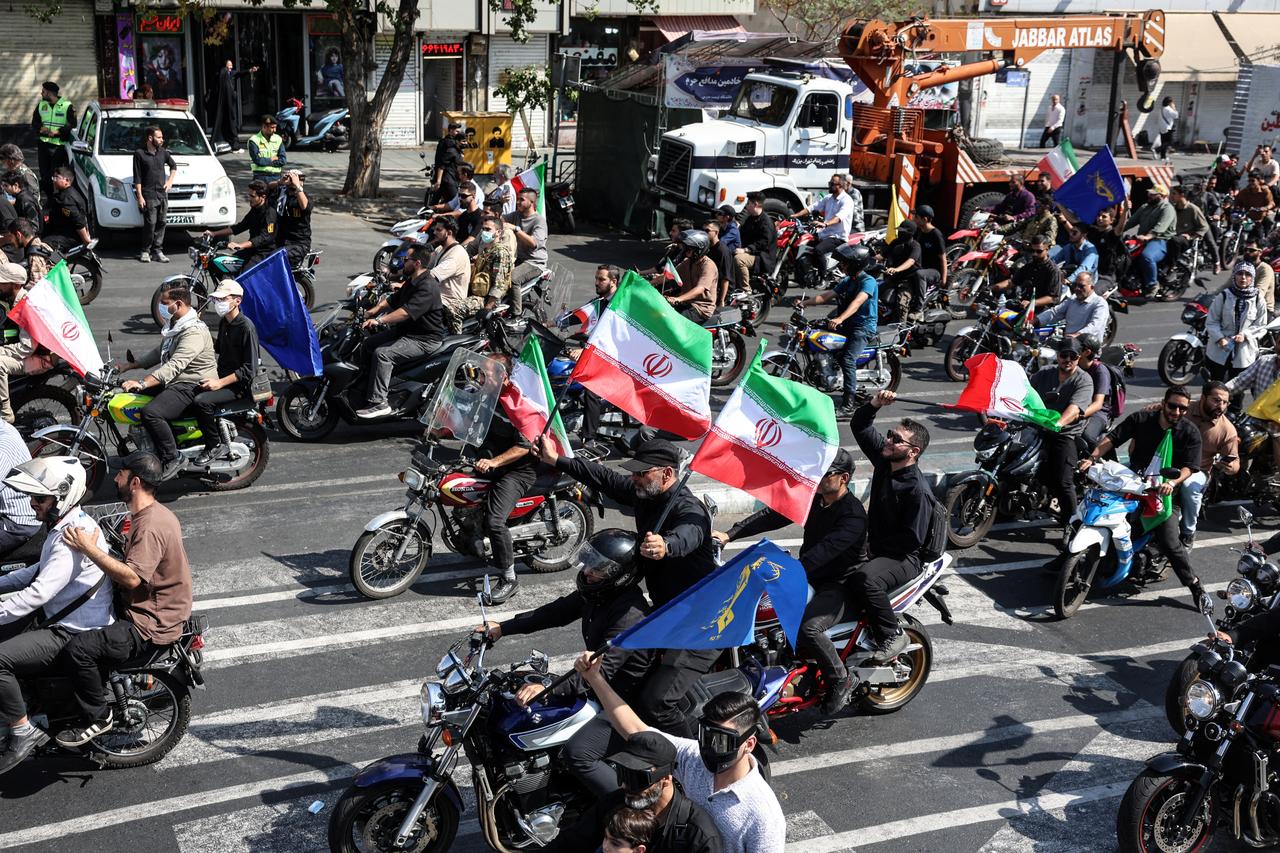
Yet a “rally to the flag” effect has led many Iranians to support the state against outside attack despite the broad unpopularity of the governing ideology and clique. By surviving, the IRGC-dominated Iranian government has validated its resistance ideology and deflected the massive public discontent that drove anti-regime protests in recent years. Meanwhile, economic support from China and military/intelligence support from Russia have made that survival more sustainable.
The “new normal” in the region may be perpetual low-level warfare that imposes costs on the global economy and Gulf security while stabilizing the regime’s hold on power.
It also features the eroding deterrent value of U.S. and Israeli military power due to extended warfare without political effect.
The U.S. might continue an economic squeeze while dialing back military operations, creating an analogue to the containment strategy against Saddam Hussein’s Iraq 1991-2003. But the countries of the region—such as Türkiye—now live alongside a revisionist power cleverer and more potent than Saddam and the prospect of another big escalation in the future.
The near term does not hold a clear path for conflict termination, creating a planning challenge for Turkish strategists.
The Turkish government fears state collapse in Iran (or anywhere near its borders) but can’t be happy with the sort of consolidated intransigence the war seems to be producing instead.
Ankara’s plans for more integrated regional trade and energy flows suffer when Iran demonstrates an ability to block or control such flows. Ankara’s preference for functional nation-states in its neighborhood similarly suffers when Iranian proxies retain the ability to challenge central authority in places like Lebanon, Yemen, and Iraq.
Israel represents another side of the coin. As long as the Netanyahu government can portray military operations in Lebanon, Syria, Gaza, and elsewhere as parts of an existential campaign against Iranian-backed terror, hoped-for progress for stabilization and reconstruction in those states will be slow or absent altogether.
A painstakingly constructed Erdogan-Netanyahu rapprochement in 2023 was undone by the Oct. 7 attacks, and since that time Israel has come to see Turkiye as a threat, becoming in turn a drag on U.S.-Turkish relations.
The notion that a Netanyahu loss in October elections will normalize the situation is unrealistic as long as a broader regional war persists—and as long as strategic elites in both countries view ties through a conflict lens.
“You Turks thrive on order.” That exchange captures a real asymmetry. Both the Iranians and Israelis seem more comfortable with regional chaos than the Turks, who have a statecraft tradition rooted in managing rather than disrupting regional frameworks. Nothing disrupts a framework like a forever war. That’s what the Middle East appears to be living through as we enter the last quarter of 2026—a war with mounting losses and no clear political way out, a mutually hurting stalemate that has all the key actors wondering when the other side will have had enough.

Several Turkish officials I spoke with in New York during the U.N. General Assembly grimly assessed that as awful as the past half year has been, 2027 could be worse.
Ankara believes both Israel and Iran are preparing for a major new round of fighting in the coming months. Iran has not successfully closed the Straits of Hormuz, giving it an incentive to expand attacks until the economic pain for the West becomes unbearable. The Trump Administration recently notified Congress of an additional $2.8 billion in military aid to Israel, including 2,000 pound bombs indicative of plans for renewed large-scale air attacks.
Escalatory steps promise more costs for Türkiye. Iranians displaced by combat operations—most of whom have stayed within national borders—could conceivably begin flowing across Turkish border crossings if conditions worsen. Continued tightening of sanctions against Iran (including secondary sanctions) could also mean more trade losses and higher energy prices in Türkiye.
Iran has pursued a strategy of holding neighbors in the Gulf at risk to put pressure on their alliances with the U.S. Tehran’s drone and missile programs remain potent enough to raise the pain level for Riyadh, Doha, and others—putting consequent pressure on Ankara to help the Gulf monarchies defend themselves.
More broadly, ongoing Russian-Iranian strategic and military cooperation endangers fragile progress on peace arrangements in the Caucasus, and the prospects for a Middle Corridor that securely transports energy resources and other trade across the Caspian and Caucasus and through Anatolia to Europe.
Perpetual warfare weakens Trump in terms of domestic politics, strengthens hardliners in Iran and Israel, and puts at risk stabilization projects in fragile states. Turkish strategists now have to consider whether Trump’s Republican Party will suffer serious losses in November’s midterms because of the war, and if so, how he might react to electoral defeat (by doubling down or walking away).
So with the region in extended turmoil and no easy “off button” for the U.S., what leverage does Ankara have to mitigate the costs of open-ended war?
In fact, the mounting costs to both Tehran and Washington provide some possible openings. Senior Turkish officials have already begun making the case to Iranian interlocutors that Trump may be the only U.S. president with the latitude before Congress to make a deal with the Iranian—by dint of both personality and proven bona fides as an Iran hawk willing to impose costs.
Iran will need economic reconstruction, and this constitutes trade space—the regime is intact but battered, and before long will likely need an intermediary trusted by Trump but also seen as balanced by Tehran.
After U.S. and Israeli elections, a door may be open to a deal trading economic incentives for nuclear concessions—basically what was on offer in Islamabad.
The best play for Ankara is to encourage both sides to renew this sort of negotiation, offer to host or facilitate the talks, observe sanctions and maintain disciplined public messaging, and prepare for the security and humanitarian challenges of another major escalation next year if talks are slow to bear fruit.
So there is a scenario in which war weariness drives pragmatism among the belligerents and Turkish diplomacy helps get a deal done. There is also a scenario in which a major new escalation and a third year of warfare (after 2025’s 12-day war and the current round that began on Feb. 28) raises economic and security risks even further.
The wildcards at play include the U.S. and Israeli elections. For Ankara, the key variables are all exogenous—and thus the strategy is one of wait, see, and be prepared to respond. As has so often been the case in this region, it’s a matter of minimizing worst outcomes.


 Set as preferred source
 Set as preferred source


 2 min read
 1 min read