Newsletters





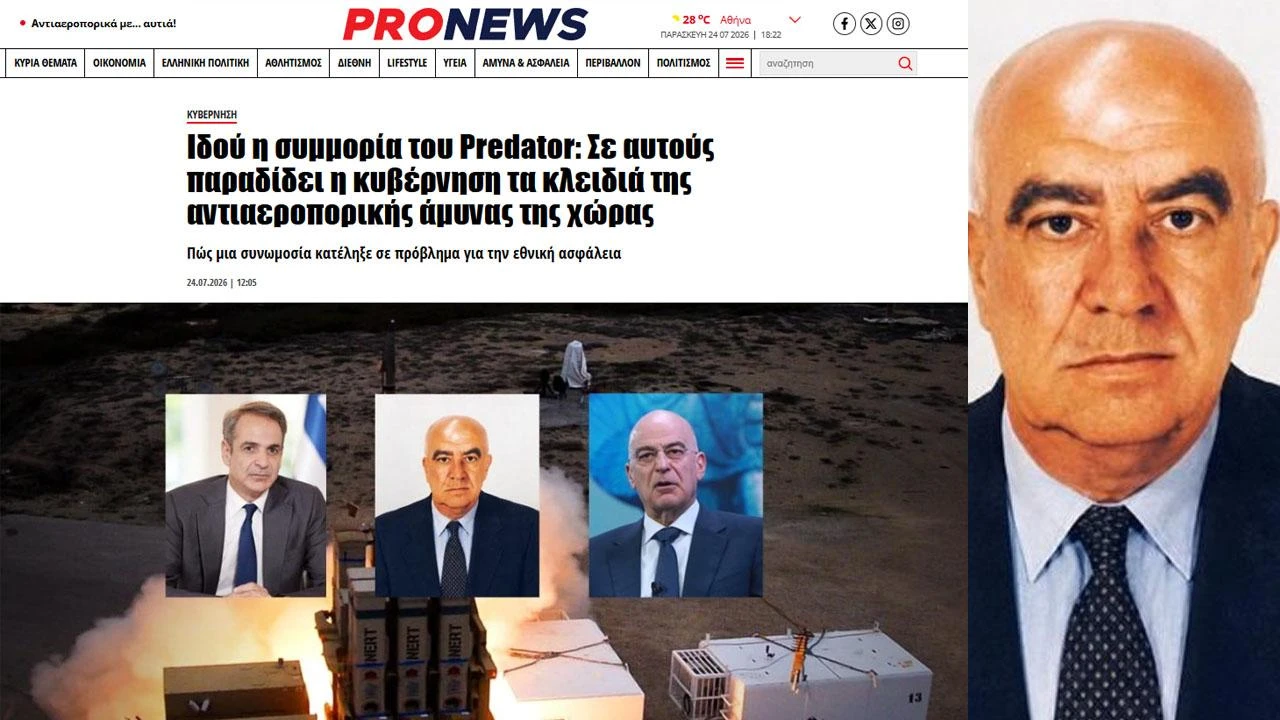
Greek opposition newspaper Pronews published a report reviving the Predator scandal that broke out in 2022, showing that an Israeli company holds the keys to Greece's national security and engages in illegal activities with the knowledge and support of the Mitsotakis government.
According to the report, the key figure who brought the Israeli-origin spyware into the country was Stavros Komnopoulos, the Athens representative of Rafael Advanced Defense Systems.
In 2020, Komnopoulos placed Rotem Farkash, the former Israeli officer who developed the software, in an apartment in Palaio Faliro belonging to New Democracy MP Georgia Martinou, and paid the rent through Kestrel, a company under his control. It is alleged that the same arrangement was set up for other Intellexa executives as well, pointing to an organized housing network.
The legal dimension of the scandal gained clarity in February 2026, after a long period of silence. Intellexa's founder, Tal Dilian—who has ties to the Mossad—was one of four people convicted of violating personal data protection and breaching communications privacy.
However, although the total sentence on paper exceeded 126 years, the time actually to be served is limited to eight years, and the appeals process is still ongoing. This gap alone sums up how lenient the Greek justice system remains toward high-profile defendants.
The scope of the scandal stands in stark contrast to the leniency of the sentence: at least 87 to 90 journalists, opposition figures, including PASOK leader Nikos Androulakis, ministers, military officials, and businesspeople were targeted with Predator.
Given such a broad target list, the fact that an eight-year sentence falls far short of being a deterrent shows that the center of gravity of the issue lies less in the punishment itself than in the mediation network behind it. How lightly this network has paid before the courts is one issue worth examining, and which doors remain open to it is another.

Official investigations insist on the defense that the Greek Intelligence Service (EYP) did not directly use the software. However, the fact that several targets were placed under legal wiretapping during the same period—alongside ongoing claims about Intellexa's ties to government circles and the shielding of an "invisible power"—remains unclarified.
In his prosecutorial testimony, Komnopoulos stated that he only sold the software and never used it. In contrast, Pronews and investigative sources maintain that he mediated the establishment of Intellexa's infrastructure in Greece and facilitated the company's contacts with officials.
That a figure standing at the very center of an espionage operation targeting the country's top political and military leaders has evaded accountability is, in itself, a stark warning about the Greek judicial system.
The most striking point is that this same individual continues to feature prominently in major defense tenders. Komnopoulos played a central role in the sale of Rafael's Spike NLOS missiles to the Greek military in 2022–2023, in the recent procurement of the PULS rocket launcher system, and most recently, the "Achilles' Shield" package approved by KYSEA, valued at three and a half to four billion euros.
This package, covering the David's Sling, Spyder, and Barak MX systems, deserves to be viewed as a direct extension of the network established during the Predator scandal. That someone associated with a major spyware scandal continues to influence the country's multi-billion-euro air defense procurement reveals a state apparatus with weak institutional memory.
Throughout the history of Greek politics, defense procurement has long been vulnerable to the same recurring brokers. The Predator scandal showed that this pattern extends beyond corruption—intertwining with a threat where a state's most sensitive security data can leak directly to foreign intelligence circles.
Nevertheless, the fact that the same names continue to hold influence in the defense supply chain also exposes the reluctance of the Greek state mechanism to learn lessons from the crisis.
The key to the systems protecting Greece's skies today lies largely in the hands of Israeli firms.
It is difficult to explain this situation as an ordinary procurement preference; the fact that commercial ties established by figures linked to the Predator scandal with the same Israeli companies keep resurfacing in defense purchases points to a systematic dependency.
The Greek opposition and some European observers describe the process as a conspiracy that has turned into a national security issue. In contrast, Athens-Israel defense cooperation continues to deepen without slowing down.
Allowing the nation's most critical strategic decisions to remain vulnerable to an unregulated network of middlemen exposes a profound failure of institutional oversight.
If the name at the center of a prosecutorial investigation can, a few years later, be found among the architects of the same state's largest armament program, the problem is no longer confined to the moral choice of a single individual. The system itself appears to lack the reflex to weed out conflicts of interest.
That oversight institutions have seen the same names at the center of different scandals for years without producing any lasting sanction constitutes another dimension of the questioning of institutional learning capacity.
The unresolved aspects of the Predator scandal continue to remain in the shadow of the new wave of armament.
Tal Dilian’s reduced eight-year sentence, Komnopoulos managing to stay outside the prosecutorial reports, and the claims of an "invisible power" never being officially investigated are proof that the scandal is not closed.
The question before the Greek public is no longer one of identity; it is how the same name, known for years, continues to hold a place in the government's most strategic armament programs without being held accountable.
As long as the answer remains unclear, every new billion euros poured into Athens' air defense will keep turning into a national security problem.


 Set as preferred source
 Set as preferred source



 4 min read