Newsletters




The most revealing moment of the 2026 World Artificial Intelligence Conference (WAIC) wasn’t what tech giants were showing off—it was what they were scrambling to fix.
With more than 1,100 exhibitors displaying over 3,000 exhibits, the event laid bare the true hurdles ahead: reliability and the sheer computing power required for widespread use have emerged as the hardest questions facing the industry.
Yet against this backdrop of technical limits, Beijing positioned its own ambitions inside an international pitch—offering open models and affordable computing services tailored specifically for the developing world.
In the global AI race, headline numbers often obscure the real story. In Arena data cited by the 2026 Stanford AI Index, the leading American model held a narrow 2.7% lead over the leading Chinese model in March. But benchmark scores can be deceiving. A Stanford review uncovered invalid questions in nine widely used benchmarks, with error rates ranging from 2 to 42%. A high score may signal raw capability, but it says far less about reliability or cost in everyday use.
Beyond raw performance, the real battleground lies in standardizing systems and expanding practical applications. At the WAIC, the China Academy of Information and Communications Technology joined several companies to release a secure protocol for agents—software designed to carry out tasks for users—across different platforms.
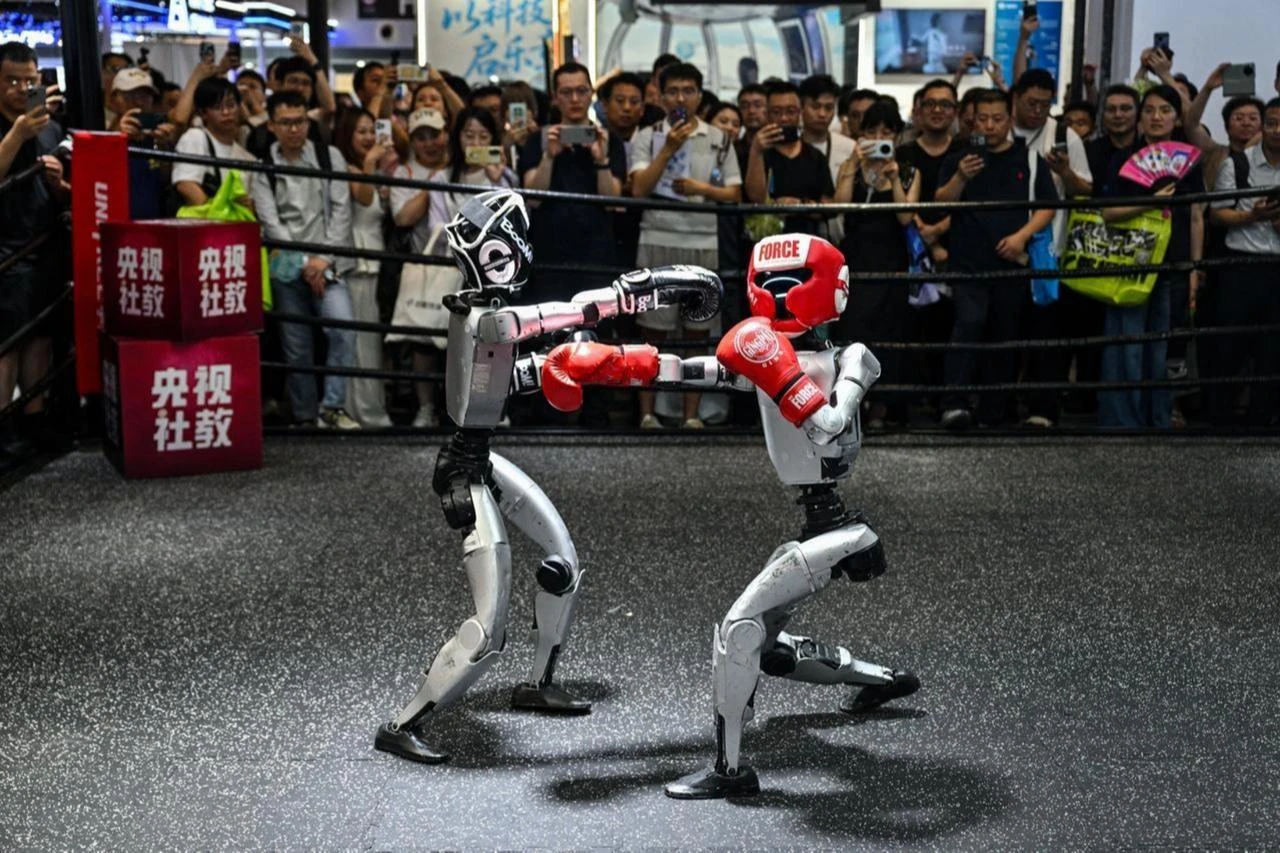
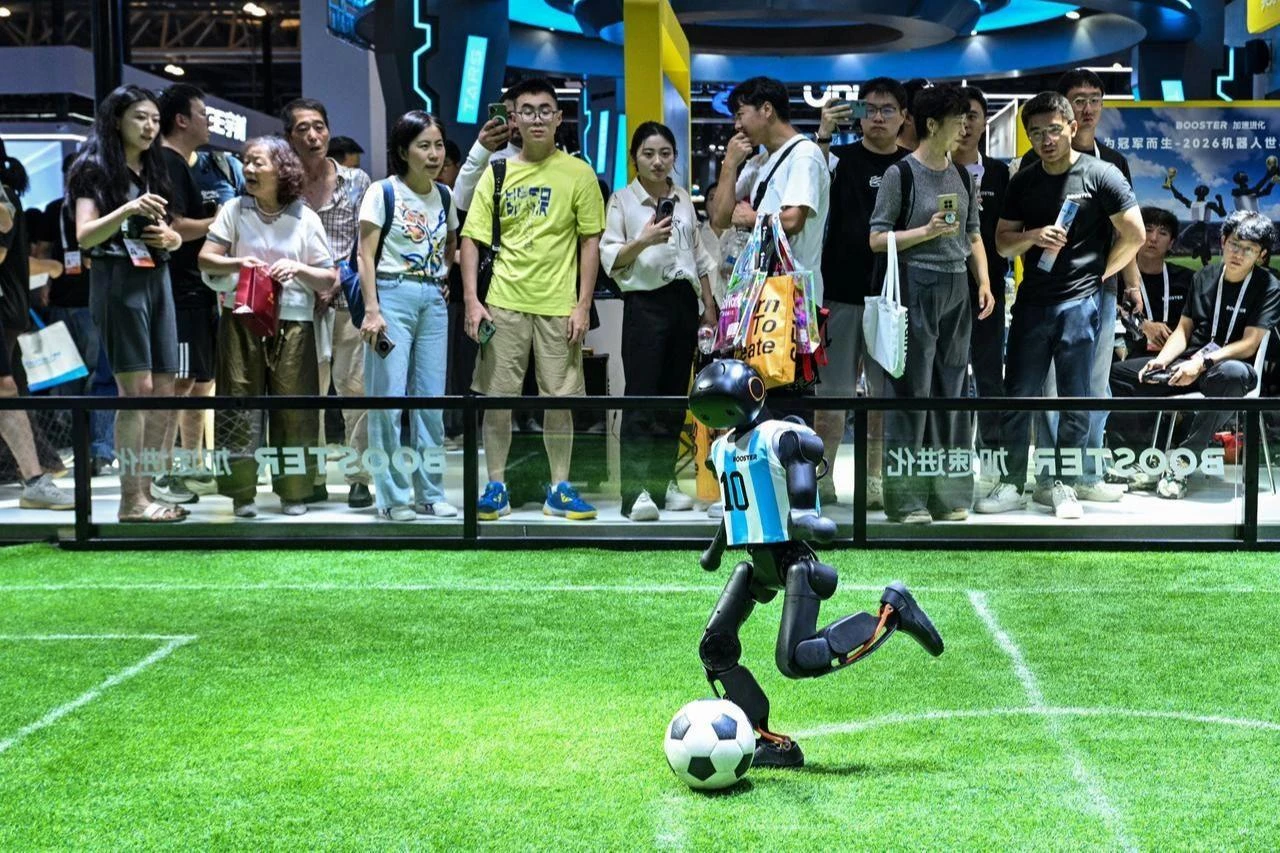
At the same time, more than 200 companies participated in the embodied-intelligence track, which covers AI systems that control machines. China installed 295,000 industrial robots in 2024, or 54.4% of the global total. Robots still perform poorly on varied household tasks. In the BEHAVIOR-1K household simulation, the leading system fully completed only 12.4% of tasks.
The trajectory of Moonshot AI’s new flagship model, Kimi K3, captures both this rapid progress and its structural constraints. The Beijing-based startup says the model features 2.8 trillion total parameters, using a sparse architecture that activates 16 of 896 experts at a time, along with a one-million-token context window capable of accommodating large amounts of text.
Moonshot plans to release the complete model weights by July 27, though its full technical report remains pending. Yet within 48 hours of launch, user requests approached cluster capacity, prompting Kimi to pause new consumer subscriptions. It serves as a stark reminder: a competitive model may arrive long before the capacity exists to provide it cheaply and consistently to a mass market.
In response to hardware constraints, domestic engineering is stepping in. Huawei presented its Atlas 950 SuperPoD at WAIC, which connects 1,024 Ascend accelerator cards—specialized hardware for AI calculations—so they operate as one large computer. American export controls continue to restrict advanced chip shipments, though Washington reviews applications for products like H200s case by case under security conditions.
Yet card numbers alone do not guarantee efficiency. A Chinese industry report from WAIC described repeated engineering work required when moving models between domestic chips with different designs and software. According to the report, executives emphasized that stable operation and the effective use of available computing power matter far more than headline figures.
The financial divide remains stark. Private capital is significantly deeper in the United States, where Stanford recorded $285.9 billion in private AI investment in 2025 compared to $12.4 billion in China. The comparison does not capture China’s government guidance funds and does not measure computing capacity.

Axios reported as the conference ended that parts of the Trump administration were again considering restrictions on advanced Chinese models. Earlier proposals reportedly included adding Chinese laboratories to the Entity List and issuing federal security warnings. The White House also considered requiring American hosts to guarantee security and accept liability for breaches.
The policy focus may be moving from chips to models. Chip export controls can make training harder, but by themselves they cannot prevent publicly released model weights from circulating. Washington could instead target how Chinese models are hosted and purchased, or increase the legal risk for companies using them.
American officials and industry figures also disagree over the trade-offs of such restrictions. The 2025 AI Action Plan describes open-source and open-weight models as strategically valuable because users can adapt them and keep sensitive data on their own systems.
It calls on the Commerce Department and NIST to research China’s most advanced models and, where appropriate, publish evaluations of what the plan describes as censorship and alignment with Chinese Communist Party talking points. However, some national security officials worry about hidden vulnerabilities and dependence on software governed abroad.
Meanwhile, Reuters reported last week that Chinese authorities had discussed restricting overseas access to some future advanced models. No rule has been adopted, and the scope remains unsettled. Nevertheless, Xi Jinping used his WAIC speech to promote open-source development and wider access.
Chinese authorities have also discussed restricting overseas access to some future advanced models. On the other hand, no rule has been adopted, and its scope remains unsettled. The discussions suggest that Beijing may favor openness where wider use expands its technology ecosystem, while reserving control over capabilities it considers sensitive.
Representatives of 29 countries signed the founding agreement of the World Artificial Intelligence Cooperation Organization in Shanghai. China’s Foreign Ministry said it would work with the other founding members to bring the organization into operation.
A separate action plan published by China’s National Development and Reform Commission and other government departments proposes multilingual datasets, affordable computing services for developing countries, and local adaptation of open models. In his address, Xi promised 5,000 AI training places for developing countries over five years and the deployment of the “MAZU” weather-warning system in 30 countries.
Neither the action plan nor Xi’s speech specifies a budget or delivery timetable for the proposed computing services and facilities. They also do not say who would own the facilities or cover their electricity costs. Those gaps will help determine whether China’s offer produces working infrastructure or mainly easier access to model files.
Moreover, China is unlikely to dislodge the United States from its established alliances. Its larger opening lies among developing countries, where affordable models, computing access, and training could expand governments’ room for maneuver, especially where Western partnerships deliver weak growth or are perceived as extractive. Meanwhile, delivery at scale remains a key constraint.
A central test will be commercial: Can Chinese providers offer dependable AI at a price that governments and companies can sustain? Shanghai made the offer more credible, but delivery at scale remains unproven.


 Set as preferred source
 Set as preferred source



 5 min read