Newsletters





This article was originally written for Türkiye Today’s weekly economy newsletter, Turkish Economy in Brief, in its Aug. 31 issue. Please make sure you are subscribed to the newsletter by clicking here.
The “normalization step in monetary policy” signaled by the Central Bank of the Republic of Türkiye (CBRT) during its third Inflation Report presentation in early August came last week.
Since the outbreak of the crisis in the Middle East in March, the CBRT had been conducting market funding not at the 37% policy rate, but at 40%, the upper band of the interest rate corridor. This practice, which continued for around six months, changed with a decision taken at the beginning of last week.
The CBRT resumed weekly repo auctions and returned to the policy rate. As a result, the overnight Turkish lira rate (TLREF), which stood at 39.9% the previous week, ended last week at 36.9%.
Inflation can stem from either demand or supply. Monetary policy works by “slowing demand.” The core of the central bank’s recent messages has been that there is a “significant cooling in demand.” This is why a transition to repo auctions has become possible.
If demand is slowing but inflation is not falling noticeably, supply-side factors such as oil prices and administered or regulated prices come into play. In such a case, keeping the interest rate at 40% or lowering it to 37% has little impact on “supply-driven inflation.”
With the transition to repo auctions last week, attention turned to the Turkish lira, which lost a limited 0.5% against the U.S. dollar, in line with the previous weeks. Therefore, based on the initial market reaction, there were no signs of a dollarization risk.
The CBRT’s move appears to represent controlled easing as much as normalization. From now on, the Central Bank will be watching demand for Turkish lira deposits more closely. (Despite the $5.8 billion increase in foreign-currency deposits the previous week, foreign currency’s share of total deposits stood at 37.9%.)
Kerem Aksoy, deputy general manager of Rota Portfolio Management, said the Turkish lira accounts for around 62% of savers’ preferences and that its returns remain attractive. In his assessment, he said, “I do not expect an additional rate cut from the Central Bank in September. Monthly inflation is still not at the desired level. On the other hand, if disinflation continues and oil prices do not rise above $90, the lowest policy rate we could see by year-end could be 35%.”
As September begins, August inflation, which will be released Thursday this week, stands out as the most important item on the market agenda.
According to a survey by financial data platform Matriks, which included 32 banks and brokerage firms, consumer price inflation (CPI) is expected to come in at 2% in August.
Economist Banu Kivci Tokali also said: “Our August inflation forecast is 1.9% month-on-month. This figure is above July’s 1.8%, but below the 2% recorded in August last year.”
Tokali said that if the forecast is realized, the decline in annual inflation from its May peak of 32.6% would continue. “Our annual CPI forecast for August is 31.6%... This is also consistent with our expectation that CPI could fall below 30% at the beginning of the final quarter. Our year-end CPI forecast is 29.5%,” she said.
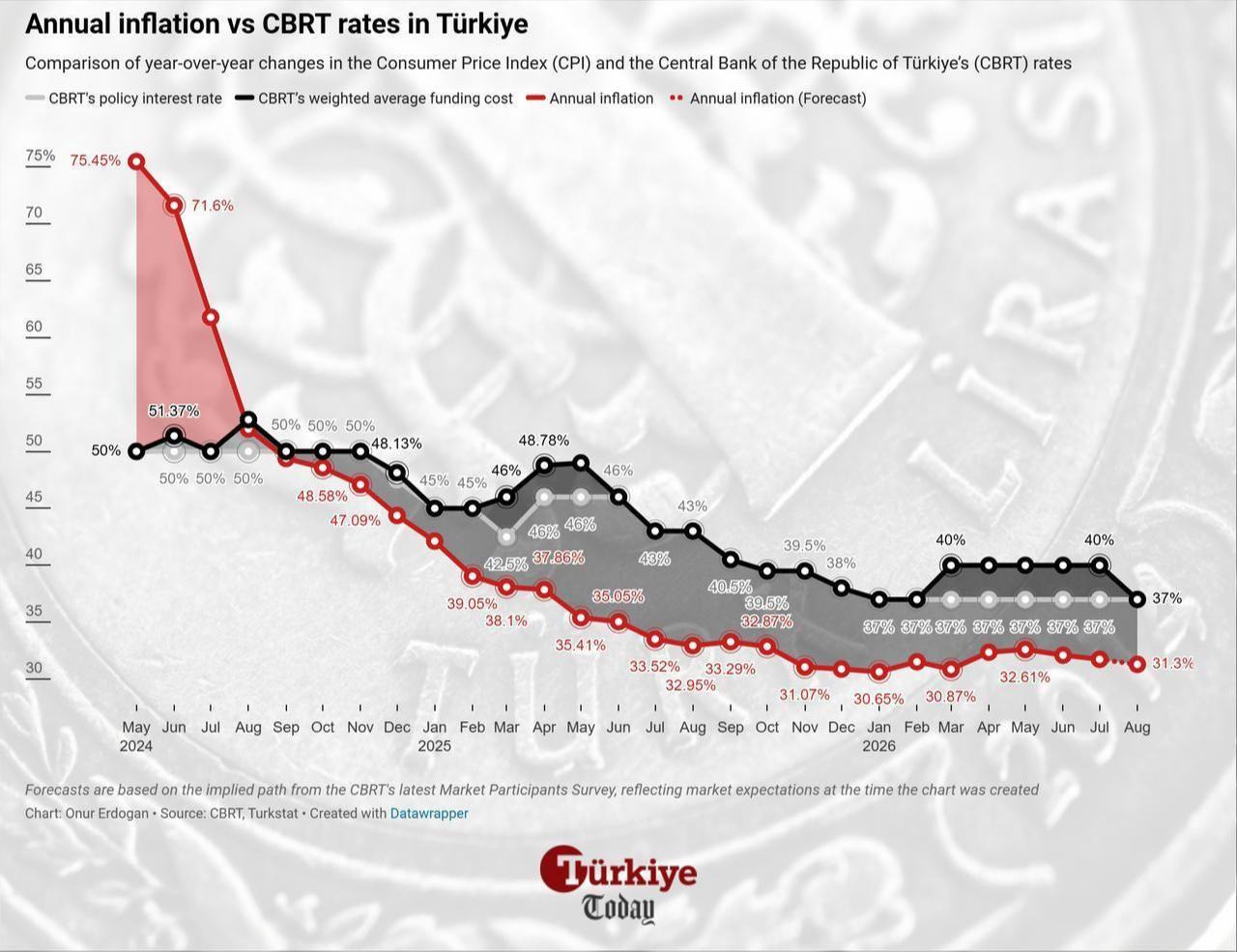

Tokali said the most significant source of inflationary pressure this month is the “transportation” category, pointing to fuel price increases reaching double digits.
“On the other hand, unprocessed food prices are showing a calm, even slightly downward, trend. But the key issue is processed food inflation. This will be particularly important in determining whether the moderate trend seen last month continues,” she said.
While these developments are unfolding in Türkiye’s markets, continued uncertainty in the Middle East and oil prices remaining above $85 are also being closely monitored.
Federal Reserve Chair Kevin Warsh also delivered his closely watched speech at Jackson Hole last week. Saying that the Fed’s primary focus should currently be on prices because inflation remains above the 2% target, Warsh said, “Although PCE and Consumer Price Index data this summer have come in better than expected, they do not show me that the underlying trends have improved meaningfully.”
Warsh said the Fed bears direct responsibility for the high inflation that has persisted for 65 months, adding, “We need to make sure that core inflation is clearly and sufficiently rapidly moving toward our target. Otherwise, we have work to do.”
The Fed’s latest message caused the dollar index to rise and precious metals to post significant declines during the final trading hours of the week. A stronger and more expensive dollar will also be one of the key indicators to watch in the coming period in terms of capital flows into emerging markets.


 Set as preferred source
 Set as preferred source



 7 min read