Newsletters




This article was originally written for Türkiye Today’s weekly economy newsletter, Turkish Economy in Brief, in its Oct. 19 issue. Please make sure you are subscribed to the newsletter by clicking here.
As the liquidation process involving investment funds in Türkiye continues, global index provider Morgan Stanley Capital International (MSCI) has temporarily frozen certain changes to its indexes concerning Turkish stocks, putting the issue back in the spotlight.
The decision stems from concerns over transparency and the actual free float of shares, and has also reignited debate over Türkiye’s market status.
MSCI said it is monitoring regulatory steps taken in Türkiye but needs more time to assess whether structural improvements are sufficient. It said that if adequate progress is not made by June 2027, it may consider reclassifying Türkiye from an “Emerging Market” to a “Frontier Market” or “Standalone Market.”
By way of background, MSCI is a global index provider that classifies countries into four main categories according to the development of their markets: Developed Markets, Emerging Markets, Frontier Markets and Standalone Markets.
A country’s classification can change, and international investors may use these indexes as benchmarks when making investment decisions. Türkiye is currently classified as an Emerging Market by MSCI.
MSCI's consideration of a possible downgrade to Indonesia's market status over similar concerns offers a notable example for Türkiye. A warning that Indonesia could lose its emerging-market status contributed to a 14.91% decline in the Jakarta Composite Index last week.
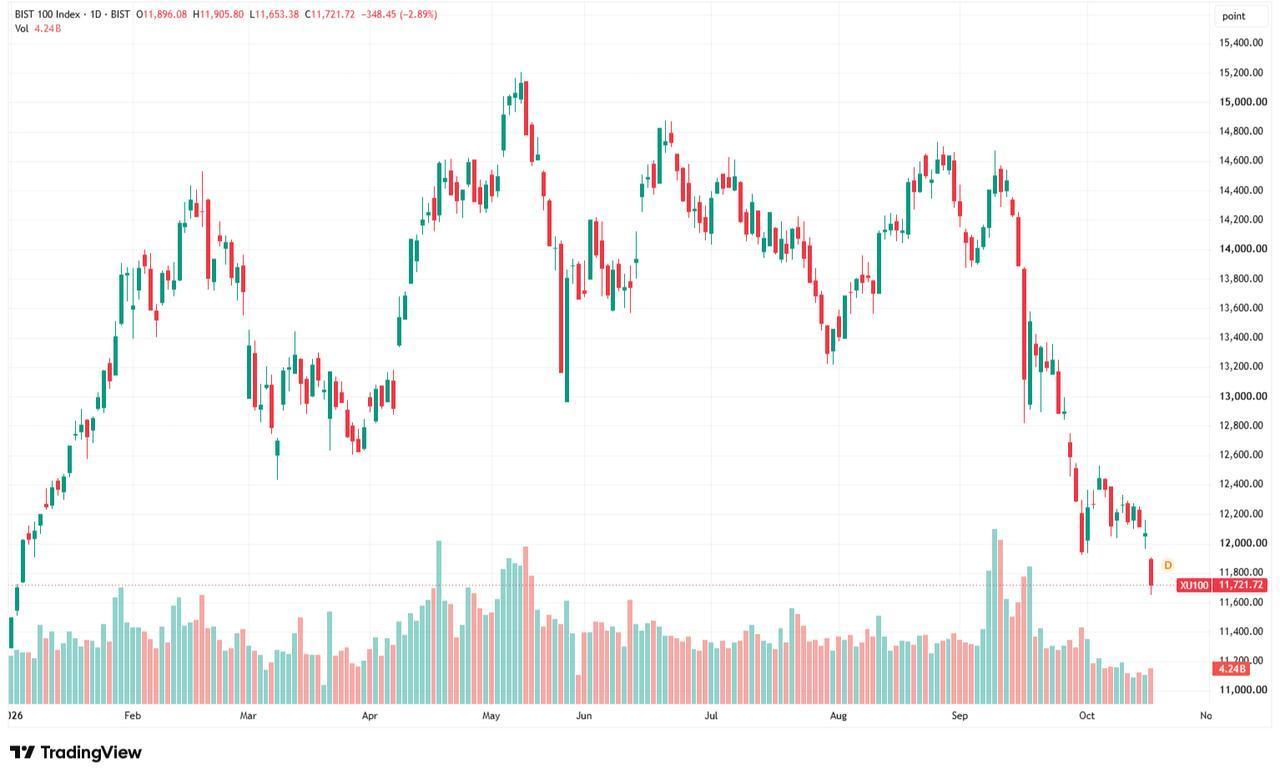
MSCI’s announcement on Friday also rattled Türkiye’s stock market. The BIST 100 index on Borsa Istanbul fell 4.44% last week, closing at 11,721.72.
Under mounting pressure on Friday, the index dropped as low as 11,653.38, its lowest level since Jan. 5. Following the start of the fund liquidations, and particularly during the first half of October, the index had been trying to consolidate within the 11,900–12,500 range. It has now fallen below that range.

Professor Dr. Celali Yilmaz, a faculty member at Istanbul Medeniyet University, said Türkiye had not reached the same stage as Indonesia, but the process warranted close monitoring because of similar concerns over market credibility and transparency.
"Türkiye is in a better position than Indonesia and has not yet reached the same stage. It is at an earlier point in a process moving in the same direction because of similar market problems. Indonesia is therefore not Türkiye's inevitable future, but it is a concrete stress scenario that Türkiye could face if the necessary steps are not taken," Yilmaz said.
HSBC Global Investment Research described the freeze on index changes in Türkiye as a "warning." The bank viewed the decision not to immediately launch a review of Türkiye's market status, along with the time granted until June 2027, as an opportunity for the market to make progress. HSBC said the regulations could deliver structural improvements over the long term and maintained its "Overweight" recommendation for Türkiye. However, it stressed that the rules must be implemented effectively and sustainably for the country to retain its status.
Dr. Nuri Sevgen, general manager of Anadolu Yatirim, said the decision had both positive and negative aspects. While welcoming the time granted to Türkiye to make improvements, Sevgen noted that the status of some stocks remained unclear because of the liquidation process. He said investors were becoming cautious because shares in strong, profitable companies, as well as troubled stocks, remained tied up in the funds.
Treasury and Finance Minister Mehmet Simsek said regulatory efforts to improve transparency and investor confidence in capital markets were continuing. He highlighted measures such as more frequent disclosure of fund portfolios, announcements of certain share ownership changes, and concentration limits and rules for secured borrowing.
Simsek said completing the liquidation of troubled funds and protecting investor rights remained priorities. He also said the government planned to complete legislation to strengthen the fight against capital-market crimes, including coordinated trading by funds, by early 2027.


 Set as preferred source
 Set as preferred source



 3 min read