Newsletters


Over the past few years, Middle Eastern powers have jostled for regional influence, and only recently have they begun sealing shiny new security pacts among themselves.
Yet when the Red Sea narrows, the phone still rings in Washington, even if nobody picks up the strike orders.
"So many experts are not understanding why Mr. Trump is reluctant to act militarily to help Saudi Arabia out in this situation," says Kenneth Katzman, a senior fellow at the Soufan Center and former Middle East analyst at the Congressional Research Service.
"There are also other questions as to why he's not using more force against Iran," Katzman told Türkiye Today as Houthi fighters completed what a decade of fighting had denied them: full control of one of the world's busiest chokepoints for oil and container traffic.
Mocha gave the world a word before it gave anyone a war. For three centuries the Yemeni port shipped beans up the Red Sea to traders who turned "mocha" into shorthand for coffee itself.
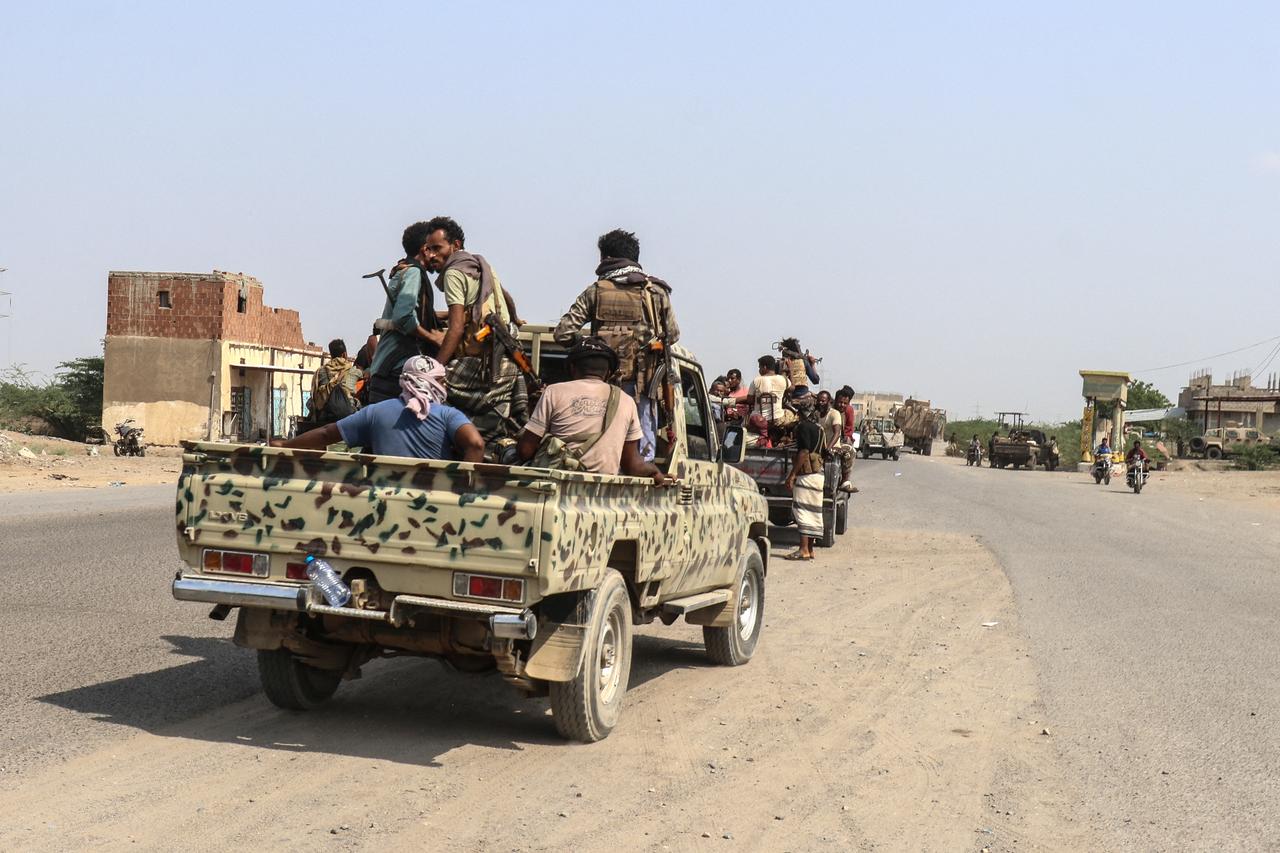
On Friday, Houthi fighters rolled through streets named for an export nobody has moved through there in generations, and hours later the group also took Mayyun Island, the sliver of rock that splits the Bab al-Mandeb Strait into navigable lanes.
It’s upon these developments that Crown Prince Mohammed bin Salman reportedly called Donald Trump twice on Thursday, first to brief him on the advance toward Mocha, then to press for American strikes once the city looked lost. Trump is said to have turned him down both times.
A same-day trip by CENTCOM commander Adm. Brad Cooper tells the more interesting story: an ally in visible distress and a White House calibrating exactly how much of that distress it will absorb secondhand.
The stakes on the ground have moved well past theoretical threat models. Saudi jets struck Mocha's airport twice on Friday to try to dislodge Houthi forces, and all of it is unfolding while the Strait of Hormuz, a thousand miles east, is already choked by the broader confrontation with Iran.
Washington now has two energy arteries under simultaneous pressure and a Gulf partner asking it to open a second front to fix one of them.


With an American president embarking on an unprecedented midterm campaign blitz, many suspect Middle Eastern affairs are of interest to President Trump only to the extent they hit voters at the ballot box, and the midterms are the only game in town.
Dr. Kristian Alexander, a Gulf security analyst who has held fellowships at the Rabdan Security and Defense Institute and Trends Research & Advisory, told Türkiye Today that Trump's refusal reflects prioritization rather than indifference.
The United States is already committed to confronting Iran directly, and a sustained Yemen campaign would split intelligence, surveillance, aerial refueling, and precision-strike assets that are stretched thin as it is, while exposing American forces and bases to new retaliation.
There is also plain skepticism about what airstrikes buy, according to the seasoned researcher. Earlier campaigns against the Houthis showed that their mobile missile batteries, drones, underground storage, and dispersed command are hard to remove from the air, and strikes can impose cost without reversing territory absent an effective Yemeni ground force. That leaves an expensive campaign with no clear exit.
Alexander also reads the refusal as Trump's transactional instinct toward allies: he reaches for direct force when American personnel or ships are hit, not by default when a partner faces a regional threat.
Intelligence-sharing lets him support Riyadh while pushing Saudi Arabia and its neighbors to carry more of the fighting themselves.
An American strike carries its own escalation risk, since the Houthis could answer by hitting U.S. bases, Saudi energy sites or shipping more aggressively, pushing oil prices higher at a moment Trump can least afford it domestically.

Alexander expects Washington to keep running a differentiated strategy: reserve its heaviest capabilities for Iran while containing the Houthis through intelligence sharing, missile defense, maritime escorts, interdiction of Iranian arms shipments and support to Saudi and Yemeni government forces.
Direct U.S. strikes stay on the table only if the Houthis start systematically targeting American vessels or show they can close the strait outright.
The complication, in his view, is that Iran and the Houthis are neither one actor nor two unrelated ones. Tehran supplies weapons and political backing, but the Houthis retain their own territorial goals and decision-making.
Squeezing Iran would not automatically remove the Houthi threat, and hitting the Houthis would not necessarily move Tehran's calculus.
That asymmetry suits Iran well: pressure at Bab al-Mandeb stretches American and Saudi resources, opens a second pressure point while Hormuz is already disrupted, and buys Tehran leverage without committing Iranian forces to the strait itself.
 2 min read
Alexander also points to a Saudi-Turkish angle. Riyadh's appeal for direct American action, despite the recently signed Mecca Joint Defense Agreement with Türkiye and Pakistan, shows the gap between political solidarity and deployable capability; the pact may deepen consultation and longer-term deterrence, but it cannot yet substitute for American surveillance, targeting and precision-strike assets.
The episode, he told Türkiye Today, exposes a paradox in the region's emerging order: Saudi Arabia is pursuing strategic autonomy and diversified partnerships, and a high-intensity crisis still sends it back to Washington.
Trump, for his part, wants to keep his leverage without resuming the old role of the region's first responder.

Two half-baked operations don't add up to a full one. Ever since Yemen’s civil war broke out, Saudi Arabia has pulled its punches in a country right on its doorstep. The United States has taken much the same approach.
Katzman, speaking to Türkiye Today, reads the same restraint with far less patience. He traces it partly to fear that striking the Houthis would invite Iranian retaliation against Gulf states, partly to concern over munitions expenditure, and partly to a belief inside the administration that Saudi Arabia has the ground and air forces to handle the fight on its own.
He does not share that belief. Bab al-Mandeb is, in his assessment, a vital American interest, and letting Iran and the Houthis tighten their grip on it threatens global oil supplies directly enough that air power is worth using.
Katzman extends the critique beyond Yemen. Iran has attacked shipping near the Strait of Hormuz off Oman on multiple occasions, and Trump has largely declined to respond, a pattern he says has cost the president credibility as commander-in-chief among people who study the region.
Unanswered attacks, in this reading, are not caution; they are a failure to deter Iran and its proxies, with consequences for American interests that accumulate the longer restraint holds.
Whichever reading is right, the port that once put a word for coffee into a dozen languages is now a Houthi checkpoint, and the strait it sits in is doing more to set the price of oil than to move it. Washington did not lose Mocha. It decided, for now, that Mocha was not its fight.


 Set as preferred source
 Set as preferred source




 1 min read