Newsletters


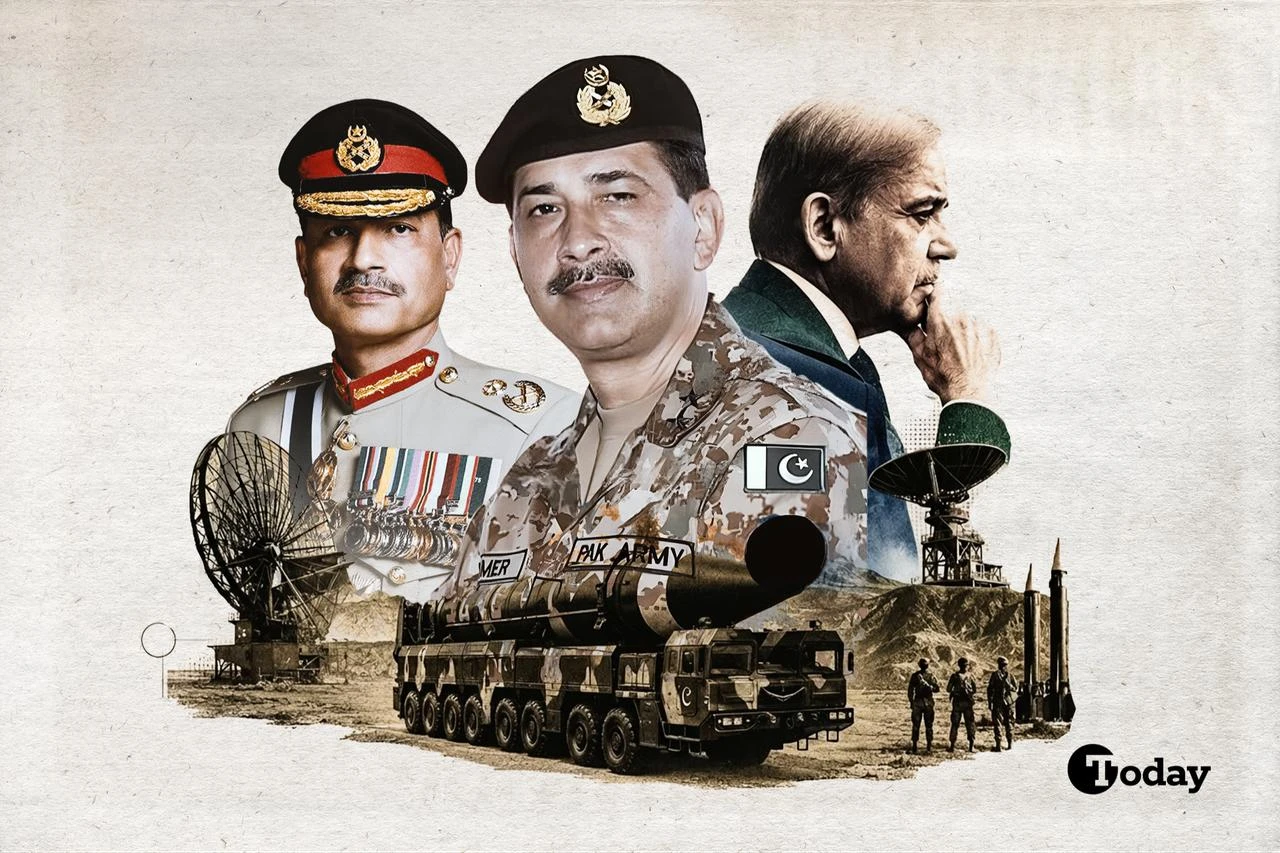


Taking one more step toward completing its most significant military restructuring in decades, Pakistan formally operationalized its newly established National Strategic Command (NSC) by announcing the appointment of Gen. Syed Aamer Raza as its first commander last week.
Before appointing Gen. Raza as Commander of the NSC, the unified operational headquarters responsible for coordinating Pakistan’s strategic forces, Prime Minister Shehbaz Sharif promoted him to the rank of four-star general.
For the next three years, Gen. Raza became the second-most senior officer in the Pakistan Army after Army Chief Field Marshal Asim Munir. In terms of military rank, he is senior to the director general of the Inter-Services Intelligence (ISI), as a three-star lieutenant general traditionally holds the spymaster’s position.
The CNSC’s post was established under the sweeping military reforms initiated by the 27th Constitutional Amendment, which rewrote Article 243, significantly altering Pakistan’s upper defense echelons in 2025.
As per these changes, the new position of chief of defense forces, currently held by Field Marshal Asim Munir, was created, along with the post of Commander of the National Strategic Command. However, the office of Chairman Joint Chiefs of Staff Committee was abolished.
The reforms seek to eliminate overlapping chains of command that previously existed between the three armed services, creating a centralized headquarters capable of coordinating strategic planning, missile forces, and nuclear operations during both peacetime and conflict.
Historically, Pakistan's nuclear command system has rested on three pillars: the National Command Authority (NCA), chaired by the prime minister and responsible for nuclear policy and employment at the top. The Strategic Plans Division (SPD), serving as the NCA's secretariat, and the third component, consisting of separate strategic force commands within the Army, Navy and Air Force, responsible for operating delivery systems.
The timing of the reforms is significant, as the main objective seems to be the creation of an integrated operational headquarters capable of coordinating nuclear forces, strategic missiles and long-range planning across all three services.
Military planners are believed to have drawn important lessons from last year's conflict with India, during which coordination between conventional forces, long-range missile units, cyber capabilities and strategic assets assumed greater importance than in previous crises.
Modern military doctrine increasingly emphasizes multi-domain operations, requiring land, air, naval, cyber and space capabilities to function through a unified command structure.
The NSC appears designed to meet those requirements by enabling faster decision-making, reducing institutional overlap and improving coordination during periods of heightened tension.
In fact, Gen. Raza himself had been overseeing many of these organizational reforms before his promotion, including the establishment of the Army Rocket Force Command, one of the principal building blocks of Pakistan's evolving strategic architecture.
And as the NSC is operational, military observers are expecting further senior-level appointments and organizational changes across the armed forces in the coming weeks as the restructuring is completed.
Explaining that the creation of the NSC is not “simply military re-organization,” Junaid Javeed, a security risks analyst, told Türkiye Today that Pakistan already had a Joint Services Headquarters but its role was relatively limited in strategic decision-making and operational command when compared with the demands of modern warfare.
Pointing out the changed character of warfare since the Cold War, Javeed said that strategic command systems were mainly built around nuclear deterrence, and political control over such use.
But now, deterrence “extends well beyond nuclear forces, combining conventional precision-strike capabilities, cyber-ops, electronic warfare, artificial intelligence, drones, space-based intelligence and real-time surveillance.”
Noting that the possession of such capabilities “is no longer enough” unless they can be “brought together within a common framework,” Javeed said that the “ability to connect intelligence, decision-making and military effects can be as important as the weapons themselves” as fragmented command structures become a liability when the pace of warfare accelerates.
Observing that recent conflicts, from Ukraine to the Israel-Iran conflict, have demonstrated the growing importance of such fusion, Javeed said that Pakistan wants to “keep pace” and the establishment of the NSC “appears to be an effort to modernize strategic governance rather than simply centralizing Pakistan’s nuclear command.”
The creation of the NSC provides the mechanism to review, assess, and coordinate the “most appropriate response” without delay, he said, and “decisions that once unfolded over days may now be taken within minutes.”
Meanwhile, Haidar M. Hussain, a defense industry consultant and founder of the magazine Defense Guardian International, told Türkiye Today that the Pakistan military gains three things from the restructuring: “command unity, strategic autonomy, and institutional permanence.”
Discussing the NSC, he said that it “consolidates nuclear stockpiles, missile systems, and delivery platforms under a single authority, reportedly modeled on China's PLA Rocket Force. This creates an integrated operational command and strengthens deterrence along Pakistan's eastern border. The Army Rocket Force Command has also been established as part of the restructuring.”
He said the separation of nuclear assets under a dedicated CNSC creates a single, unified command for strategic forces and reduces the potential for miscommunication across tri-services.
Moreover, he noted, “The constitutional insulation of the CNSC appointment ensures the command chain is legally unassailable, preventing political or legal challenges during crises. The 'always-never' principle remains unchanged: weapons are always available when lawfully needed and never used inadvertently, accidentally, or without proper authorization.”


As one of the world’s nine nuclear-armed states, Pakistan’s nuclear weapons policy is directed by the NCA, and though the separate service commands have been brought under the NSC, the NCA continues to retain authority. And as the basic institutional framework remains the same, the prime minister continues as Chairman of the NCA.
Zeeshan Shah, a political analyst based in Washington, told Türkiye Today that this move would help “centralize decision-making within the Pakistan Army about its strategic arsenal and planning as the strategic forces command eliminates unnecessary bureaucracy.”
Debating whether the NSC could impact the role of the civilian-led National Command Authority, Shah said that even after the setup of the NCA, since Pakistan’s nuclear tests in 1998, “critical decision-making has remained with the military, so having a strategic forces command formalizes their official control.”
In Shah’s opinion, “The setup of a strategic forces command is most certainly following the Chinese setup of the PLA Rocket Force.”
He noted that, “for a number of years Pakistani military officers had been embedded as observers with various units of the PLA. So it is not a huge surprise that the Pakistan Army would choose to emulate the PLA Rocket Force and bring its nuclear arsenal under a single unified command structure.”
According to Hussain, “The restructuring does not alter nuclear doctrine or launch authority, as the NCA retains final authority, with unanimous decision required.”
Appreciating that Pakistan has already demonstrated command discipline during crises, including the four-day war with India in May 2025, he said that it “restored deterrence without reckless nuclear signaling.”
Notably, he observed that the constitutional amendments insulate the CNSC appointment from judicial review, and the appointing authority's discretion "shall not be called into question before any court on any ground whatsoever, and the CDF and CNSC offices are now constitutionally embedded, ensuring continuity regardless of political transitions.”
But the NSC “does not alter launch authority, safety protocols, or the NCA's civilian oversight, as Pakistan has maintained a record of zero nuclear theft incidents and has been recognized by the IAEA for its nuclear security standards.” In fact, he said that the NCA has “prevented nuclear accidents and unauthorized-use incidents over its 27-year history.”
Therefore, apparently, a balance has been achieved between the powers of the NCA and the NSC, whilst improving synchronicity; the basic structure remains unchanged
Pakistan has maintained an internationally recognized record of nuclear security; the International Atomic Energy Agency has repeatedly acknowledged Pakistan's cooperation on nuclear security, with IAEA officials describing aspects of its nuclear security practices and training as examples from which other countries can learn.
Not only that, Pakistan hosts the Pakistan Centre of Excellence for Nuclear Security, which provides training to both domestic and international participants.
In Javeed’s opinion, the strength of the NSC in ensuring nuclear security, safety and the responsible employment of strategic forces will “depend less on its creation than on how the institution develops, how effectively it integrates existing capabilities and, ultimately, how it performs in practice.”
Nuclear safety is no longer “only about preventing an accidental or unauthorized use of nuclear weapons. It also depends on protecting command-and-control networks from cyber intrusion, maintaining secure communications during conflict, ensuring that information reaching senior decision-makers is reliable, and preserving continuity of command under extreme pressure.”
He said that, “If the NSC can strengthen these areas, it could make an important contribution to Pakistan’s wider nuclear governance. Greater centralization can reduce miscalculation and improve aspects of nuclear safety, but it will not do so automatically.”
Ultimately, Javeed said, the success of the NSC will depend on “whether it can give Pakistan’s armed forces greater interoperability and decision-making speed without concentrating strategic authority to the point where independent judgment is weakened.”


 Set as preferred source
 Set as preferred source



 6 min read