Newsletters




Oil prices surged more than 3% at Monday’s opening after U.S. President Donald Trump rejected Iran’s offer of a seven-day truce that Tehran said would allow it to reopen the Strait of Hormuz.
Brent crude futures rose toward $107.9 per barrel, while U.S. benchmark West Texas Intermediate climbed as high as $94.6, as hopes of restoring oil flows through the key waterway came under pressure after Trump turned down the proposal.
European natural gas prices at the Dutch TTF Hub, meanwhile, started the week with a 1% rise, trading around €72.9 per megawatt-hour ($83).
Major Asian markets moved lower on Monday, with Japan’s Nikkei 225 falling 0.3% and South Korea’s Kospi dropping 2.4%. China’s Shanghai Composite slid more than 1.7%, while Hong Kong’s Hang Seng bucked the trend and climbed 0.8%.
U.S. futures linked to major stock indexes also weakened, as Nasdaq futures fell more than 0.8%. European stock futures, meanwhile, traded higher. Euro Stoxx 50 futures rose 0.22%, DAX futures gained 0.19%, and FTSE futures advanced 0.27%.
Gold fell sharply by 2.5% to $4,180 per ounce, while silver declined more than 4% to $61.7. Palladium and platinum also lost more than 3%, falling to $1,220 and $1,720 per ounce, respectively.
Cryptocurrencies also edged lower. Bitcoin dropped 1.6% to $83,180, while Ethereum declined 2.1% to $2,650. The total cryptocurrency market capitalization fell 1.5% to $2.9 trillion.
Amid heightened geopolitical and market uncertainty, the U.S. 10-year Treasury yield, which reached 5.23% on Friday, its highest level since 2007, settled at 5.21% on Monday. The two-year Treasury yield rose 4 basis points to 4.91%, while the 30-year yield, which hit 5.53% on Friday, its highest level since 2004, stabilized at 5.51%.

Elevated energy costs continue to weigh on the economic outlook as U.S.-Iran tensions remain high. U.S. President Donald Trump said Sunday that he expects his envoys to take part in negotiations with Iran in the coming days, while adding that Tehran has yet to offer acceptable terms to resolve the ongoing conflict.
Meanwhile, Trump said the U.S. military is actively helping move petroleum shipments through the Strait of Hormuz, a key waterway that normally handles around a fifth of global energy flows but has been disrupted since the war began. He added that tanker traffic reached record levels over the weekend.
More than 20 million barrels of crude passed through the chokepoint, according to Trump, marking the highest volume recorded since the outbreak of hostilities.
Rising bond yields globally are also pushing up borrowing costs for technology companies taking on billions of dollars in debt to finance their artificial intelligence projects, adding further pressure to the outlook.
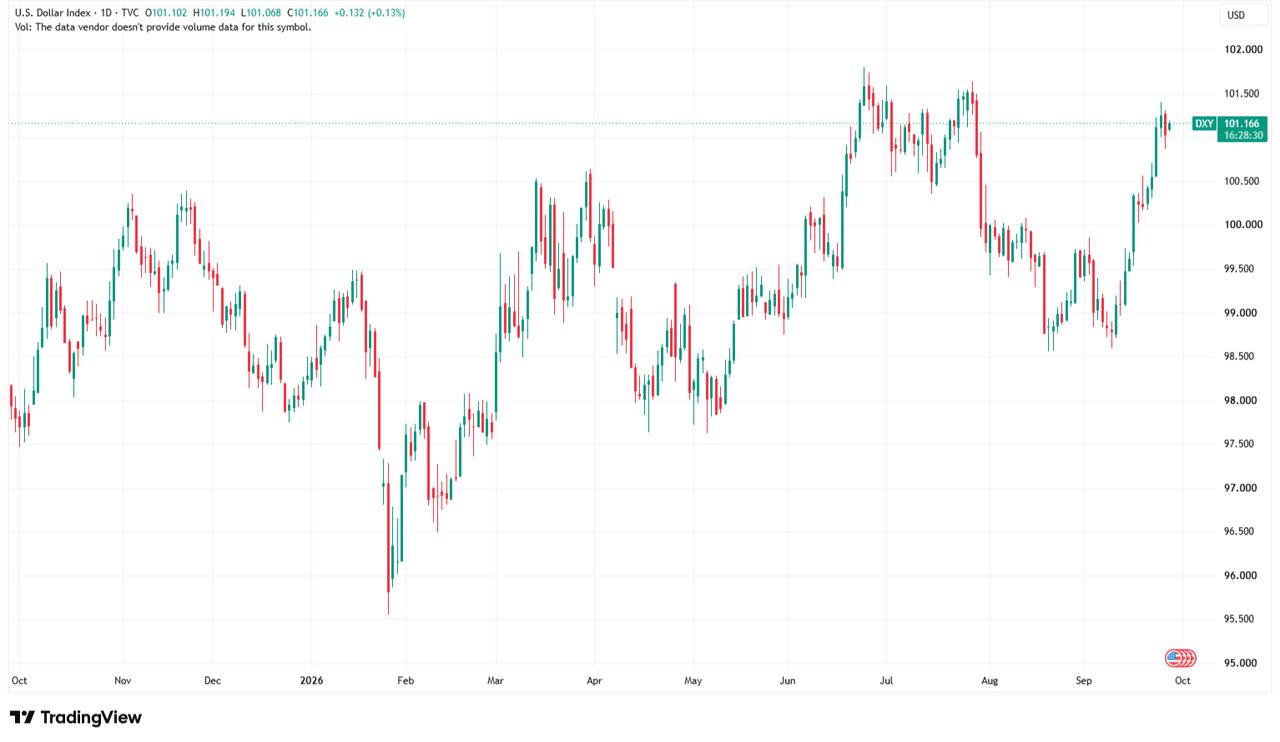
The dollar index rose 0.1% to 101.1, while money-market pricing put the probability of a Federal Reserve rate hike in October at 68%. The Fed raised its policy rate by 25 basis points at its Sept. 16, 2026, meeting to a range of 3.75%-4.00%, marking its first rate increase since 2023. Its next policy meeting is scheduled for Oct. 27-28, 2026.


 Set as preferred source
 Set as preferred source


 1 min read
 1 min read