Newsletters




The Central Bank of the Republic of Türkiye (CBRT) is likely to keep the policy rate at 37% at its upcoming Monetary Policy Committee (MPC) meeting on Wednesday, April 22, according to surveys conducted among market participants.
The decision might mirror the policymakers' decision to pause its easing cycle in its previous meeting in March, when they stressed the upward inflationary pressure stemming from the rising energy costs amid the Iran war.
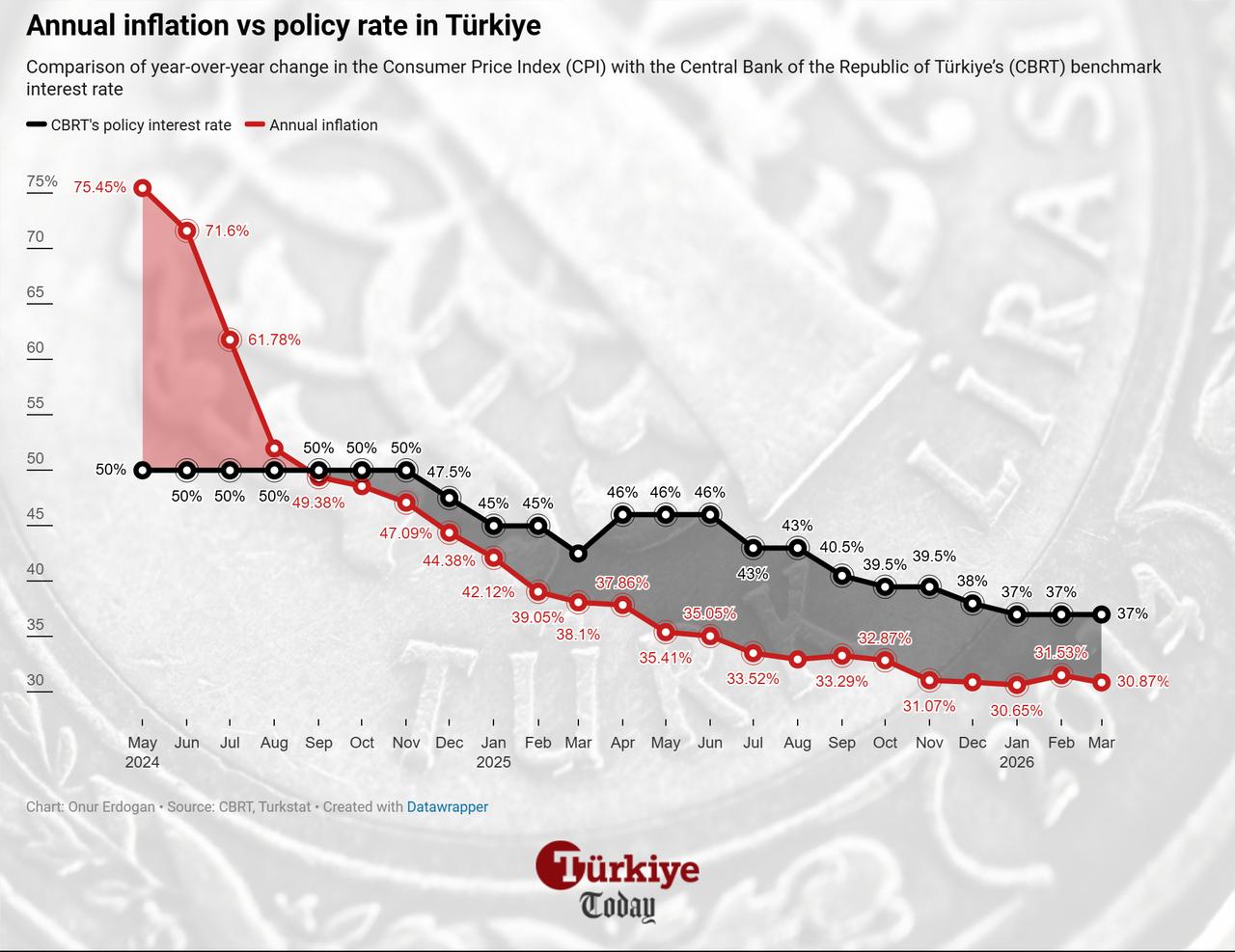
In March, the bank paused its easing cycle, holding the policy rate at 37% while continuing to fund the market through its higher overnight rate at 40%.
Multiple surveys suggest policymakers are likely to keep the policy rate unchanged, although a notable share of economists still sees room for a hike.
A survey by Matriks Haber, covering April 2026 and year-end projections for 2026 and 2027, showed most participants expect no change this month, while 12 of 30 pointed to a 300-basis-point increase.
Looking ahead, economists broadly expect a gradual easing cycle. Of 12 respondents, five projected rate cuts at all five remaining meetings, while others saw reductions in four, three, or two.
Year-end policy rate expectations for 2026 moved higher, with the median rising to 34% from 30%. The forecast range widened to 29%–37%, up from 28%–31%.
A separate survey by AA Finans also pointed to a hold at 37% in April. Of those surveyed, 22 expected no change, while 15 forecast hikes—14 by 300 basis points and one by 100 basis points.
The median expectation in the AA Finans survey remained at 37%, with a year-end median of 33%.
Meanwhile, the central bank's Survey of Market Participants pointed to a slightly higher near-term path, with projections of 37.75% for the first meeting, 37.38% for the second, and 36.53% for the third, alongside a year-end expectation of 32.94%.

Since the Iran war began on Feb. 28, the central bank has faced mounting pressure on inflation and the Turkish lira amid capital outflows.
The bank is estimated to have sold nearly $60 billion from its reserves through net interventions during the first month to curb foreign exchange demand, support market liquidity, and shield the lira from abrupt volatility.
Citing these challenges, international rating agency Fitch Ratings kept Türkiye’s credit rating at "BB-" but revised the outlook to "stable" from "positive," which had been set earlier this year.
The agency also cut the outlook on 12 Turkish non-bank financial institutions to "stable" from "positive," aligning them with the country’s sovereign outlook.
Meanwhile, Standard & Poor's held Türkiye’s long- and short-term sovereign ratings at "BB-/B" and maintained a "stable" outlook, pointing to continued policy discipline and the economy’s capacity to absorb external shocks.
The agency added that a potential upgrade would hinge on stronger progress in rebuilding foreign exchange reserves, restoring long-term confidence in the Turkish lira, and reducing inflation to single-digit levels.
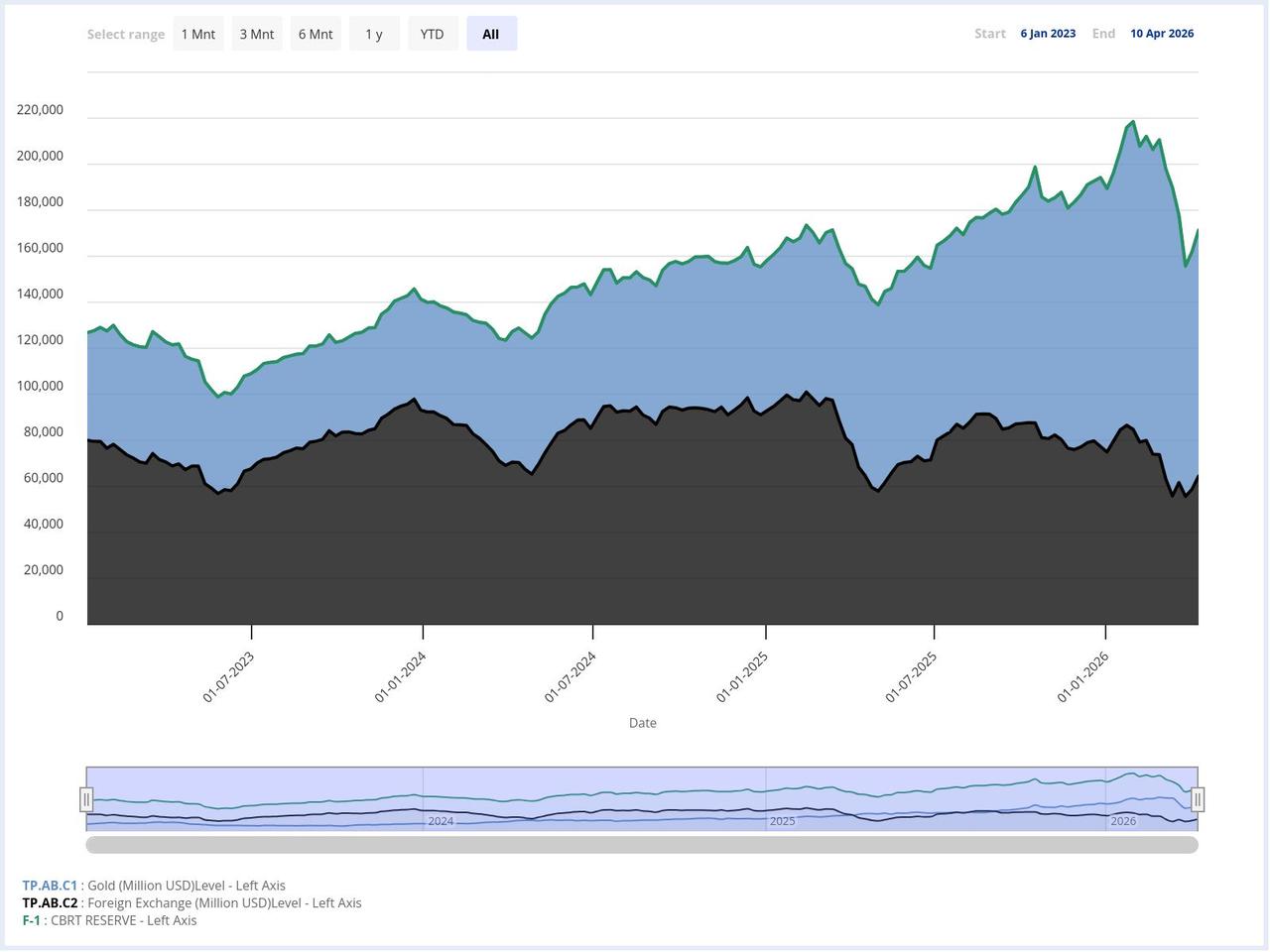
As of the week ending April 10, the Turkish central bank’s reserves showed signs of easing pressure in line with the de-escalation of the Iran conflict, as renewed talks and a ceasefire took hold.
Gross reserves rose to $170.9 billion, while net reserves rebounded to $55.6 billion, and swap-excluded net reserves surpassed $30 billion again.
Inflation, meanwhile, declined to 30.9% in March, with monthly price growth at 1.9%, driven by a 4.9% increase in energy prices.
During investor meetings in the U.S. this week, Finance Minister Mehmet Simsek and CBRT Governor Fatih Karahan reiterated that the Iran war is expected to weigh on the disinflation process but remain manageable, while pledging to continue the program.


 Set as preferred source
 Set as preferred source


 1 min read

 1 min read