

 Newsletters


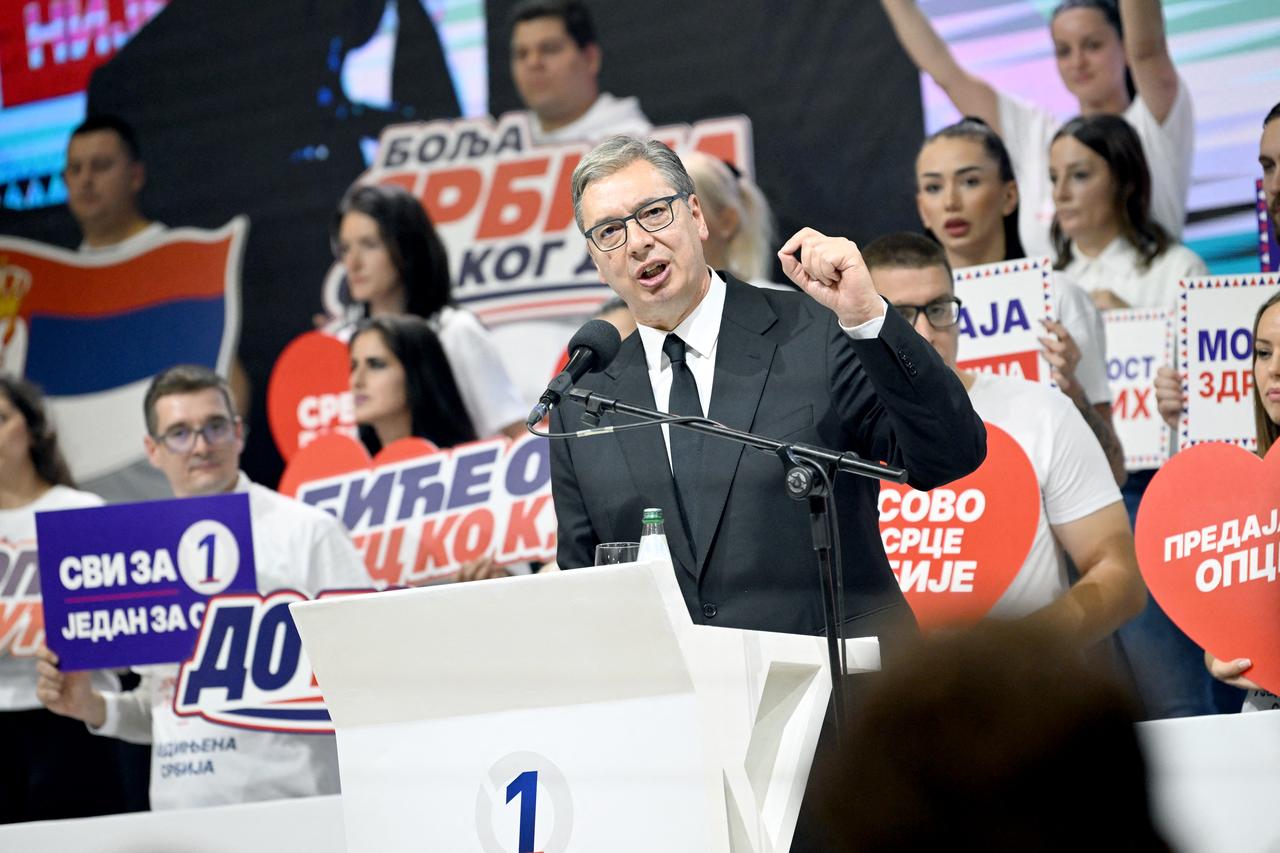
Serbia's ruling camp and its student-led challengers are heading into Sunday's snap parliamentary elections confident of victory, even as sharply divided opinion polls leave the outcome far from certain.
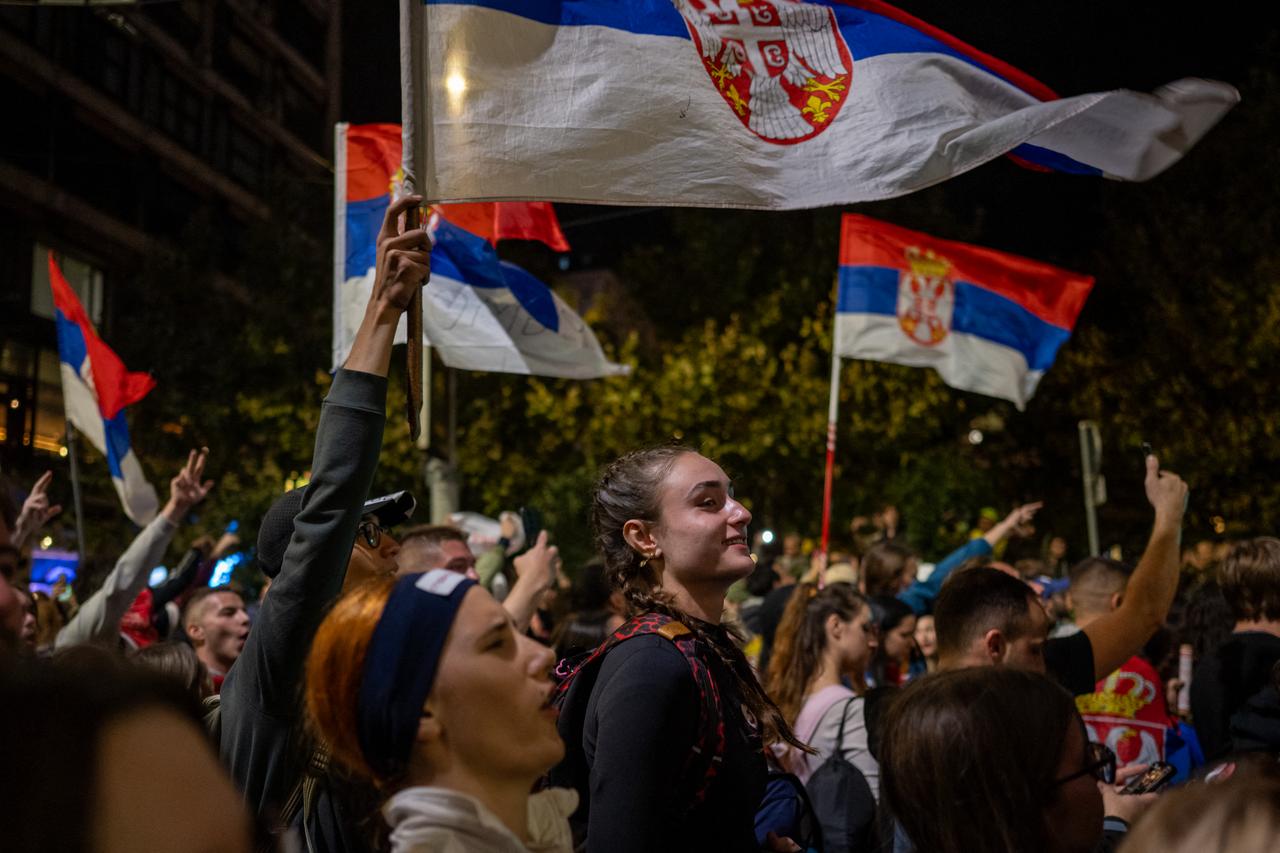
"I am sure we will win, and I am sure that on the 26th we will wake up in a free Serbia," Masa Perepeliuc, a 21-year-old political science student in Belgrade, told Agence France-Presse (AFP) ahead of Sunday's snap parliamentary elections.
Aleksandar Vucic is equally convinced, but of a very different outcome. Earlier this month, the former Serbian president declared that his opponents would lose by a wider margin than they expected.
After nearly two years of student-led protests, the country is approaching what could be one of its most significant political moments since the overthrow of Slobodan Milosevic on Oct. 5, 2000.
The election represents the most serious challenge to the Serbian Progressive Party's (SNS) hold on power since it entered government in 2012, coming from a movement that emerged outside the country's traditional opposition parties.
What makes Sunday's election particularly difficult to predict is that both camps have reasons to believe their strategies have worked.
Vucic still commands an extensive party organization and a loyal electoral base, while the students have managed to mobilize people who had grown disillusioned with established political parties.
Neither side appears prepared for the possibility that the other might win.

The student movement began after the collapse of a concrete canopy at the Novi Sad railway station on Nov. 1, 2024, which killed 16 people.
What initially started as demands for accountability over the disaster gradually developed into a nationwide movement challenging the Serbian government.
By the spring of 2025, the students had moved beyond demands for an investigation and were calling for early elections.
Their protests had already brought hundreds of thousands of people onto the streets, but turning that public support into an electoral organization presented an entirely different challenge.
The students responded with an approach that traditional opposition parties had struggled to replicate. They marched across Serbia, visited small towns and villages, and engaged directly with residents, including in areas where the SNS has historically enjoyed considerable support.
This was important because the movement sought to expand beyond the traditional opposition electorate in Belgrade and other major cities, reaching residents in smaller towns and villages through marches, public meetings and door-to-door campaigning.
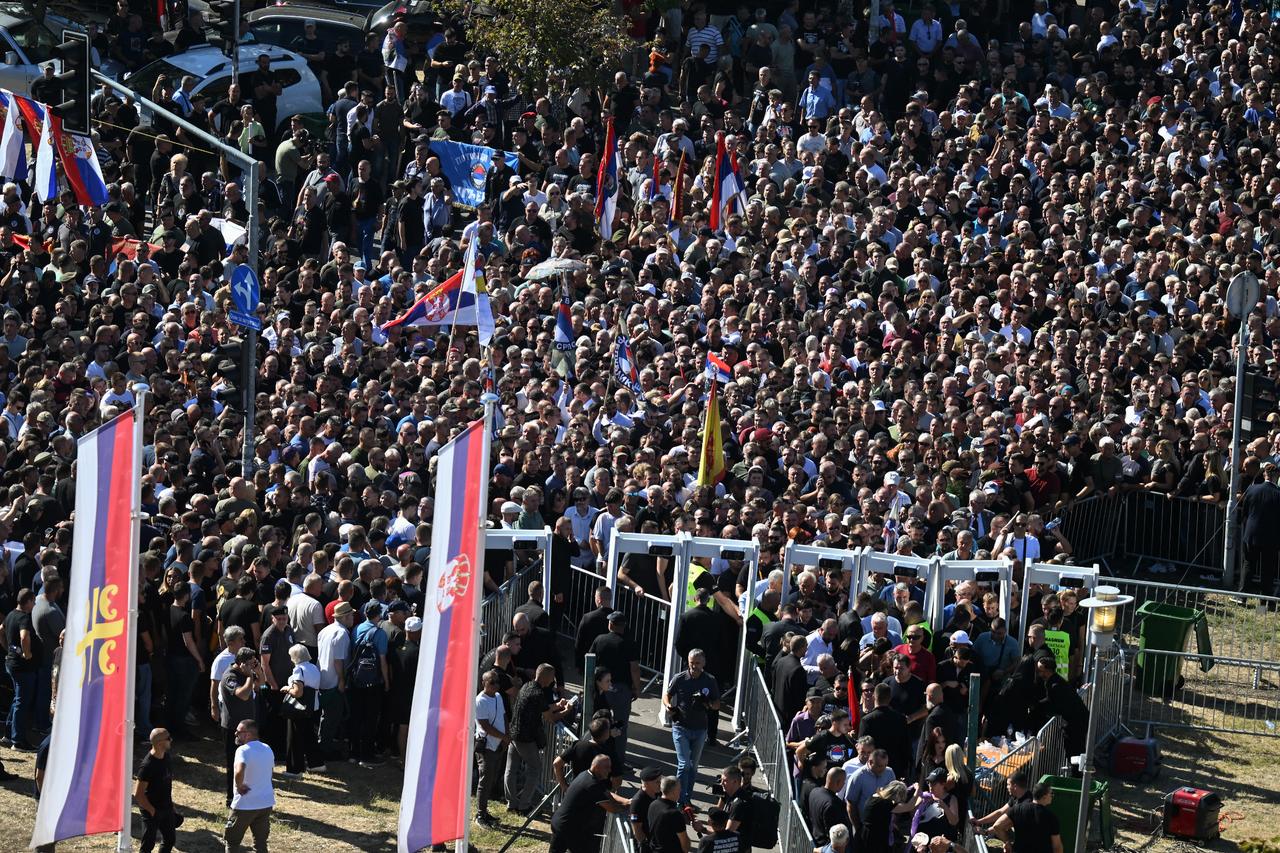
The scale of that mobilization was visible again Thursday, when an estimated 150,000 people gathered at Belgrade's Slavija Square for the Student List's final campaign rally, according to the independent Archive of Public Gatherings.
The gathering demonstrated the movement's ability to bring supporters onto the streets. Whether that enthusiasm translates into enough parliamentary seats is another matter.
The Student List has also avoided the model of a political movement built around a single dominant leader.
Its candidates, many drawn from academic and professional backgrounds, were selected through a decentralized process involving university assemblies.
That approach has helped distinguish it from Serbia's established parties.
Yet it also leaves questions about how such a movement would operate in government, particularly when its candidates have limited political experience and have not fully clarified their positions on several contentious foreign-policy issues.
The students have concentrated their campaign on corruption, accountability and the rule of law, while largely keeping divisive foreign-policy debates out of their campaign. They have, however, explicitly ruled out imposing sanctions on Russia.
This approach has allowed voters with different political views to support the same movement without necessarily agreeing on Serbia's broader direction.
Such differences may be easier to manage during an election campaign than around a cabinet table.
The available polling provides little clarity about the outcome.
A survey published Oct. 20 by New Serbian Political Thought (NSPM), conducted among 1,050 respondents between Sept. 25 and Oct. 5, placed the Student List at 44.5% and the SNS-backed United Serbia list at 42.7% among decided voters.
A September survey by Faktor Plus, however, showed a considerably different picture, putting the ruling bloc at 48.6% and the students at 37.1%.
The latest Ipsos survey, published Oct. 22, placed Vucic's United Serbia list at 47.4% and the Student List at 40%. The poll, conducted among 3,624 respondents, was commissioned by Vucic's electoral list.
The surveys were conducted at different times and used different methodologies. Their results offer little basis for treating either campaign's confidence as proof of an impending victory.
Turnout and the distribution of votes among smaller parties will also matter.
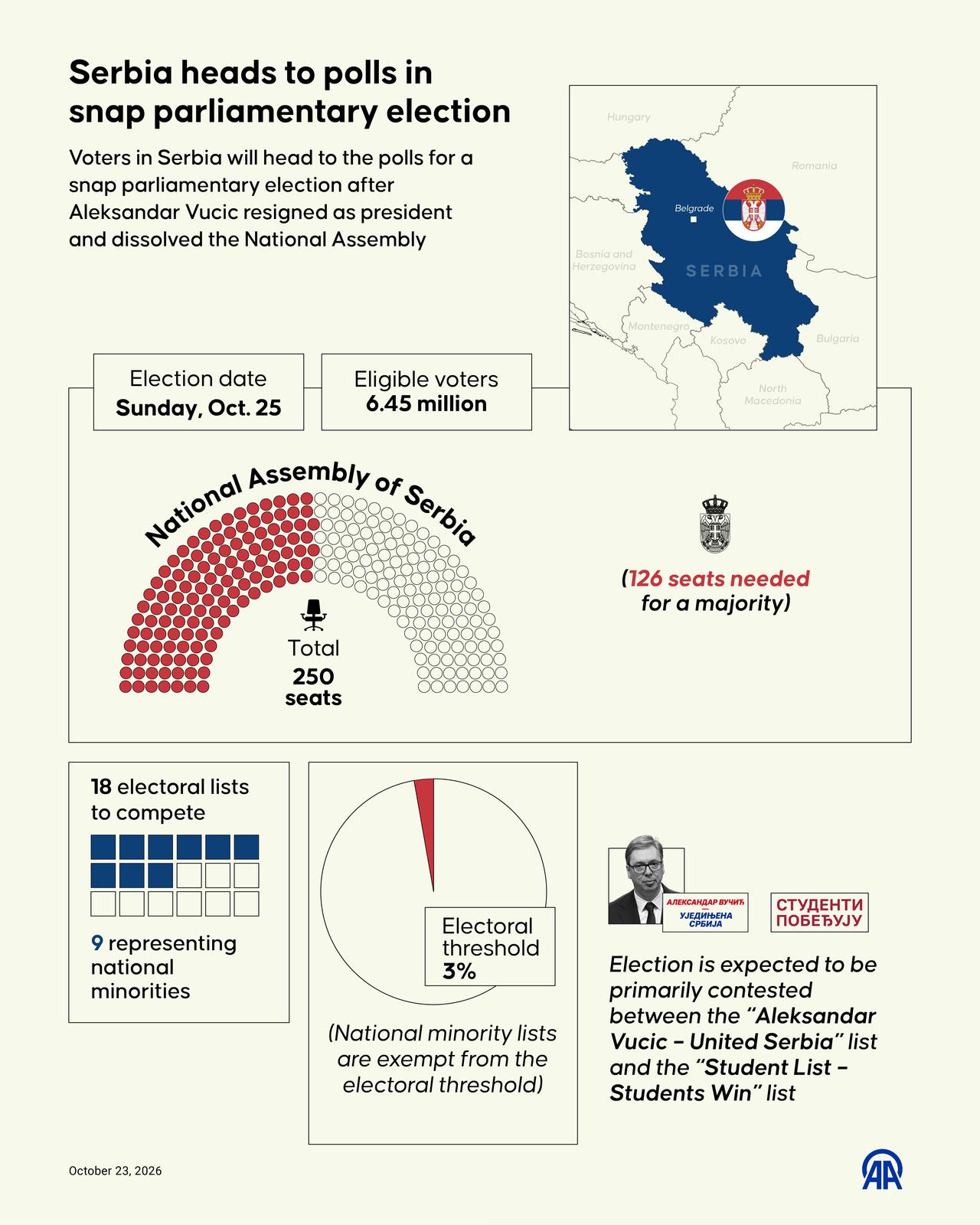
Although the contest has largely become a confrontation between the Student List and the SNS, 18 electoral lists are competing for 250 seats in Serbia's National Assembly. Most must pass a 3% electoral threshold to enter parliament, while national minority lists are subject to different rules.
This makes the performance of smaller parties particularly important. The Socialist Party of Serbia, a longtime coalition partner of the SNS, and opposition groups running separately from the Student List could affect the parliamentary arithmetic if neither main bloc secures the 126 seats required for a majority.
Winning the largest share of votes would therefore not necessarily guarantee the ability to form a government.
There is another reason why Sunday's vote carries considerable political uncertainty.
The election follows an unusually confrontational campaign marked by violence, intimidation allegations and disputes over the neutrality of state institutions.
According to a report published Oct. 21 by election monitoring organization CRTA, 116 incidents involving physical violence or verbal threats were recorded during the campaign. The organization also raised concerns about unequal campaigning conditions, the use of public resources and pressure on voters.
These findings are especially significant given the controversies surrounding Serbia's previous elections.
Following the December 2023 parliamentary vote, the Organization for Security and Cooperation in Europe's election observation body documented an uneven playing field, including the ruling party's systemic advantages, media bias and pressure on public-sector employees.
Those earlier findings do not establish what will happen on Sunday, but they help explain why confidence in the electoral process has become an issue in its own right.
The ruling camp has repeatedly accused the student movement of attempting to destabilize Serbia with foreign support.
The students, meanwhile, have accused the authorities of using state institutions and security forces against their supporters.
Against this background, a close election result could prove particularly contentious. Both camps have spent the final days of the campaign telling their supporters to expect victory, even as the polls fail to offer a consistent picture of the race.
The danger is that the gap between those expectations and the eventual results could deepen existing political tensions, especially if disputes arise over the vote count or alleged irregularities.
This does not mean that unrest is inevitable or that the legitimacy of the election should be prejudged.
It does mean that the transparency of the counting process, the work of election observers and the response of political leaders to the results will be closely watched.
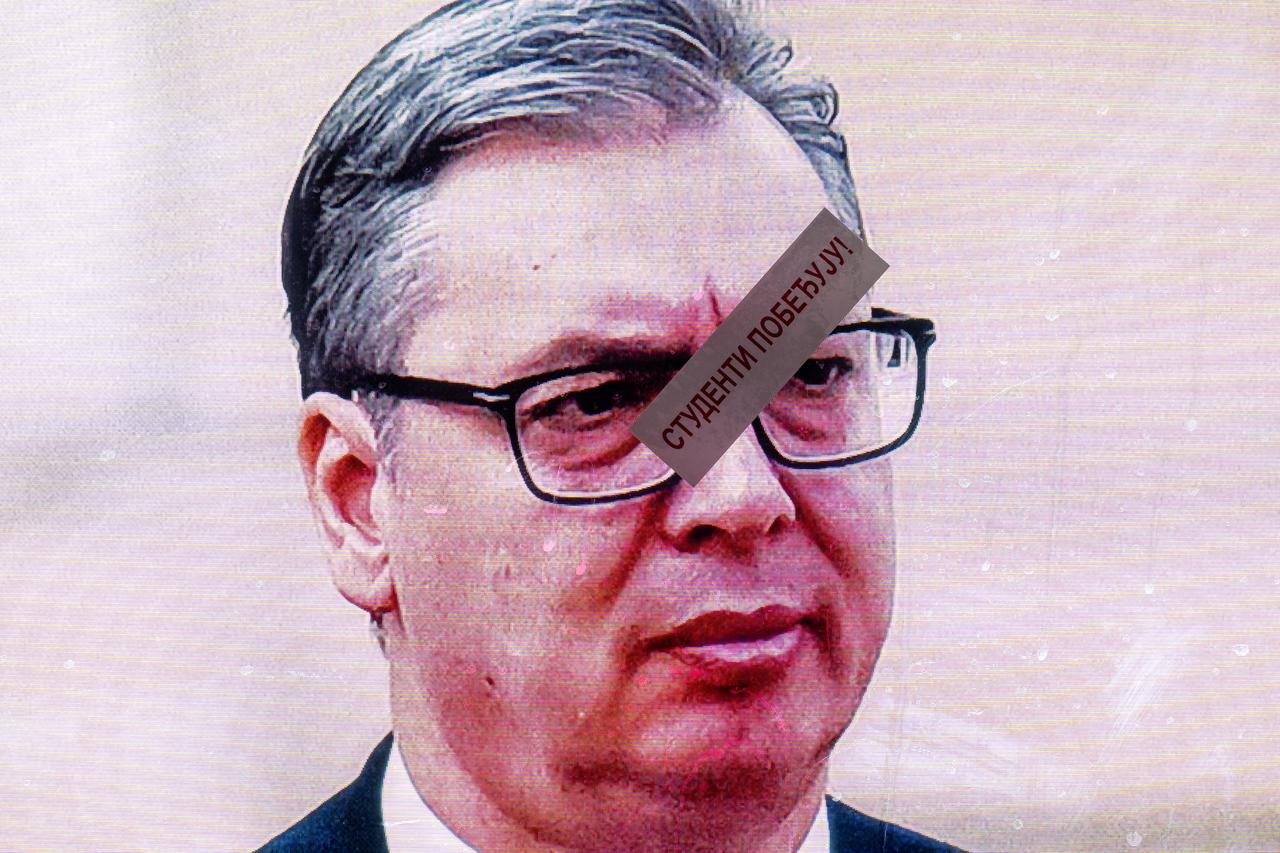
For Vucic, the election will determine whether he can return to executive power as prime minister after resigning from the presidency in September. It will also test the electoral strength of a political organization that has dominated the Serbian government since 2012.
For the students, the stakes are different. After nearly two years of protests, they are attempting to turn public mobilization into parliamentary power, something Serbia's established opposition parties have repeatedly struggled to achieve.
Even a strong electoral performance would leave them facing difficult decisions about coalition partners, governing priorities and the relationship between their decentralized movement and its parliamentary representatives.
The European Council on Foreign Relations outlines five possible post-election scenarios, ranging from a convincing SNS victory, a narrow and contested SNS win, and a parliamentary deadlock to a narrow student majority or a decisive student victory.
A disputed result could lead to renewed protests and legal challenges, while a parliamentary deadlock could put smaller parties, including the Socialists, in a position to determine the next government.
Even a student victory might not guarantee a smooth transfer of power, particularly if the results are challenged or state institutions resist the transition.
The next government, regardless of its composition, will also inherit the political disputes that brought Serbia to this election, alongside longstanding questions about relations with the European Union, Russia and Kosovo.
 3 min read

Sunday's vote may therefore be remembered as one of the most consequential political events in Serbia since October 2000, although its significance will depend on more than which electoral list finishes first.
For now, both camps are preparing to celebrate victory on Sunday night. By Monday morning, at least one of them will have to confront a result it did not expect.
How Serbia's political leaders and institutions handle that disappointment could be as important as the election result itself.


 Set as preferred source
 Set as preferred source


 1 min read


