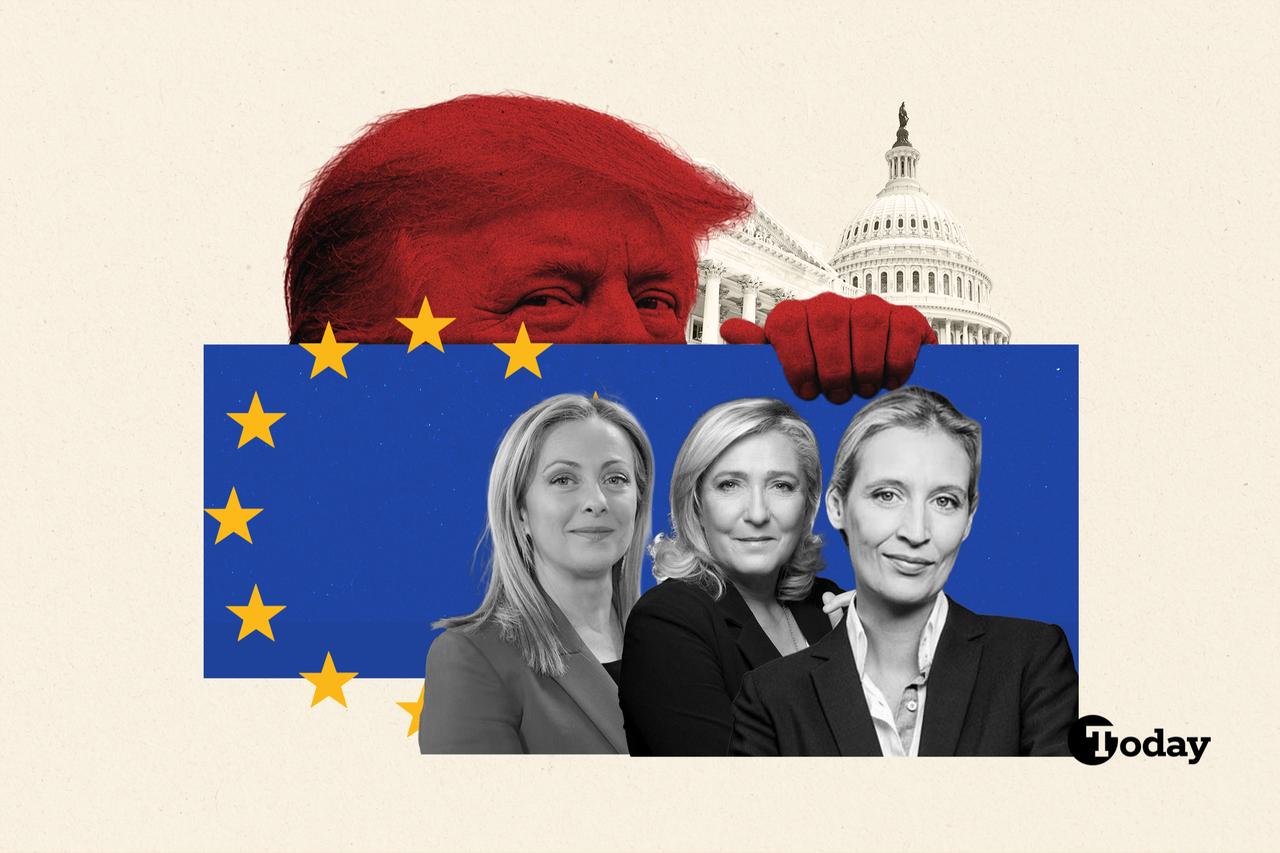
European NATO allies will be eager to make this week's summit all about President Donald Trump. They'll play to his ego, praising him for pushing member states to boost defense spending. But the bigger goal is to keep the U.S. committed to NATO for as long as possible—even as most privately suspect the alliance may be on its last legs.
And yet on funding, there has been real progress. Most NATO members now meet the 2% of gross domestic product (GDP) minimum target on defense spending, and most have committed to longer-term goals of 3.5%—or 5% under a broader definition that includes infrastructure spending.
The irony is that some of the biggest laggards on defense spending have been Trump's own European MAGA-aligned allies: the Czech Republic, Slovakia, and Hungary under Orbán — at least until recently.
But in many ways, headline targets for increasing defense spending are brain-dead.
First things first, increased defense spending is not cost-free—"there is no magic money tree," as former U.K. Prime Minister Theresa May famously quipped. Most European countries—and even the U.S., for that matter—already run bloated budgets, with large deficits and public debt-to-GDP ratios at or above 100%.
Funding increased defense spending will require difficult choices: either higher budget deficits or cuts to other public services. Higher deficits mean more debt, higher borrowing costs, and eventually higher taxes—and ultimately, slower growth and a smaller economy to bear the cost of higher defense spending.
Spending cuts will likely mean slashing welfare budgets—and that, too, comes at a cost. It's worth remembering that Europe faces two major national security threats: Russia, and the rise of far-right nationalism, fueled in part by Putin and by the social-media billionaires aligned with Trump.
And yet cutting welfare spending to fund defense will just accentuate social pressures and divisions—perhaps allowing Putin to become the ultimate winner through the back door.
Second, there seems to be little focus on the huge inefficiencies already in defense spending. In the U.K., the history of defense procurement has been all but catastrophic, with multiple over-budget, over-time and failed projects, including Ajax APC, the Nimrod MRA4, battlefield radios, et al.
There are then vanity projects like the QE2/Prince Charles aircraft carriers, which are at risk of becoming white elephants for a Royal Navy that cannot afford to man them with F-35s or provide critical fleet support.
This shows that defense decision-making has been pretty disastrous for decades, marked by a lack of consistent, long-term planning or strategy—in the U.K., despite numerous strategic defense reviews.
But surely if Russia is the number one existential threat to Europe, a 2% of GDP defense spend should be more than enough to match that threat, as Europe outguns Russia in GDP terms at least 10-fold.
Europe's problem, though, is not that it spends too little on defense, but that it has failed to prioritize threats, match military resources to those threats, and get to grips with common production and procurement. Perhaps the most efficient and logical endgame would be some pooling of militaries—though a full-fledged Defense Union for Europe might still be a step too far.
Third, Trump's attacks on Europe for not spending enough on defense are overly simplistic and fail to account for broader development spending and the huge gains delivered from the EU enlargement process.
It is true that as the Cold War ended, Europe cut defense spending. However, much of that peace dividend went to structural reform and cohesion budgets, facilitating EU enlargement to former Warsaw Bloc states in Europe.
These structural fund flows have totaled up to 1% of GDP across Europe, but they have transformed the economies of Emerging Europe from poor, actually all but bankrupt states in 1989-1991, to now vibrant and wealthy economies—a much bigger cake to provide bigger slices of even just a 2% of GDP defense spend.
Poland is a good example—its GDP in 1991 was less than $100 billion, but it is now $1.1 trillion. Poland actually spends over 5% of its GDP on defense, so well over $50 billion, which would have been half its GDP in 1991. The point here is that it's not just about defense spending as a proportion of GDP, but also the size of economies.
Actually, the expansion of NATO and growth in development spending have been just as important as defense spending itself in enlarging the overall "cake" from which defense's share, or slice, is taken. Trump likes to single out Germany, in particular, for its past relative delinquency in defense spending—but Germany has done most of the heavy lifting in funding EU structural funds.
Fourth, defense primes are always in favor of massively increasing defense spending, since they tend to capture a disproportionate share of that spending—yet most of the sector's huge inefficiencies and failures have occurred on their watch. All this also overlooks the profound changes now underway in warfare, visible in the wars in Iran and Ukraine.
The dominance of drones in warfare suggests a total rethink is in order as to how NATO and Europe do defense.
In an era of iteration warfare, the defense primes don't seem fit for purpose. The hugely expensive, multi-year, even multi-decade, big defense projects now appear hard to justify.
Defense, defense production, and defense procurement need to be nimble. But drones and technology should enable us to do more with less. This likely requires a blank-sheet approach for Europe, at least when it comes to defense.
Understanding what we can afford—and the trade-offs that are central to that—is equally important. What are the threats, and what specifically do we need to counter them? For Europe, it needs to plan for a world where the U.S. is increasingly absent as a backstop for European defense, while the existential threat comes from Russia.
Remember that NATO was established with the specific objective of countering the threat from Moscow and the Soviet Union. We countered that threat not only with the old technology of tanks, planes, and ships, but also by ensuring successful economic development—building strong economies capable of eventually outproducing, or outgunning, the Soviet Union.
That remains the key battle—it should be about ensuring an efficient, wealthy European economy (per the Draghi reforms), while also ensuring efficient, well-targeted defense spending.
The 3.5%/5% defense spending targets are, in fact, dangerous, as they suggest that money alone is the answer to Europe's defense problems—which it absolutely is not.