Newsletters




This article was originally written for Türkiye Today’s weekly economy newsletter, Turkish Economy in Brief, in its Feb. 23 issue. Please make sure you are subscribed to the newsletter by clicking here.
Türkiye has been among the "best-performing markets" at the start of 2026, and the BIST 100 index hit a new record high of 14,532 last week. A profitable week closed at 13,934 points. Rising U.S.–Iran tensions in the Middle East stood out as a key trigger behind those profit sales. Briefly looking at pricing developments, we see that...
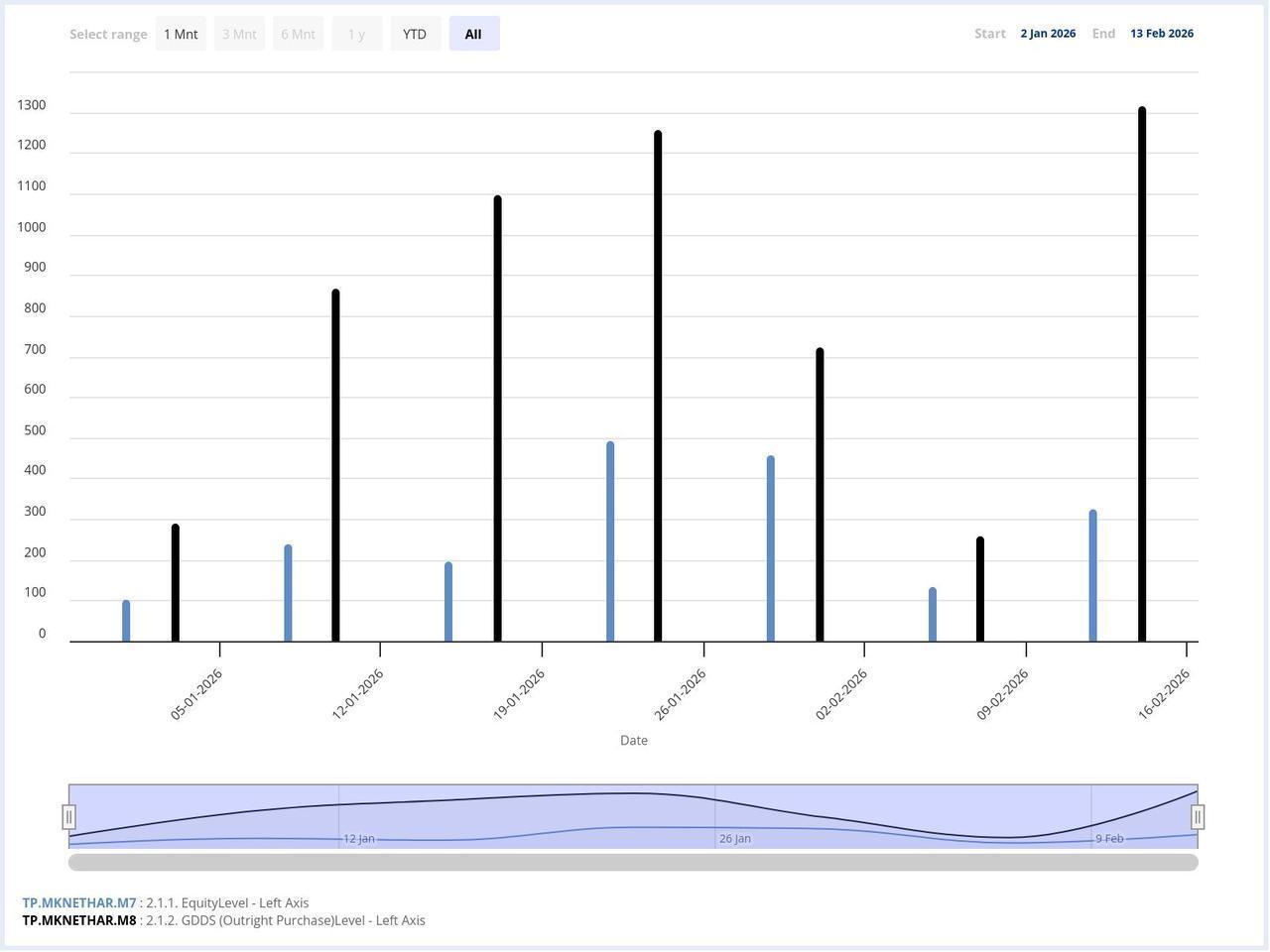
The main theme supporting Turkish markets this year is disinflation. Falling inflation and interest rates form the backbone of this story, and foreign investors are actively investing in this scenario. Recent capital inflows confirm this trend. According to the latest data, in the week ending Feb. 13, foreign investors purchased $1.31 billion in Turkish bonds and $322.2 million in Turkish equities.

Positive reports on Türkiye are also coming from global financial institutions. Last week, Goldman Sachs recommended a "long position" on the Turkish lira. The U.S. investment bank said improving macroeconomic indicators, current monetary policy, and rising reserves have made the lira more resilient.
It is now clear that foreign investors have largely embraced Türkiye’s economic program. Treasury and Finance Minister Mehmet Simsek also delivered important messages on this issue.
Simsek said they held intensive meetings with around 800 investors over one and a half weeks in London, New York, and Hong Kong. He noted that earlier discussions focused on whether the program would continue, but those concerns have now faded. He said speculation about the program’s future or political backing is no longer taken seriously. Instead, investors are now asking more technical and macro-focused questions, especially about the disinflation outlook. He emphasized that Türkiye now offers consistency, predictability, and a strong economic narrative.
There has been no change in Türkiye’s main disinflation-based economic outlook. However, rising oil prices and the wealth effect created by gold could present new challenges that need careful management.
QNB Finansbank Chief Economist Erkin Isik shared calculations based on gold trade and domestic production data, estimating Türkiye’s total gold stock at around 4,281 tons as of January 2026. Based on a gold price of $5,063 per ounce, he said the country’s total gold holdings are approaching $700 billion.
Rising gold prices are creating a strong wealth effect for Turkish households that hold gold. Despite high interest rates in 2025, record sales were seen in housing and automobiles, largely attributed to this gold-driven wealth effect.
Meanwhile, Türkiye imports most of its energy, meaning oil price increases directly affect both the current account balance and inflation. Every $10 increase in oil prices adds roughly $2.6 billion to the annual current account deficit and increases inflation by around 1.2 to 1.5 percentage points.
For this reason, it is especially important to keep a close eye on gold and oil prices. To close, it is worth recalling Minister Simsek’s recent message:
“Once uncertainties related to Iran are resolved, energy prices will most likely return to a downward trend. This will be very important for Türkiye, as it will have positive effects on our current account balance, disinflation process, and economic growth.”


 Set as preferred source
 Set as preferred source



 7 min read