Newsletters




This article was originally written for Türkiye Today’s weekly economy newsletter, Turkish Economy in Brief, in its Nov. 2 issue. Please make sure you are subscribed to the newsletter by clicking here.
Markets ended October with heightened volatility. Fears of rising inflation fueled by higher global oil prices, uncertainty over the U.S. Federal Reserve's interest rate policy and concerns about technology stocks triggered a wave of selling in equities and precious metals.
Gold prices fell 6.87% in October to $3,875 per ounce. The tech-heavy Nasdaq-100 index also dropped 6.65% over the month, with a particularly sharp 3.46% decline on Friday drawing attention.
In Türkiye, investors are keeping a close eye on global risks, the ongoing liquidation of investment funds and corporate earnings.
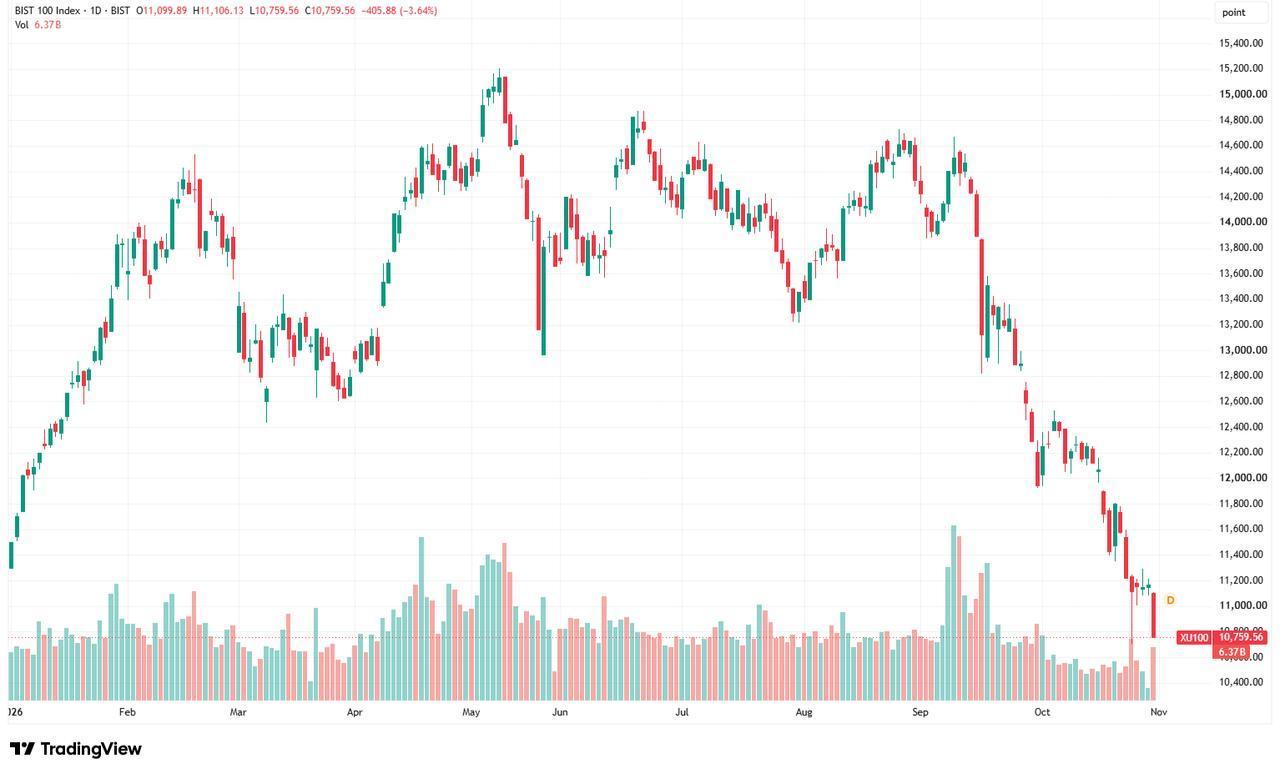
The BIST 100 benchmark index on Borsa Istanbul fell 3.22% last week, closing at 10,759 points. It ended October down 9.94%.
The index had already plunged 16.65% in September, when the fund crisis first emerged. As a result, the market's two-month decline reached around 25%, a level rarely seen in recent years.

Payments to investors affected by the fund liquidations after September’s market rout are also continuing.
Last Friday, interim payments were made to 235,705 investors in seven funds subject to extraordinary liquidation. A total of ₺29.3 billion ($586.8 million) was deposited into fund holders' accounts.
In an earlier round of regular liquidations, ₺68 billion was paid to 63,759 investors across 93 funds.
Payments under regular and extraordinary liquidation procedures have now reached ₺97.3 billion, covering 299,464 investors across 100 funds.
November begins with a crucial week for the markets, and Nov. 3 stands out as a particularly important date.
October inflation data, due to be released in Türkiye, will be the most important domestic economic indicator. In a report assessing the latest price trends, Anadolu Yatirim forecasts monthly consumer price inflation of 1.97% in October, putting the annual rate at 28.99%.
Inflation remains a key factor in determining whether Türkiye can continue cutting interest rates.
Meanwhile, the latest figures show that the Central Bank of the Republic of Türkiye's (CBRT) gross reserves fell by $6.9 billion in the week ending Oct. 23 to $162.2 billion, their lowest level in four months.
Another development making Nov. 3 significant is the U.S. midterm elections. Concerns that conflict in the Middle East could flare up again after the vote are drawing global attention. Oil prices have also climbed to their highest levels in six months amid these concerns.
Expectations of renewed tensions between the U.S. and Iran, along with the possibility of increased military activity in the region after the Nov. 3 elections, are keeping risk premiums in energy markets elevated.
Fears that rising energy costs could accelerate global inflation again are also raising concerns that interest rates may remain high for longer.
The Federal Reserve kept its policy rate unchanged at 3.75%-4% at its Oct. 28 Federal Open Market Committee (FOMC) meeting.
Markets are now focused on what comes next, with the possibility of a rate hike in December gaining traction.
Recent remarks by St. Louis Fed President Alberto Musalem have reinforced these expectations. Pointing to persistent inflation risks, Musalem said additional monetary policy tightening could become necessary in the near future.
A new conflict in the Middle East would mean more than a renewed rise in geopolitical risks for Türkiye and its surrounding region. Higher oil prices also pose a threat to the Turkish economy, particularly its current account balance and inflation, as well as other key macroeconomic indicators.
In the short term, developments in the Middle East and the direction of oil prices are likely to remain among the most important issues shaping market sentiment.


 Set as preferred source
 Set as preferred source



 5 min read