Newsletters





This article was originally written for Türkiye Today’s weekly economy newsletter, Turkish Economy in Brief, in its Aug. 24 issue. Please make sure you are subscribed to the newsletter by clicking here.
Global markets turned their attention to the U.S. Treasury market last week. The yield on the 30-year Treasury rose as high as 5.34%, reaching levels not seen since 2007 and emerging as one of the most critical issues in global markets.
Concerns over high inflation and rising government debt triggered sharp sell-offs in bond markets not only in the U.S. but also in Germany and Japan. The situation became even more concerning as technology companies took on heavy debt to finance artificial intelligence investments while oil prices remained elevated.
Against this backdrop, the U.S. Treasury Department decided to increase its buyback operations for 10- to 20-year and 20- to 30-year Treasury bonds from $2 billion to $4 billion to support market liquidity.
The move raised hopes that selling pressure in the bond market would ease and borrowing costs would fall. The 30-year Treasury yield subsequently declined to as low as 5.17%.
However, the yield rose again toward the end of the week and finished Friday at 5.27%.
Dr. Kutay Gozgor, research director at Kuveyt Turk Investment Research, argued that the U.S. Treasury Department’s latest move was not a permanent solution to structural problems but rather a temporary measure designed to stop the rapid rise in Treasury yields.
“As long as the U.S.’s record budget deficits, rising defense spending and elevated inflation expectations remain on the table, the term premium investors demand for long-term uncertainty will remain high,” Gozgor said.
He added that weak demand at the 20-year Treasury auction immediately after the decision indicated that the market was not yet fully convinced by the intervention and wanted to see a concrete improvement in U.S. fiscal dynamics before embracing lasting optimism.
Meanwhile, attention also focused on the signal the U.S. administration’s decision sent to markets, rather than simply on its direct impact.
Ole Hansen, commodity strategist at Saxo Bank, said markets could interpret the move as evidence that policymakers were becoming concerned about the economic and financial consequences of the disorderly rise in long-term borrowing costs.
Measures aimed at easing stress in U.S. Treasuries could encourage investors to expect a more supportive financial environment, Hansen said.
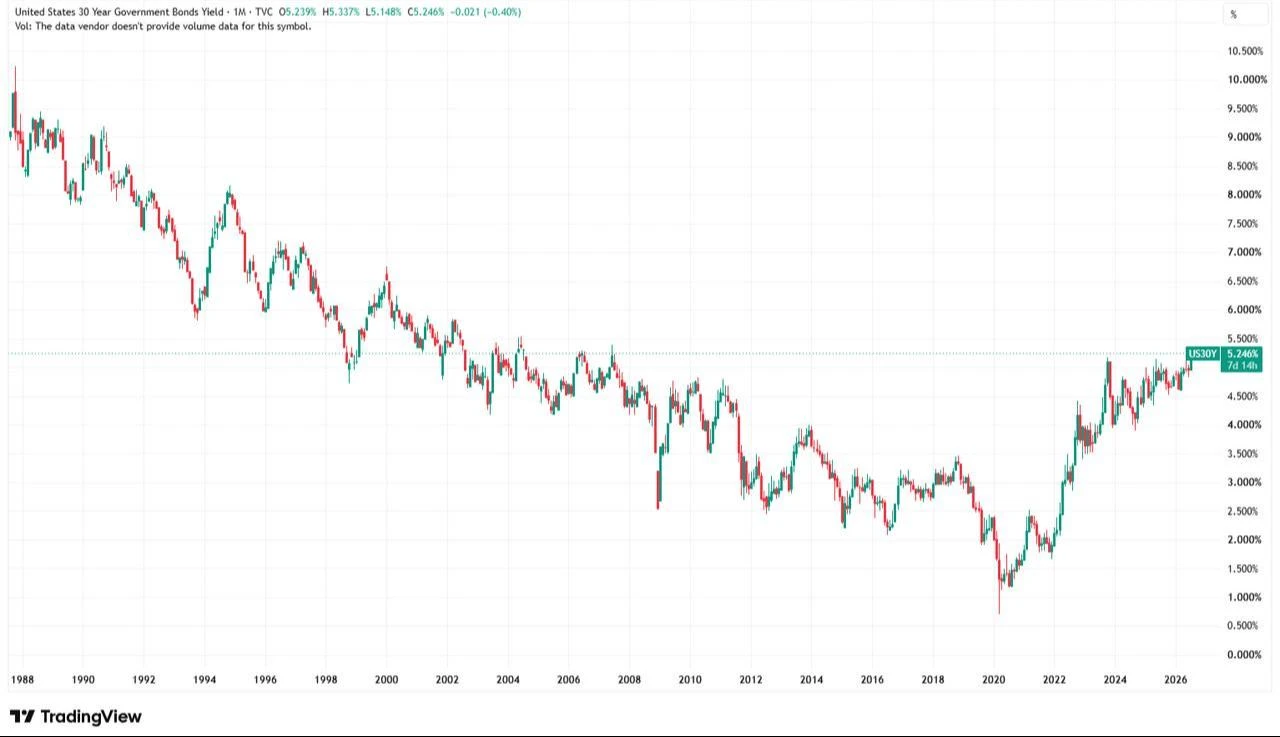

Because the U.S. dollar is the world’s reserve currency, long-term interest rates in the country provide the foundation for credit and borrowing costs worldwide.
Long-term U.S. Treasury yields, particularly those on 10-year and 30-year bonds, therefore serve not only as indicators of the U.S. market but also as a kind of benchmark interest rate for the global financial system.
When international companies issue bonds or banks borrow in global markets, their borrowing costs are determined by adding risk premiums to these rates. When U.S. interest rates rise, borrowing becomes more expensive, affecting economic activity.
A 2023 study by the Switzerland-based Bank for International Settlements, titled “What Happens to Emerging Market Economies When U.S. Treasury Yields Rise?” examined periods of sharp increases in Treasury yields and their effects.
The study said the experience of the past 20 years showed that rapid increases in U.S. Treasury yields had, at times, been associated with currency depreciation, declines in asset prices and large capital outflows in emerging markets.
U.S. Treasuries serve as a barometer for the global economy, making them an important factor in determining risk appetite for emerging-market economies, including Türkiye, as well as for precious metals and crypto assets.
Last week, gold prices closed above $4,600 per ounce in global markets, while the increase in August alone approached 14%.
The BIST 100 index in Istanbul also gained 2.42% over the week, reaching 14,514.82 points and testing the critical 14,600 resistance level after six weeks.
Speaking of gold, a study conducted by QNB in Türkiye in May estimated that the country held around 4,304 tons of gold.
When gold was trading at around $4,000 per ounce last month, the value of Türkiye’s gold holdings stood at approximately $550 billion.
Based on the latest gold price, the value of the country’s gold holdings reached approximately $632.5 billion. The latest rally therefore increased the value of Türkiye’s gold holdings by around $82.5 billion.
It appears Türkiye is once again approaching a period in which the wealth effect could become a major topic of discussion.


 Set as preferred source
 Set as preferred source



 7 min read